
What Is Couples Counseling Like? a 2026 Guide
Couples counseling is a structured, therapist-guided process of about 12 to 20 sessions that focuses on recurring patterns, communication, and repair, not on deciding who is at fault. Most of the work happens in a predictable sequence you can prepare for, plus small experiments between sessions where new responses get tested against real disagreements.
It's a Tuesday night. The dishes are done, the television is on, and neither of you has said anything that matters in three days. Nothing exploded. Nobody did anything unforgivable. You're just tired, and the same small argument keeps finding you in different costumes, and one of you finally said the sentence out loud: "Maybe we should talk to someone."
Then came the search, the profiles, the half-finished intake form, and the question that stopped you: what happens in that room?
That question deserves a real answer, not a reassurance.
A First Session You Can Picture
The waiting room is the worst part. Two of you sit with a stack of old magazines, one leg bouncing, both rehearsing an opening sentence. Then the door opens, and the question becomes who walks in first.

The therapist introduces herself, names her license and training, and explains confidentiality and its limits before anyone shares anything personal. You'll hear the safety exceptions plainly: risk of harm to self or others, suspected abuse of a child or vulnerable adult, and court orders. If the practice uses a no-secrets policy, meaning anything one partner discloses privately may be raised in the joint session, she says so now rather than in month two. If she doesn't mention it, ask.
Then the sequence unfolds, and it's remarkably consistent from practice to practice:
Uninterrupted time. Each partner gets a stretch of the session to describe why they're there and what they want to be different, without the other responding.
Live observation. The therapist watches how you talk to each other, not just what you report. Who interrupts. Who goes quiet. Who softens when the other's voice cracks.
A structured exchange. She may ask one partner to say back what they just heard, then ask the other whether it landed.
A closing summary. In the final minutes she names the pattern she noticed and proposes a direction for next week.
What's normal: feeling awkward, exposed, or like you're performing for a stranger in session one is the rule, not the exception. The discomfort fades once the structure becomes familiar.
A first session is mostly information gathering, so don't expect a verdict on your relationship. Standard sessions run about 50 minutes. Many therapists meet each partner once individually after the joint intake to gather history they won't say in front of the other; some don't, and either is defensible. You'll schedule the next appointment before you leave, usually weekly at first.
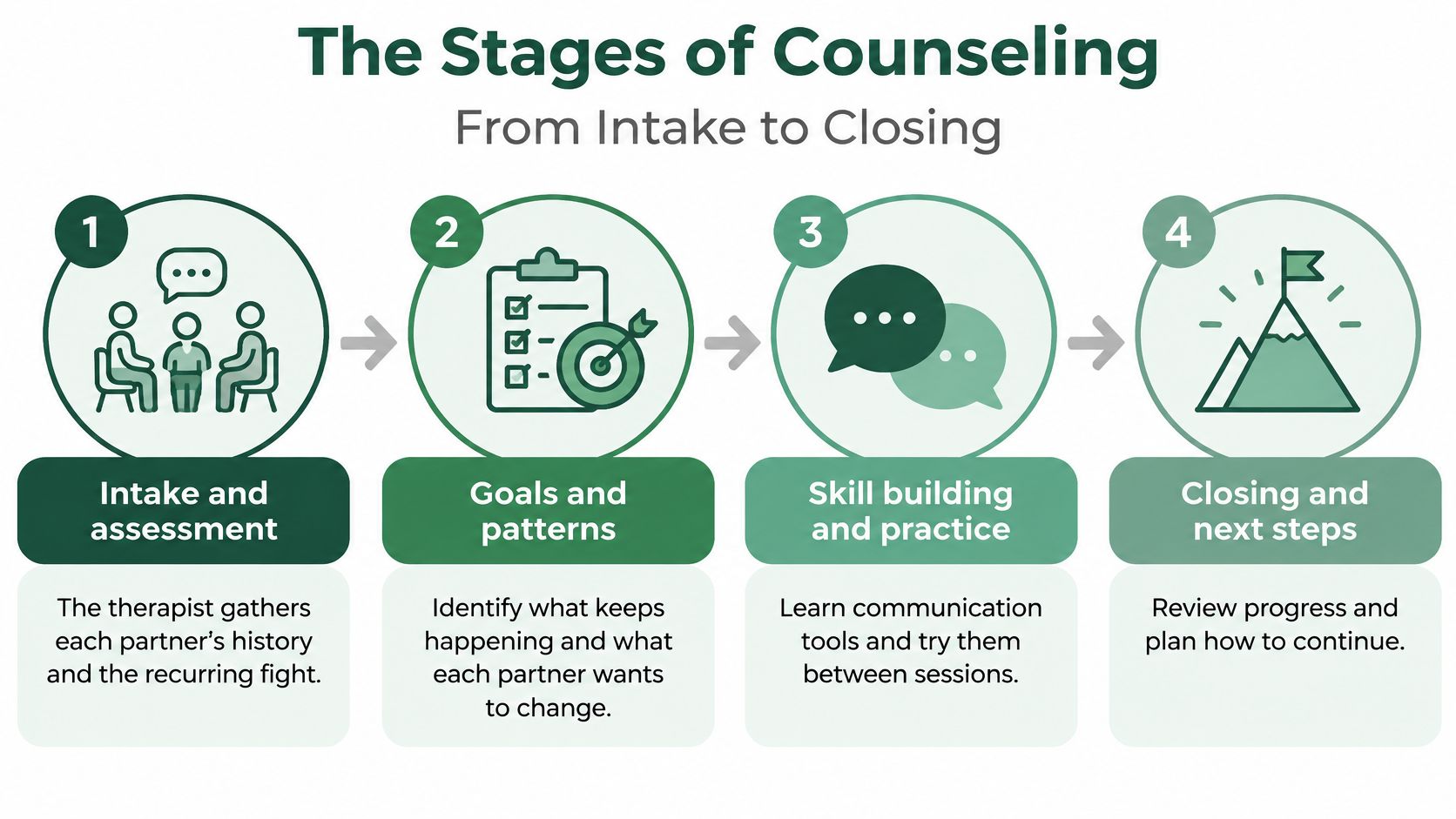
The Stages of Counseling From Intake to Closing
By the third week, many couples walk out asking the same question: we talked, we got emotional, and home still feels the same. You are usually still in an early stage. Counseling moves through a set arc, the way a course moves from the syllabus, to practice, to a final review. Once you can name the stage, a quiet week stops feeling like proof that nothing is working.
Modern couples counseling grew out of marriage counseling and marital therapy that emerged in the 1930s, when approaches were largely atheoretical or psychoanalytic, and structured behavioral and emotion-focused models developed later and now sit at the center of practice. Reviews of behavioral marital therapy put brief formats at roughly 12 to 20 sessions, as this overview of couple therapy research describes, though length depends on your goals, risk factors, and whether you are working on a single recurring conflict or long-standing relational trauma.
The arc usually breaks into four stages:
Intake and assessment (roughly sessions 1 to 3). The therapist gathers each partner's history, maps the recurring fight, screens for safety concerns, and asks what each of you wants. Between sessions, note when the argument flares and what happened in the minute before it. A useful note is one line: who spoke first, and what the first sentence was.
Psychoeducation and pattern mapping. She names the negative cycle out loud, often something like pursue-withdraw: one partner pushes for engagement, the other goes quiet, and each reaction feeds the other. You will be asked to identify your own contribution, which is harder and more useful than identifying your partner's. Expect this stage to feel exposing. Naming your part is awkward for almost everyone, and that awkwardness is the work, not a sign you picked the wrong therapist.
Skills practice (roughly sessions 7 to 15). The focus shifts from describing the fight to changing one move inside a real one. Each week you try a single new response during an actual disagreement, not a rehearsed speech. One week that might mean waiting until your partner finishes. Another week it might mean saying you need a ten-minute break before the volume rises. Clumsy attempts count. A new response rarely feels natural the first time you use it at the kitchen counter.
Consolidation and closing. You review gains, list early warning signs, plan for the next stressor, and decide whether to continue, taper, or stop. A concrete close looks like this: both of you can spot the first thirty seconds of the old fight and name what you will do differently before it peaks. Counseling cannot promise the disagreement disappears. It can leave you with a plan for the next hard week.
Many distressed couples improve with behavioral and emotion-focused approaches in research settings. Those gains are often smaller in ordinary practice, and for some couples they fade after sessions end, which is one reason the closing stage includes a plan for the next stressor rather than a declaration that you are finished.
A better scoreboard: progress shows up as faster repair after a rupture, not as a month without disagreement.
What the Therapist Actually Does in the Room
Watching a skilled couples therapist work can look deceptively simple. It isn't mediation and it isn't refereeing. The therapist is running a set of deliberate moves, and once you can name them, the process stops feeling like magic.
Slows the exchange down. "Hold on. Say that again, and this time let him finish before you answer."
Translates accusation into need. "You never help" becomes "I feel alone with the workload, and I need a partner in it."
Names the cycle in real time. "This is the part where you go quiet and she follows you. Watch what happens next."
Runs structured exercises. Speaker-listener turns, emotion check-ins, and guided repair attempts after a rupture. Good active listening techniques are the scaffolding for most of it.
Calls a break when arousal spikes. A timed pause with an agreed return time, because flooded partners can't hear each other.
Holds the frame. Keeps one partner from dominating, protects room for the quieter voice, and ends on time.
The therapist doesn't decide who is right, because the client in the room is the relationship. That single shift explains most of what confuses first-timers: the goal isn't a verdict, it's a change in how the two of you handle each other.
Evidence-based work targets specific mechanisms that keep distress alive, including rigid negative interaction cycles, low responsiveness, and avoidance of vulnerable emotion, which is the focus of this APA clinical demonstration of emotionally focused couple therapy. Some therapists add body-based tools to that foundation. Our sessions often include techniques such as breathing techniques, yoga, and mindfulness, and our approach blends Eastern and Western practices through mind-body-spirit work, which helps partners settle before a hard conversation rather than white-knuckling through it.
You'll know the approach is landing when conflicts get shorter, repair comes faster, and each of you can reflect the other's meaning back with fewer corrections.
How to Prepare Before Your First Appointment
Preparation isn't homework you can fail. It's a way to walk in with something more useful than a list of grievances.
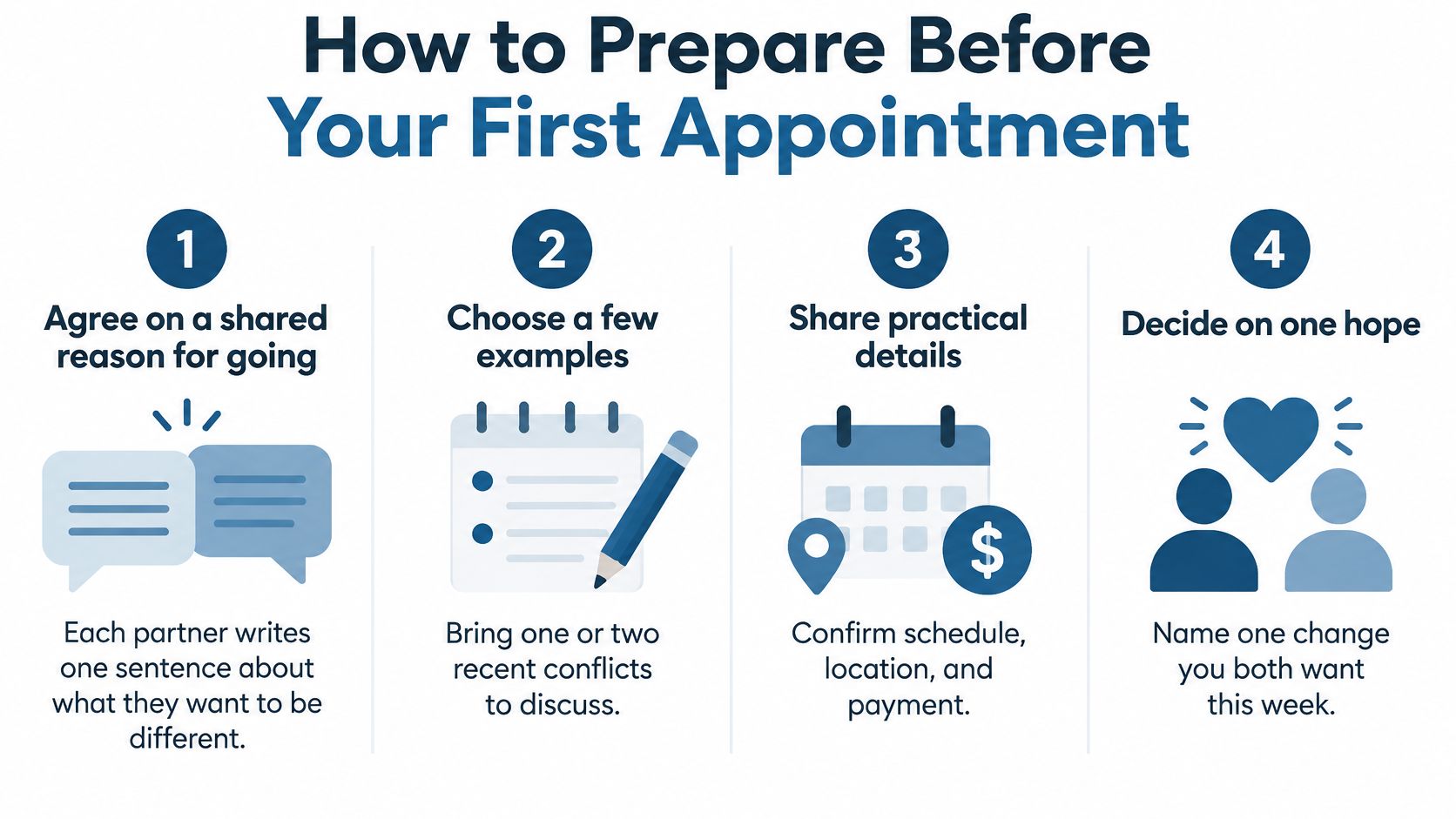
Agree on a shared reason. Each partner writes one sentence about what they want to be different in six months. Compare them before the session. Mismatched goals aren't a dealbreaker, but they're worth knowing.
Choose the therapist together. Check credentials, experience with your specific issue, and whether the therapist works with couples whose communication styles or identities resemble yours. Both partners should feel able to be honest in front of this person.
Bring two or three recent, specific examples. "Last Thursday, when you said you'd handle the school forms and then didn't" is workable. "You're always unreliable" is a character summary, and no therapist can do anything with it.
Settle logistics first. Childcare, transportation, and whether you're meeting in person or online. Arriving flustered undercuts the hour.
Make one agreement in advance. Nothing said in session gets used as ammunition later that night.
Between appointments, expect real work: tracking when the cycle starts, trying one new response during an actual disagreement, and completing any worksheet your therapist assigns. Couples counseling is an active, structured process, and the APA guide to treating challenging couples describes the same design: early sessions assess distress, interaction cycles, individual histories, safety, and goals, then combine psychoeducation with rehearsal of listening, emotion regulation, and strategically timed pauses.
One honest caveat: if there is coercive control or active violence, joint sessions may not be safe. A competent therapist screens for this before conjoint work begins, and couples work gets adapted or paused when one partner can't disclose freely.
If you want a fuller walkthrough of the pre-session conversation, this guide on how to prepare for couples counseling covers the logistics and the language. And if the first therapist isn't a fit, switching is normal. It isn't a failure, and it isn't a bad sign about your relationship.
When Your Situation Does Not Fit the Standard Picture
Two partners, one couch, matching schedules: that is the picture most "what to expect" pages draw. Plenty of couples show up with a different setup. The first meeting can still follow a familiar order. You sort out who is present, what feels safe to say, and how the hour will run. The details change. The sequence does not have to.
Online sessions. Remote sessions are often the most practical option for couples facing transportation limits, childcare, inflexible jobs, disability, or a rural location. They are not the right container when conflict can turn unsafe, and an in-person room may be the better choice then. A randomized VA trial found that a brief couples treatment for PTSD was effective both in-office and through home-based telehealth, with benefits maintained at six months, as reported in this Department of Veterans Affairs summary. Digital relationship programs have generally been found to improve relationship satisfaction, though the strength of that evidence varies from study to study. Before the first video appointment, settle three practical questions. Can each of you join from a separate room if you need privacy? What will you do if the connection drops mid-sentence? Would meeting in person be safer because arguments have already crossed into fear?
A video square works like a small kitchen table. You can still hear each other, but closing a laptop is not the same as a therapist stepping in. A long silence on screen is ordinary the first time. Name it, then return to the question in front of you.
LGBTQ+, transgender, and nonbinary couples. Competent care means a therapist who asks pronouns and uses them, respects how much you want disclosed, and never treats your identity as the problem you came to fix. Research on transgender and nonbinary adults in Canada, published in the Journal of Marital and Family Therapy, identified difficulty finding competent and affirming therapists, geographic limits, cost, and institutional barriers as major obstacles to relationship and family therapy. Many LGB+ partners also hesitate because they fear prejudice, or a clinician who has not been trained for their relationship. In a first session, you should hear your names and pronouns used correctly within the first few minutes.
Neurodivergent couples. Partners may move at different speeds. One person might need time to find words. Another might lose the thread when the room is loud, bright, or full of unspoken rules. ADHD-related trouble with planning, autistic communication styles, and sensory sensitivities are reasons to change the session, not proof that someone communicates badly. Ask for a written agenda, a timed pause, a quieter room, or the questions in advance. Ten open-ended prompts at once can feel like a pop quiz. A short list you can see works more like a map.
What to look for | Warning sign |
|---|---|
Asks each partner's pronouns and uses them consistently | Assumes gender, orientation, or relationship structure without asking |
Treats the relationship pattern as the client, not one partner as the problem | Takes sides or agrees one partner is "the difficult one" |
Screens for safety, coercive control, and abuse before joint work | Skips safety questions and moves straight to joint conflict work |
Offers accommodations for processing speed, sensory needs, or written agendas | Interprets neurodivergent communication differences as character flaws |
Confirms confidentiality limits and how records are handled | Vague or reluctant to explain privacy, especially for telehealth |
Explains the treatment model and what progress will look like | Promises reconciliation or a fixed outcome before assessment |
If one partner cannot disagree without paying for it later, joint counseling is the wrong room. A therapist who offers couples counseling for high-conflict and narcissistic dynamics should say that early, and without blaming you for needing a different plan.
What Kind of Progress to Expect and When
Here's the headline number, and it's a strong one. A meta-analysis of couple therapy outcomes found substantial improvement in relationship satisfaction from before treatment to after treatment, with a Hedges' g of 1.12 and a 95% confidence interval of 0.92 to 1.31. Couples placed on waitlists showed no statistically significant improvement, with a g of 0.12. Gains were generally maintained across short- and long-term follow-ups.
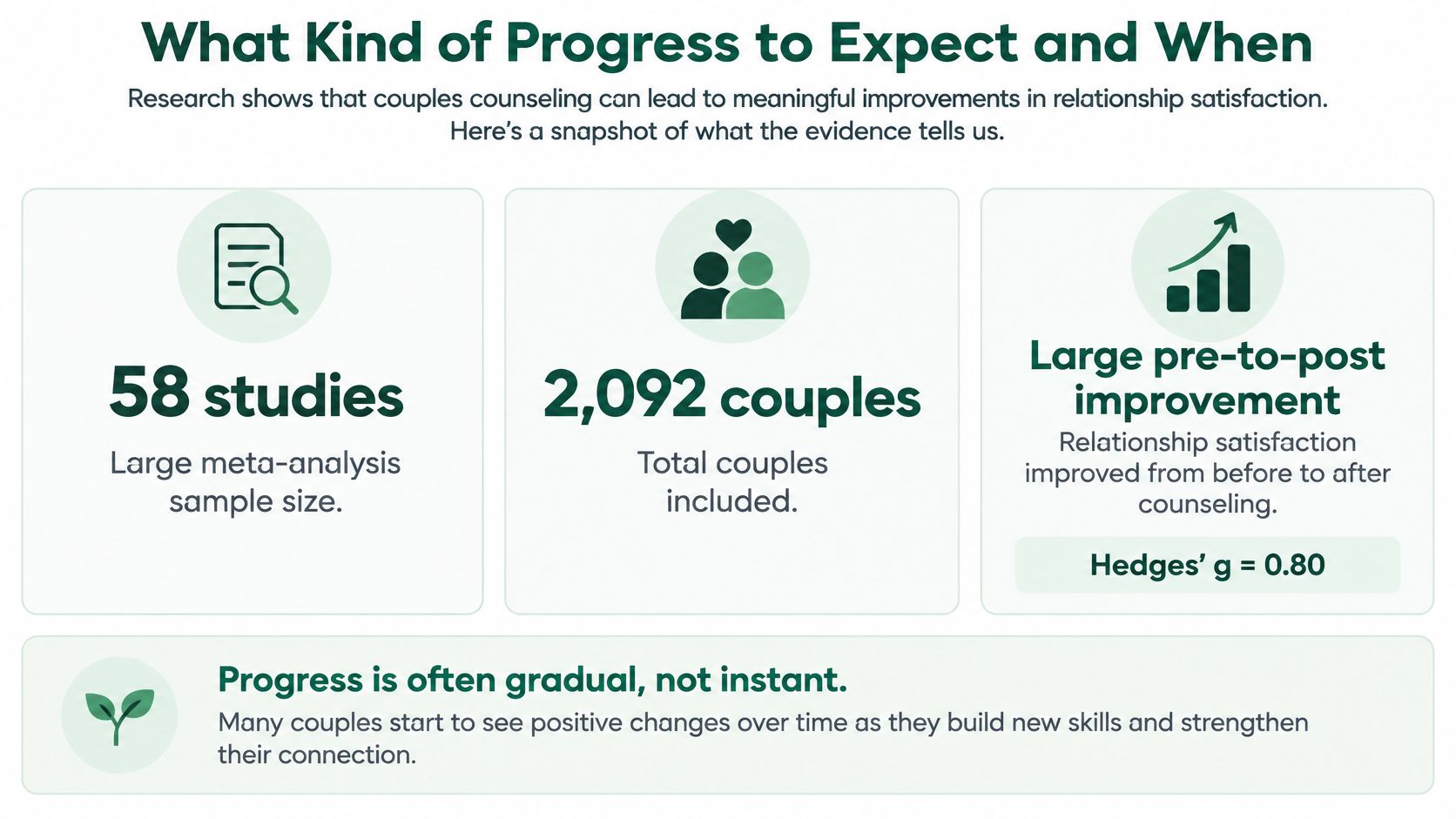
Numbers like that describe groups, not your kitchen. In a five-year follow-up of a randomized trial comparing two behavioral approaches, clinically significant improvement appeared in 50.0% of couples receiving integrative behavioral couple therapy and 45.9% of those receiving traditional behavioral couple therapy, according to the published trial results. That means meaningful change was common, but far from automatic. For emotionally focused therapy, a meta-analysis covering 20 studies and 332 couples reported that about 70% of couples were symptom-free at treatment completion, with stronger therapist adherence to the model associated with stronger gains, per this review of EFT outcome research.
Measure | Result | What it means in practice |
|---|---|---|
Satisfaction change, treatment vs. waitlist | g = 1.12 vs. g = 0.12 | Large improvement from counseling; little change from waiting |
Five-year follow-up, clinically significant improvement | About 46% to 50% of couples | Roughly half saw lasting meaningful improvement in that sample |
Emotionally focused therapy, symptom-free at completion | About 70% | Many couples finish with fewer distress symptoms; not a guarantee |
Typical brief course length | 12 to 20 sessions | Plan for several months of weekly sessions |
Progress often looks less dramatic than the research summaries. The first shift may be small: one partner pauses before launching into a complaint, the other answers with less defensiveness, or both can name the pattern without assigning blame. It can feel like learning a new dance step. At first, you count the beats and watch your feet. Later, the movement becomes smoother because you have practiced it in a lower-stakes space.
In day-to-day terms, many couples notice shorter fights and faster repair somewhere in the first four to eight sessions. That window is a pattern clinicians see in practice, not a research finding, so treat it as a rough expectation rather than a deadline. Some couples see little movement by then, and the honest response is to change the approach or the goals, not to conclude the relationship is doomed. If you're weighing timelines, this piece on how long therapy takes to work is a useful companion.
All three endings are valid: rebuilding together, setting healthier boundaries, or separating with clarity and safety. Counseling can help you choose one on purpose.
Choosing a Therapist and Booking the First Appointment
You now know what the process looks like. The remaining decision is who sits in the other chair, and that choice shapes your experience more than the model named on the therapist's website.
Match on three criteria.
Specific experience. Communication breakdown, infidelity recovery, neurodivergent couples, and entrenched high-conflict patterns call for different skills. Ask what percentage of the therapist's caseload is couples work, and what kinds of couples they typically see. A therapist who mostly treats individuals and squeezes in the occasional couple is a different bet than one whose week is built around two-person sessions.
Treatment model. Behavioral, integrative, or Gottman-informed approaches all have coherent logic behind them. What matters is that the therapist can explain the model and what progress will look like, in plain language, before you commit. If the answer comes back as jargon, keep looking.
Practical fit. Location, telehealth availability, session fee, and scheduling. Our practice is a boutique, self-pay counseling practice, which means you'll know the fee up front rather than discovering it after a benefits check.
Then book. Shortlist two therapists, call both, and ask three questions: what's your experience with our specific issue, how do you handle confidentiality and records, and what does progress look like by session eight. That third question does double duty. It tests whether the therapist thinks in concrete milestones, and it gives you a checkpoint you both agreed to before the work started. Ask about a free initial consultation if the practice offers one, since a short conversation reveals fit faster than a profile page ever will. If you're unsure how to judge chemistry, this explanation of what predicts a good therapy fit walks through the signals worth watching for.
Momentum rule: book the first session within two weeks of starting the search. Long gaps give the same old pattern time to talk you out of it.
Expect the first call to feel slightly awkward. You're describing your hardest problem to a stranger in ninety seconds. That's normal, and a good therapist will make it easier by asking organized questions rather than leaving silence for you to fill.
For readers in St. Petersburg and the Tampa Bay area, Be Your Best Self & Thrive Counseling, PLLC is one local option to research directly, including current services, clinician credentials, and availability. Wherever you land, the sequence you read about here is what you're walking into: a structured hour, a named pattern, and a next step.
If the pattern you keep having feels bigger than either of you, Be Your Best Self & Thrive Counseling, PLLC offers couples and marriage counseling in St. Petersburg and Sarasota, in person or online throughout Florida, with a free initial consultation to talk through fit and goals before you commit to a weekly slot. The therapists here work with high-conflict couples and draw on Gottman-informed approaches alongside mind-body-spirit tools such as mindfulness and breathing techniques. Visit Be Your Best Self & Thrive Counseling, PLLC to schedule that first conversation.