
Autistic Burnout vs Depression: How to Tell Them Apart
Why does a standard depression checklist so often point straight to clinical depression when an autistic adult is running out of functional capacity? On the surface, autistic burnout vs depression can look nearly identical. Both leave you exhausted, pulled away from people you care about, and struggling to get through ordinary days. Because most clinical screening forms ask how tired, flat, or overwhelmed you feel right now without asking what changed in your environment first, chronic overload frequently gets misread as a standalone mood disorder.
Sorting out what's happening takes a different lens. Instead of focusing only on low mood, you have to look at the trigger-and-recovery pattern and the hidden cost of sustained masking. Autistic burnout and depression aren't mutually exclusive. They can show up side by side, one can set the stage for the other, and each can make the other harder to shake. The sharper clinical question is what dropped from your personal baseline, and what happens to your energy and mood when life's demands come down.
Immediate support matters first. If you're having thoughts of suicide or self-harm right now, you don't need to sort out a label before getting help. In the United States, call or text 988 to reach the Suicide and Crisis Lifeline for free, confidential support around the clock, or call local emergency services immediately.
Autistic Burnout and Depression at a Glance
Confusion between these two states is completely understandable, even for experienced clinicians. When an autistic adult hits a wall, the outward signs blur together fast. You might notice persistent fatigue that sleep doesn't repair, social withdrawal, disrupted sleep or appetite, trouble concentrating, heightened irritability, and slipping self-care. In severe stretches, hopelessness can appear in both.
Because those surface signs overlap so heavily, a brief mood questionnaire on its own can't separate them. In a 2023 Autism in Adulthood survey of 141 autistic adults who had lived through autistic burnout, 98% scored above the study's clinical cut-off for depression. That single number shows why relying on a depression score alone can steer support in the wrong direction.
Side-by-Side Comparison of Typical Patterns
The table below lays out how the two states typically differ across triggers, skills, sensory tolerance, and recovery. These rows reflect patterns seen in research and clinical practice rather than formal diagnostic criteria.
Feature | Autistic burnout | Depression |
|---|---|---|
Typical trigger | Sustained masking, sensory load or social demand without enough support | Often no single trigger; may follow loss, stress or biological vulnerability |
Core experience | Exhaustion and loss of usual functioning | Persistent low mood and loss of interest |
Skill change | Common; executive functioning, communication or daily living may drop from baseline | Concentration and motivation may drop; core skills are not the defining feature |
Sensory tolerance | Often markedly reduced | Not a defining feature; may be affected by fatigue |
Typical duration | Pervasive episodes, usually lasting at least three months | Diagnosed when symptoms persist, typically for at least two weeks |
Role of mood symptoms | May be present but often secondary | Central and persistent |
Recovery pattern | Tends to improve as demands drop and supports return | Usually needs treatment; reduced demands alone may not resolve it |
Reading across the rows makes the divergence much clearer. Autistic burnout isn't a formal psychiatric diagnosis, yet a co-produced study in the journal Autism found that autistic adults frequently have burnout misidentified as depression, anxiety, bipolar disorder, or borderline personality disorder. The same review also noted that in one 2023 study, 44% of participants with recent burnout endorsed thoughts of suicidality or self-harm, which reinforces why careful safety screening matters regardless of which label fits best.
A Practical Two-Part Check
When you're trying to make sense of a crash, start with a plain two-part test:
Capacity dropped after rising demand: If everyday skills like speaking, cooking, or organizing tasks fell away after months of heavy social or sensory strain, and low mood showed up mostly as a reaction to feeling depleted, autistic burnout is likely driving the picture.
Low mood stays put regardless of load: If persistent sadness, emptiness, and lost interest sit at the center of your experience and stay just as heavy even when responsibilities ease, clinical depression needs direct evaluation.
The deciding question isn't whether you feel low. It's whether your functional capacity dropped after sustained demands outpaced your support.
Holding that two-part check in mind prevents an unnecessary either-or trap. You don't have to rule out depression to recognize burnout, and recognizing burnout doesn't make depression disappear. Both conditions can run at the same time, so each possibility deserves a direct look rather than an assumption.
What Autistic Burnout Is and Where It Departs From Depression
Peer-reviewed research defines autistic burnout as a distinct syndrome built around three core features, according to foundational work published in Autism in Adulthood: chronic physical and mental exhaustion, a substantial loss of previously available skills or functioning, and reduced tolerance of sensory input. The proposed mechanism is prolonged life stress colliding with a mismatch between what an environment demands and what a person can sustain without adequate support. Unlike ordinary tiredness after a busy week or routine workplace strain, these episodes are pervasive and typically last at least three months.
That difference between temporary overload and long-running depletion matters when you're gauging recovery. Understanding the broader line in stress vs burnout helps explain why a quiet weekend rarely fixes chronic exhaustion. With autistic burnout, the loss reaches past energy into baseline capabilities like communication, executive planning, self-care, and emotional regulation.
How Skill Loss Shows Up in Daily Life
Abstract definitions are easy to misread, so look at two everyday scenarios. Say an elementary school teacher spends every workday monitoring facial expressions, modulating vocal tone, and filtering fluorescent lighting and classroom noise. By November, she comes home unable to speak in full sentences, relies on text messages with her partner, and sits in a dark room for two hours just to tolerate dinner. She still loves teaching and still cares about her hobbies, yet her speech and processing speed have dropped far below her usual baseline.
Now consider a software developer whose company switches from quiet offices to an open-plan floor with constant chatter and bright glare. Within two months, his sensory tolerance plummets so sharply that grocery stores feel unbearable. At home, he stops cooking meals he used to make effortlessly and can't bring himself to open routine personal emails, even though he doesn't feel pervasive guilt or self-blame.
Where Clinical Depression Diverges
Clinical depression follows a different diagnostic structure. Clinicians diagnose a depressive episode based on persistent mood and cognitive criteria, including sustained sadness or emptiness, markedly reduced pleasure in activities once enjoyed, feelings of worthlessness, and changes in sleep or appetite. While depression certainly slows down concentration and motivation, sensory intolerance and regression in core everyday skills aren't defining features of a depressive episode.
Autistic burnout also tends to bring increased visibility of autistic traits and sharper executive-function roadblocks, as documented in the 2020 qualitative study by Raymaker and colleagues of 19 autistic adults (10 describing burnout and 9 comparison participants discussing employment). Those researchers defined autistic burnout as involving "significant mental and physical exhaustion" alongside reduced everyday functioning, while noting that their small qualitative sample established clinical patterns rather than population rates. Reliable population prevalence for autistic burnout still isn't established in large epidemiological datasets.
In any clinical conversation, that brings you back to two grounded questions: What changed from your own usual baseline, and what shifted in your environment right before that change started?
What Drives Autistic Burnout, Depression or Both
Autistic burnout rarely arrives out of thin air. In most cases, it builds slowly through sustained masking across workplaces or schools, where hiding natural movement, scripting small talk, and forcing eye contact eat up cognitive reserves every hour. Chronic sensory environments add another layer, especially bright lighting, unpredictable noise, or crowded spaces with no quiet exit. Unexpected changes in routine, heavy caregiving or employment pressure, and the quiet removal of accommodations that once kept life manageable can push a person past their limit. Spotting those mental health triggers early makes it easier to trace why a sudden decline happened.
Before attributing fatigue and fog solely to burnout or depression, medical contributors have to be checked and ruled out. Untreated sleep disorders, thyroid or other hormonal conditions, anaemia, and medication side effects can closely mimic or intensify both low mood and functional exhaustion. A basic primary-care checkup and blood panel often uncover physical drains that therapy or rest alone won't resolve.
The Feedback Loop Between Masking and Mood
Research confirms that depression and masking-related depletion are tightly intertwined rather than cleanly walled off from each other. A recent peer-reviewed study of autistic adults reported estimated pooled depression prevalence of 23% for current depression and 37% over a lifetime, while more than 70% of its own study sample scored in the clinical range for depression. The researchers also found that burnout-related exhaustion partially mediated the link between social camouflaging and depression.
Think of what that loop looks like in practice. Say an autistic hospital nurse masks intensely through twelve-hour shifts for eight straight months, holding back sensory distress and mirroring colleagues to stay employed. First, her executive functioning and sensory tolerance crash. After months of barely making it off the couch on her days off, isolation sets in, favorite routines stop bringing any comfort, and persistent hopelessness takes hold. Masking drained her reserves into burnout, and prolonged depletion opened the door to depression, which then stripped away whatever capacity she had left to cope.
What Research Numbers Actually Show
Psychometric studies clarify why clinicians treat these two states as overlapping yet separable rather than identical. In a 2025 validation study of the 27-item AASPIRE Autistic Burnout Measure involving 379 autistic adults, burnout scores correlated only moderately with depression at r = 0.52 (r = 0.56 after correcting for measurement attenuation), staying well below the r = 0.70 benchmark typically used to treat two constructs as interchangeable. Even so, 39% of that sample reported a co-occurring depression diagnosis, reinforcing why clinicians screen for both.
Study or measure | Figure | What it shows |
|---|---|---|
2023 survey of autistic adults | 141 respondents; 98% above depression cut-off | Screening scores alone cannot separate the two |
Depression among autistic adults | 23% current; 37% lifetime (pooled estimates) | Depression is common and intertwined with masking and burnout |
Camouflaging, exhaustion and depression | Burnout-exhaustion partially mediates the link | Masking depletion may help explain co-occurrence |
2025 measure validation (Autism in Adulthood) | 379 adults; omega 0.98; 12-month test-retest 0.59 | Burnout measure is internally consistent and reasonably stable |
Burnout and depression correlation | r = 0.52 (0.56 corrected) | Overlapping but not interchangeable; below the 0.70 threshold |
Population prevalence of autistic burnout | Not yet established | Reliable rate remains unknown |
Identifying what started the slide directly shapes the first move in recovery. A decline driven by masking and sensory overload calls for immediate load reduction and environmental adjustments, whereas a biologically driven mood episode needs targeted depression treatment right alongside practical support.
How to Tell Which Pattern You Are Seeing
When exhaustion has dragged on for months, memory gets foggy. Trying to untangle autistic burnout vs depression inside your head usually ends in frustration, so put the observations on paper over a couple of weeks instead. Start with the two foundational steps pictured below, then work through the full seven-step check.
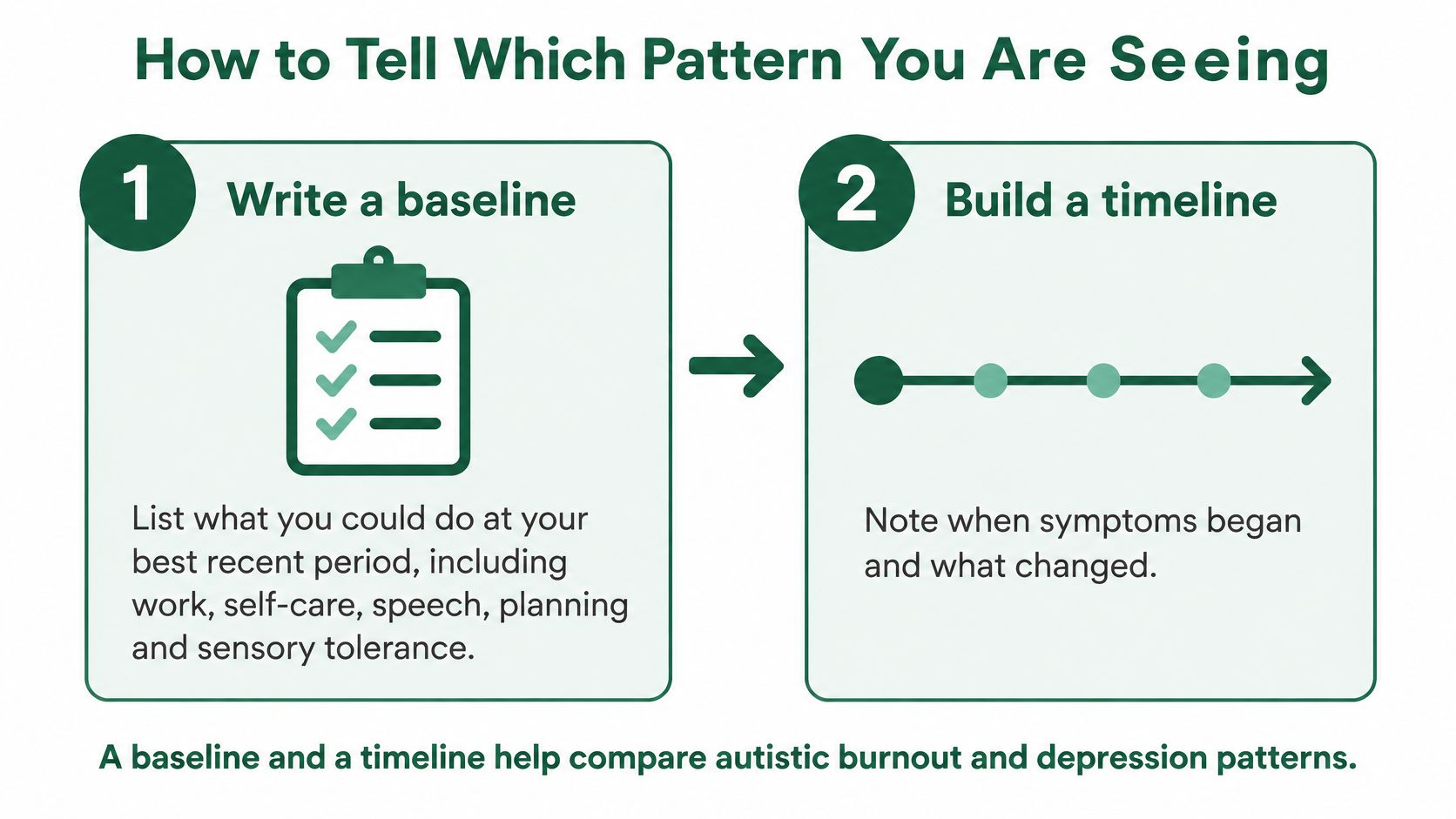
A baseline and a timeline help compare autistic burnout and depression patterns.
Mapping Your Baseline and Triggers
Write a clear baseline. List what you could handle reliably during your most recent steady period, covering work or study output, basic self-care, spoken communication, planning, and everyday sensory tolerance. Without a written benchmark, it's surprisingly easy to forget how much skill you lost.
Build a concrete timeline. Mark the month your energy or functioning began slipping, then write down every demand shift that occurred right before it, such as a new manager, noisier housing, heavier caregiving, or losing flexible hours. Seeing those dates side by side reveals whether overload came first.
Separate lost skills from shifts in mood. Draw two columns on a sheet of paper: place functional drop-offs like cooking, answering emails, or tolerating grocery lighting on one side, and emotional changes like numbness, sadness, guilt, or lost enjoyment on the other. This visual split stops exhaustion from automatically getting labeled as mood alone.
Testing Recovery and Ruling Out Other Factors
Run a small demand-reduction test. Over two to four weeks, lower every load you safely can, whether that means wearing noise-canceling headphones, simplifying meals, canceling optional social obligations, or unmasking at home, and track whether any baseline function begins returning. While you're resetting physical stamina, practical guides on rebuilding energy without caffeine jolts can also remind you to support steady daily energy rather than relying on stimulants that mask deeper fatigue.
Track mood across low-demand and high-demand days. Notice whether your mood brightens on quiet days when pressure eases, or whether heaviness stays glued in place even during genuine rest. Reviewing core signs and symptoms of depression alongside your daily log helps highlight persistent low mood or lost pleasure that rest isn't touching.
Review sleep, medications, and physical health. Jot down changes in sleep duration or quality, recent prescription adjustments, headaches, dizziness, or ongoing physical symptoms to share with a primary-care doctor. Ruling out anaemia, thyroid shifts, or medication side effects prevents months of treating the wrong target.
Screen for safety every step of the way. If thoughts of self-harm or suicide show up at any point, treat that as urgent rather than waiting to finish your notes. Call or text 988 in the United States immediately, matching the crisis resource listed at the start of this guide, or contact local emergency services right away.
Keep the goal clear. These seven steps don't give you a formal diagnosis. They give you a factual, time-stamped record that helps a clinician distinguish burnout from depression in a fraction of the usual time.
Support Options That Match Each Pattern
Getting the pattern right matters because the wrong intervention can make things worse. Pushing someone in deep autistic burnout to add intense social activation without lowering sensory and masking load often deepens the crash. Conversely, telling someone with clinical depression to take time off and stay isolated can leave persistent hopelessness untouched.
Measurement research published in the journal Autism shows that masking stays linked to burnout severity even after accounting for alexithymia, interoception, sensory sensitivities, and overall autism traits, which makes load reduction a genuine clinical intervention rather than mere lifestyle advice. Effective care tests how functioning responds when demands drop while watching closely for depressive symptoms that need direct treatment.
Restoring Capacity in Autistic Burnout
Recovery from autistic burnout centers on lowering cumulative demand and rebuilding access to skills that prolonged masking pushed aside. Practical steps include adjusting lighting and sound at home or work, locking in predictable daily routines, using written or text-based communication when spoken words drain too much energy, and protecting genuine rest that doesn't come with hidden performance expectations. Exploring structured strategies for how to heal from burnout can help turn vague advice about slowing down into concrete boundary changes.
Clinicians who understand autism also help translate those needs into workplace, school, or household accommodations. That might mean requesting written agendas before meetings, shifting to quieter workspaces, or dividing executive-heavy chores so recovery isn't undone every Monday morning.
Treating Clinical Depression Directly
When clinical depression sits at the center of the picture, reducing demands alone rarely lifts persistent sadness, emptiness, or loss of pleasure. Evidence-based psychotherapy, including cognitive behavioral therapy adapted for autistic communication styles and other structured modalities, helps address entrenched mood patterns, self-criticism, and withdrawal cycles. For moderate, severe, or long-lasting depressive episodes, a medication review with a qualified prescriber is another important option to weigh carefully, keeping an eye on sensory sensitivities and side effects.
Running Parallel Care When Both Coexist
Because burnout and depression so often overlap, the most reliable approach avoids forcing a false choice. You run both tracks at once: cut unsustainable sensory and masking loads to relieve burnout while starting targeted psychological or medical care for depression. Progress gets measured directly against your written baseline notes.
If skills and energy rebound as demands fall: The picture leans strongly toward burnout-led depletion, and long-term accommodations become your priority.
If mood stays flat, hopeless, or numb despite lighter loads: Depression requires sustained, direct treatment alongside ongoing environmental support.
Finding a Clinician Who Understands Both
When evaluating any mental health provider, ask how they work with autistic adults, how they measure changes from your personal baseline, and how they coordinate with primary-care doctors or prescribers when medical factors are involved. If you're in the Tampa Bay region, Be Your Best Self & Thrive Counseling, PLLC is one option to consider alongside other local and neurodiversity-affirming providers. We're a boutique, self-pay counseling practice specializing in mind-body-spirit approaches to mental health, providing mental health counseling in St. Petersburg and Sarasota, Florida. We offer online counseling, in-person counseling, workshops, group therapy, and workbooks, giving adults flexible ways to build sustainable recovery routines.
Know When to Get Professional Help Now
Waiting until everything falls apart makes recovery longer and harder. Use the triage guide below to match what you're seeing right now to the clearest next move.
Situation | What It May Suggest | Action to Take |
|---|---|---|
Thoughts of suicide or self-harm | Possible depressive crisis needing immediate risk assessment | Call or text 988 in the US, or call local emergency services now |
Low mood most days for two weeks or more with lost interest | Possible depressive episode | Book an evaluation with a clinician experienced in autism and mood disorders |
Lost skills after sustained overload, with new sensory intolerance | Possible autistic burnout | Reduce demands and see a clinician to check for depression and medical causes |
Sudden loss of speech or inability to care for yourself | Medical or neurological cause possible, or severe burnout | Seek same-day medical assessment |
No change after several weeks of reduced demands | Depression may be present alongside burnout | Seek evaluation for both conditions |
Crisis Care Comes Before Ongoing Counseling
If you or someone you care about is experiencing suicidal thoughts, active self-harm urges, or an inability to stay safe, immediate crisis support is the right first step. In the United States, call or text 988 for the Suicide and Crisis Lifeline, or reach out to local emergency services right away. Sudden loss of speech or a sharp inability to manage basic food, hydration, or safety also warrants same-day medical evaluation to rule out urgent neurological or physical causes.
Outpatient counseling serves a different role. At Be Your Best Self & Thrive Counseling, PLLC, we work specifically with non-emergency issues and with motivated people who are ready to change but need a bit of help building the life and relationships they want. Handling urgent safety or medical stabilization first ensures you're well supported before stepping into ongoing therapy.
Preparing for a Productive Clinical Evaluation
Once immediate safety is steady, bring your written baseline and timeline notes to an appointment with a licensed clinician or primary-care provider. Ask directly whether they have experience working with autistic adults and confirm that they'll assess autistic burnout and clinical depression separately rather than collapsing every sign of exhaustion under one label. If you're also managing chronic worry alongside low mood, reading practical guidance on how to help depression and anxiety can help you prepare specific questions for your visit.
Caregivers and parents supporting autistic children often hit their own parallel wall of exhaustion while juggling advocacy, appointments, and sensory needs at home. If caregiving pressure is part of your timeline, exploring dedicated self-care strategies for special needs parents offers targeted ways to protect your own capacity while coordinating care for your family.
Getting an early, specific assessment changes the whole trajectory of recovery. When burnout and depression are each named accurately, both can be treated together with a plan that actually fits your nervous system and daily life.
If you're navigating lingering exhaustion, masking fatigue, or overlapping depression in St. Petersburg, Sarasota, or online across Florida, our team offers mind-body-spirit counseling to help you rebuild sustainable routines and clarify what your mind and body need next. Explore our online and in-person counseling, group therapy, workshops, and workbooks by visiting Be Your Best Self & Thrive Counseling, PLLC to schedule a free initial consultation.