
What Is Emotional Flooding? Signs and How to Calm Down
Emotional flooding is an influx of great and uncontrollable emotion that overwhelms a person, impairs thinking, and makes it hard to listen, speak clearly or solve the problem.
You might be standing in the kitchen, trying to explain why you're upset, when your chest tightens and the conversation stops making sense. You still care about the issue and the person in front of you, but you can't find a useful sentence. At that moment, pushing harder for an answer may be less helpful than making room to recover.
What Emotional Flooding Means in Plain Terms
A couple starts arguing about dishes. One partner raises their voice, and the other suddenly can't follow a single sentence. What began as a practical disagreement now feels impossible to resolve.
The American Psychological Association defines emotional flooding as “an influx of great and uncontrollable emotion.” In plain language, you feel overtaken rather than upset. You may know what you want to communicate, yet struggle to organize it into words or take in someone else's meaning.
Think of a smoke alarm blaring so loudly that you can't hear the conversation happening in the room. The conversation hasn't disappeared. Your ability to attend to it has become overwhelmed by something that feels more urgent.
The important distinction: Strong feelings aren't automatically flooding. The concern is whether overwhelm has disrupted your ability to understand, respond and choose.
A state, not an identity
Flooding is often discussed in couple conflict, but the broader experience isn't limited to romantic relationships. Emotional overwhelm can accompany anxiety, stress or panic, and it can overlap with sensory overload. Neither a particular diagnosis nor a particular emotion is required.
The person beside the sink might look angry, frightened or unusually quiet. None of those appearances, by itself, tells you what's happening internally. Ask about their experience rather than deciding that they're dramatic, indifferent or deliberately difficult.
Flooding is a state that can be managed, not a character flaw. That doesn't excuse hurtful conduct. It means the immediate task is to restore enough steadiness for responsible communication, rather than demand a thoughtful explanation from someone who can't currently organize one.
How Flooding Takes Over Your Body and Your Listening
An argument about dishes can become an argument about whether either person cares. Couple-conflict research on emotional flooding describes a connection between perceived relational threat, physiological activation and impaired information processing. The shift can feel sudden, like a door closing in the middle of a sentence. One moment, the request is about dishes. The next, the whole relationship seems to be on trial.
From criticism to defensive action
A remark feels threatening. A complaint about unfinished chores lands as a judgment about being a bad partner. Heart rate, blood pressure and breathing can increase as sympathetic activation rises.
Attention narrows. Instead of noticing the practical request, the listener concentrates on the accusation they believe they're hearing. Flexible interpretations become harder to access.
Meaning gets lost. The speaker adds context, but the listener can't track it. A qualification or attempt at reassurance may not register.
A familiar defense takes over. The listener interrupts, attacks back or withdraws. Their partner may interpret that response as further evidence of not caring, increasing the pressure.
The infographic maps this progression without implying that everyone follows an identical sequence.
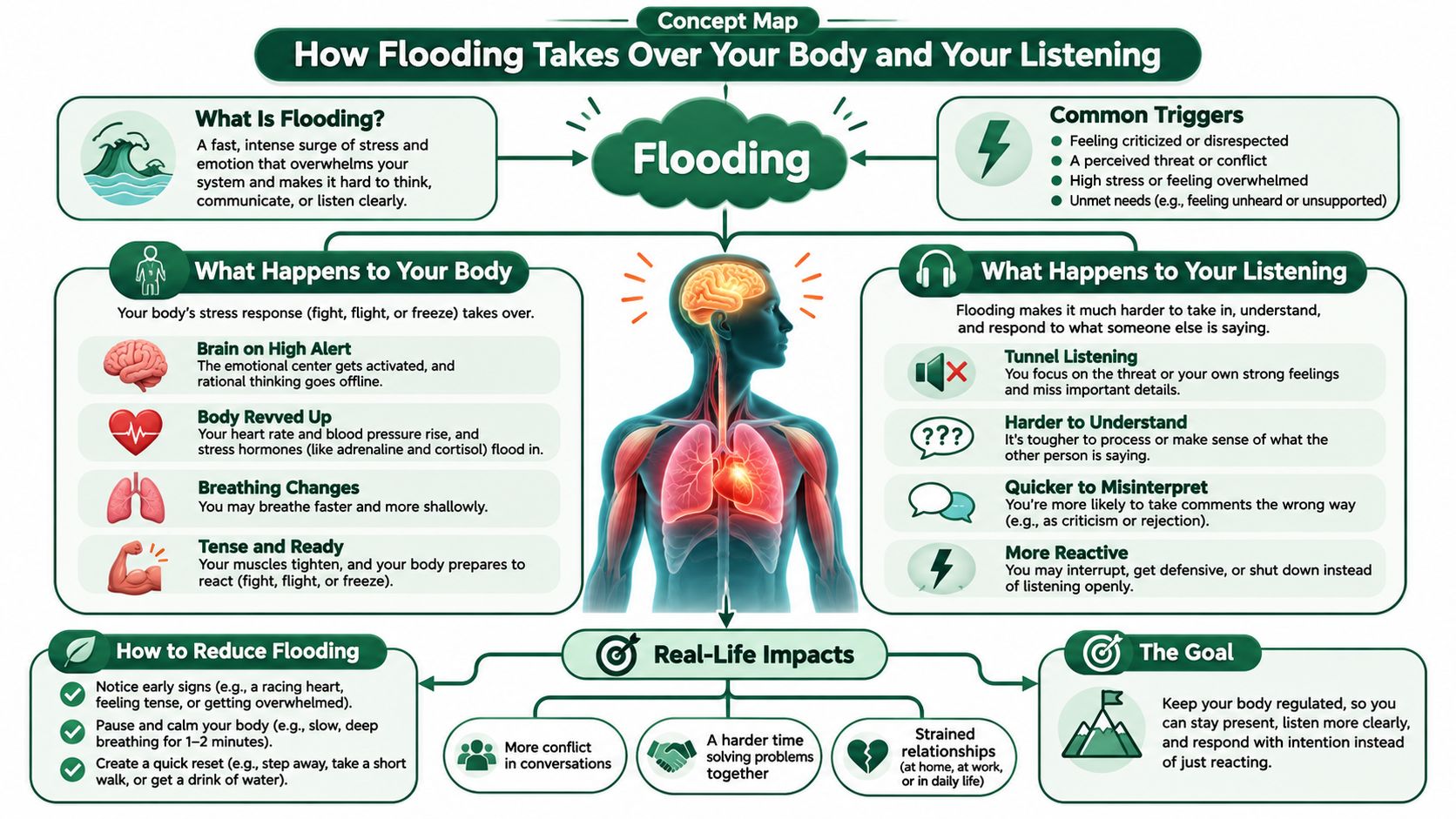
Caption: Perceived threat can increase bodily arousal, narrow attention and interfere with communication.
A useful self-check is: can I repeat what the other person meant in my own words? If the answer is no, insight and problem-solving can wait. The listening system needs a reset first.
What a racing heart can tell you
Gottman's conflict-management guidance uses approximately 100 beats per minute as a practical marker of flooding during relationship conflict. That's a warning sign, not a universal diagnostic cutoff. A pulse reading alone can't establish whether someone is flooded, and you don't need a wearable device to recognize that comprehension has deteriorated. A person may still speak fluently while missing the meaning underneath the words.
An analysis discussing cognitive overwhelm during flooding explains why people may fall back on overlearned behaviors when they can't attend to much beyond their physiological state. Repeating an argument or retreating into silence may be familiar, even when neither response helps. Under pressure, the mind reaches for the route it knows best.
Understanding fight, flight, freeze and fawn responses can provide useful vocabulary without turning those patterns into diagnoses. The same pressure can also shape communication in other settings, including handling tough questions in board meetings, though flooding in close relationships carries added emotional weight because the people and the history are intertwined.
Regulate the state before attempting insight or problem-solving. The 2023 Frontiers in Psychology study by Berenguer-Soler, García del Castillo-López and Pineda is among the relatively few peer-reviewed publications focused specifically on flooding in couple conflict. The wider literature remains limited, so causal explanations should be treated as emerging rather than settled.
Signs of Flooding in Your Body, Speech and Behavior
Use this table to notice changes during conflict, not to diagnose your partner.
Signs of emotional flooding by area
Area | Sign | What It Often Looks Like |
|---|---|---|
Body | Racing heart or pounding pulse | Pulse rises noticeably during conflict, a warning sign rather than a diagnosis |
Body | Flushed face, tight jaw or shoulders | Muscle tension that stays after the topic changes |
Thinking | Blank mind or lost thread | Can't say what the partner just said in their own words |
Thinking | Narrowed focus on threat | Hears sentences as criticism, including neutral ones |
Speech | Rapid or pressured talk | Repeats the same point, interrupts or speaks faster as voice rises |
Speech | Clipped one-word replies | Silence or short answers that look like withdrawal |
Behaviour | Urge to leave or stonewalling | Wants to exit the room or stops responding entirely |
Behaviour | Rigid arguing or sudden apology | Defends the same position, or apologizes in a way that doesn't match the feeling |
Loud isn't the only presentation
Escalation can look fast and forceful. Someone speaks over their partner, repeats a defense and becomes increasingly agitated. A quieter presentation may involve stillness, blankness or difficulty producing more than a short reply.
Silence doesn't prove calmness or indifference. Neurodivergent people, highly sensitive people and trauma survivors may describe overwhelm differently, including needing less language or needing to leave the room. Ask what helps rather than expecting distress to have a particular appearance.
Notice a change from someone's usual functioning, not whether they match a stereotype of an upset person.
Match the plan to the experience
The Intimate Partner Flooding Scale validation study defines flooding around unexpected, intense partner negativity and perceived difficulty processing information. Its validation work found associations with relationship satisfaction, anger, depressive symptoms and observed negative conflict behavior. Those associations don't make flooding a fixed personality trait or prove that someone is irrational.
The same outward action can have different explanations. Leaving might reflect overwhelm, sensory discomfort, a safety concern or an attempt to control a conversation. A useful pause plan accounts for the mechanism, not just the visible behavior.
Record your own earliest changes: perhaps jaw tension appears before rapid speech, or you stop understanding before you notice your pulse. Recognizing that sequence gives you a more practical signal than waiting until you're completely overwhelmed.
Common Triggers and How Flooding Differs From Plain Anger
Suppose a partner accuses you of never listening. You might feel angry and still explain your position clearly, or you might lose the thread and start responding on autopilot. The intensity of the feeling isn't the only distinction.
Flooding compared with related states
State | Core Feature | How to Tell It Apart |
|---|---|---|
Emotional flooding | Overwhelm that impairs thinking | Words stop making sense or come out on autopilot |
Ordinary anger | Strong feeling with thinking still available | You can follow the argument and choose your words |
Anxiety | Worry about a future threat | Attention runs ahead to what might happen next |
Shutdown | Freeze and withdrawal | Blank and silent, often after too much input |
Sensory overload | Too much noise, light, touch or crowd | Reducing stimulation helps, though recovery isn't always immediate |
These are working distinctions, not diagnostic boundaries. Anxiety can involve present danger, shutdown can accompany flooding, and sensory overload can coexist with relational distress. You don't have to identify a single perfect label before reducing demands.
Look for the trigger and the context
Research examining flooding in couple interactions places emotional overwhelm within the interaction, rather than treating it as proof that one partner is uncaring. Useful triggers to explore include:
Perceived criticism: A complaint sounds like a judgment of your worth.
Dismissal or interruption: You feel unable to finish or be understood.
Sarcasm or public accusations: You experience embarrassment, contempt or exposure.
Too much input: Noise, crowds or time pressure make a difficult conversation harder.
A person's history and current circumstances matter. Ask about accumulated stress, sleep, past trauma and alcohol use rather than assuming the same remark should affect everyone equally. Identifying mental health triggers can help you describe the context without making another person responsible for every reaction.
Use a comprehension check
Ask yourself: Can I still say what the other person just said in my own words?
If you can't, flooding may be involved. This isn't a definitive test: distraction, language differences and sensory overload can also disrupt comprehension. Its value is practical, because it tells you that continuing the argument may not produce understanding.
Ordinary anger may call for clearer expression and boundaries. Sensory overload calls for reduced input. When emotional overwhelm has disrupted comprehension, stabilization comes before further discussion.
How to Pause Safely in the First Five Minutes
A flooded nervous system works like a circuit breaker: capacity drops before judgment does. The goal in the first five minutes is to lower load enough to come back, not to win, explain perfectly or solve the relationship. Start with one plain check: “If the pressure stopped for sixty seconds, could I take in one sentence and answer it?” If yes, this may be anger or anxiety that still has words. If the answer changes only when noise, light or crowding drops, sensory load may be the driver. If your mind goes blank or you cannot form words, treat it as shutdown or flooding and stabilize first.
Name your state without blame. Try: I'm flooded and can't think clearly right now. This describes your capacity rather than accusing your partner of causing it. Avoid using the label as a verdict about who's wrong.
Agree on a specific return time. For example, propose a break of twenty to thirty minutes, then check whether that's workable for both of you. This is a sample agreement, not a guaranteed recovery window. Leaving with no plan can make a pause feel like abandonment. If you are the steadier partner, lower your voice, offer the time and step back; save questions for the return.
Cut the input. Move somewhere quieter, lower harsh lighting and put screens aside. Don't continue the argument through the doorway or by text. Physical distance won't offer much relief if the verbal pressure follows you.
Try comfortable paced breathing. As an optional exercise, inhale for four counts and exhale for six, for two to three minutes. Don't force deep breaths or persist if you feel dizzy or more distressed. Mentally rehearsing your rebuttal while breathing keeps your attention on the dispute.
Ground in your surroundings. Try identifying five things you can see and four things you can feel, such as the chair beneath you or your feet inside your shoes. Use this as an invitation, not a performance test. If counting adds pressure, notice one stable object and let your eyes rest there.
Move or write with a purpose. Take a short walk or write what happened, what you felt and what you need. Avoid composing a prosecution brief or a message to send immediately. Choose an activity that helps you become more available for conversation.
Return and check readiness. Restate the topic in a sentence, then paraphrase your partner's concern. If you still can't process it, say so and negotiate another specific check-in. Don't disappear or force a solution to prove the break worked.
The visual summarizes the broader pause process; the steps above offer choices within it.
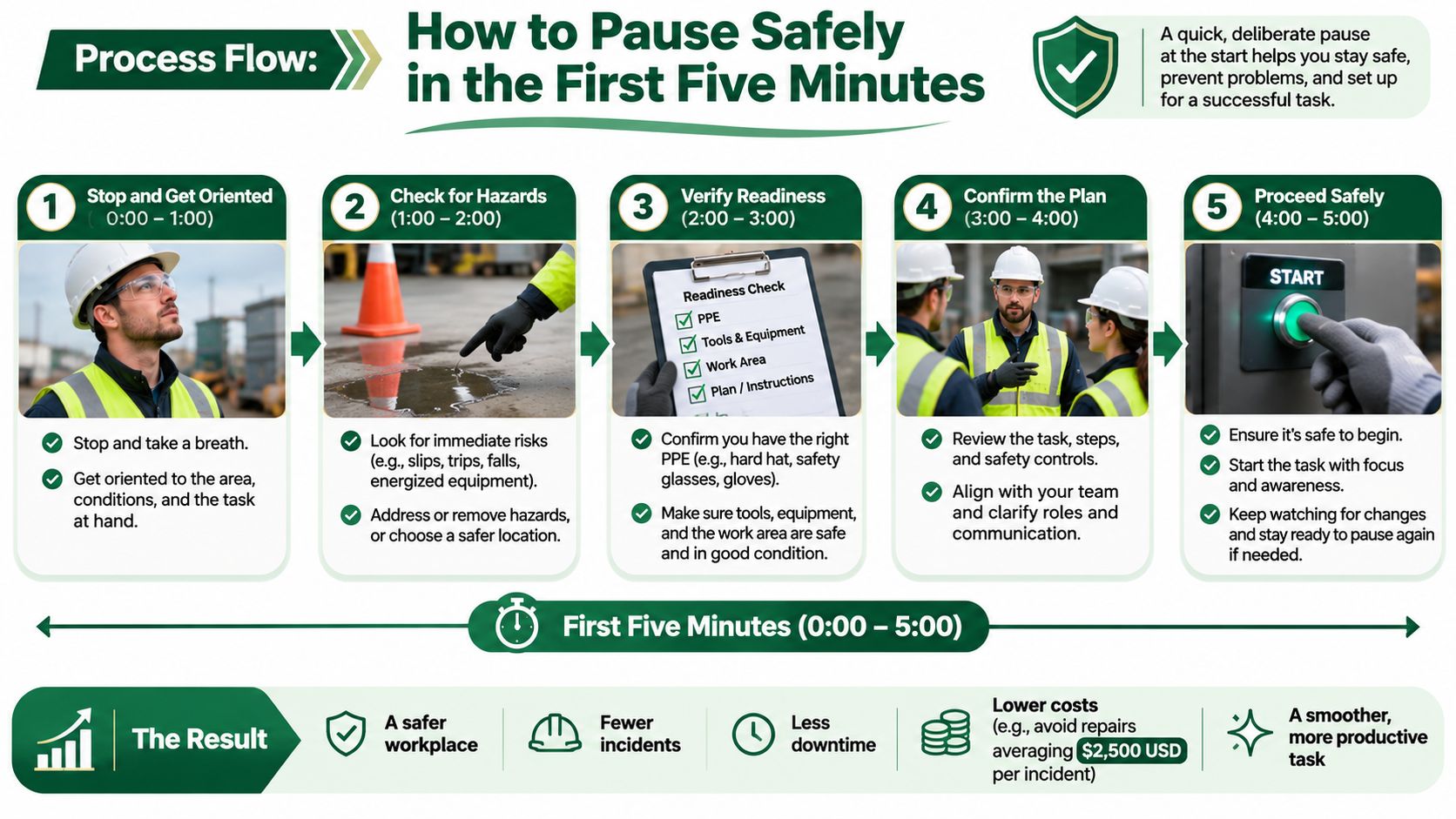
Caption: Establish safety, reduce demands, regulate and reconnect through an agreed pause.
Choose the method that fits
No single calming method fits everyone. Immediate verbal processing may add pressure when someone needs quiet or movement. Family norms and cultural background can also shape whether silence, eye contact, direct emotion or time alone reads as respect, so match the tool to the person in front of you.
Regulation strategies and when they fit
Strategy | Works Best When | Watch Out For |
|---|---|---|
Sensory reduction | Noise, light or crowds contribute to overload | Leaving without a return time |
Paced breathing | Pulse is rising and speech is rushed | Forcing breaths while rehearsing the argument |
Grounding | Mind feels blank or detached | Never returning to the topic |
Structured writing | Thoughts loop and need an outlet | Writing grievances to send later |
Walk or movement | Restlessness or an urge to escape dominates | Leaving angrily without an agreement |
Concrete problem-solving | A clear next step feels settling | Offering solutions before the person feels safe |
Stabilization isn't the whole repair
Temporary containment can protect the conversation; it becomes a problem only when the return never happens. Ask what this moment requires: safety, understanding, repair or a decision. Longer-term processing belongs in a conversation both people can participate in.
Adapt distress-tolerance techniques to the person rather than making calmness a test they can fail. General stress material such as the REVETIX stress and mood guide may cover everyday tension, while this pause is specific to conflict and depends on the agreement you make. Partners don't need identical methods. One might write while the other walks, with both following the same agreement about respectful distance and returning.
What to Do When Your Partner Is the One Flooding
Chasing the argument, demanding eye contact or repeating your point louder can add pressure when your partner is already struggling. You don't need to settle the disagreement in the same moment that you recognize their overwhelm.
Make the next few minutes easier
Lower your own intensity. Slow your speech and soften your volume before explaining anything.
Ask rather than diagnose. Try: You seem overwhelmed. Would a pause help us?
Offer a plan, not a punishment. For example: Could we take twenty minutes, then return to the school decision?
Ask a small, answerable question. If welcome, try: Can you tell me something you can hear right now? Don't demand a summary of the argument.
Follow through. At the agreed check-in, describe their position before raising yours.
These de-escalation techniques are invitations to reduce pressure, not tools for managing another adult into agreement. Stop prompting if your questions become another demand.
Look at the pattern, not just the silence
A return and genuine re-engagement support the interpretation that the break was for regulation. Repeatedly using silence to punish someone or permanently end discussion raises a different concern. Missing a return time alone doesn't prove manipulation, because recovery can take longer than expected.
If your partner doesn't return, don't chase an escalating conversation that night. Discuss the broken agreement when you're both settled, unless an urgent practical or safety issue needs attention. If this repeatedly prevents any resolution, consider counseling to develop a plan both partners can use.
Decide When to Get Professional Support
When a relationship includes intimidation, threats, violence or coercive control, safety planning and specialized support take priority over communication work. If you're in immediate danger, seek emergency assistance and a safe place rather than negotiating a shared pause.
When a home plan isn't enough
Everyone floods sometimes. A pause-and-return plan works when both partners can use it, so if you keep agreeing to pauses and the arguments keep ending the same way, the pattern has outgrown the tools you have. Consider a professional assessment when you notice signs like these:
Persistent disruption: Episodes happen most weeks, last for hours or repeatedly end in someone leaving or escalating.
Complicating factors: The pattern follows trauma, or it tracks alcohol or other substance use.
Limited recovery: You can't regain steadiness afterward or resume the conversations that matter.
Treat these as prompts for a first appointment rather than a verdict on your relationship. A therapist can help you map your earliest warning signs, rehearse a pause agreement until it holds under pressure, work through the anxiety or trauma feeding the cycle, and practice hard conversations at a manageable level of stress. Reading about emotional dysregulation in adults can also help you describe what needs attention.
If you're forming new connections after an unsafe relationship, Special Bridge safety guidance offers practical precautions, while coercion or control calls for specialized help.
Take a manageable next step
Be Your Best Self & Thrive Counseling, PLLC offers individual and couples counseling and a free initial consultation to explore fit. The practice works with non-emergency issues and motivated people who are ready for change, and sessions often include techniques such as breathing, yoga and mindfulness alongside talk therapy.
This week, write your three earliest warning signs on a card and agree on a pause plan if it's safe to do so. You might book a consultation if the pattern repeats twice more, but don't wait for that threshold if you're frightened or struggling now.
Be Your Best Self & Thrive Counseling, PLLC offers individual and couples counseling to help you recognize overwhelm, build regulation skills and work toward healthier communication. Visit Be Your Best Self & Thrive Counseling, PLLC to arrange a free initial consultation and discuss a pause-and-return plan that fits your needs.