
Emotional Dysregulation in Adults: Signs and What Helps
You've reread a colleague's short email, snapped at someone who asked an ordinary question, and spent the afternoon replaying what happened. Or perhaps nobody noticed anything: you smiled through a meeting, went quiet afterward, and still can't settle enough to finish your work. Emotional dysregulation in adults can be loud or almost invisible. What matters is how you respond to emotion, how much choice you have in that response, and how you recover.
What Emotional Dysregulation Means for Adults
Say a colleague receives a brief email asking for a revision. They feel criticized, send a sharp reply, then keep mentally defending themselves long after the exchange ends. Another person might feel the same sting but become silent, unable to ask what the sender meant.
Emotional dysregulation means difficulty adjusting an emotion's intensity, duration, or expression to the situation. It's like a thermostat that stays on high after the room has warmed up, or swings between extremes instead of making small adjustments.

An ordinary work interaction can become difficult when emotional activation continues after the immediate problem has passed.
A Pattern, Not A Character Judgment
Dysregulation isn't a stand-alone diagnosis or evidence that someone is immature. It's a transdiagnostic pattern, meaning it can occur across different conditions and concerns, including anxiety, depression, ADHD, trauma-related symptoms, and relationship conflict.
A 2022 cross-cultural study in the International Journal of Clinical and Health Psychology examined 9,238 adults aged 18–59 across 10 societies, finding a dysregulated profile in every society, averaging 9.2%, from 6.1% in Lithuania to 12.7% in Japan. Researchers used the Adult Self-Report to identify broadly heightened psychological and behavioral symptoms, not strong feelings or occasional irritability.
That distinction matters. You can't use these prevalence estimates to diagnose yourself, and having a difficult afternoon doesn't establish a persistent pattern.
A Gentle Self-Check
Consider these questions across different situations, rather than judging your worst moment:
Intensity: Does my response become stronger than I want, leaving little room to choose what I do?
Duration: Does the feeling continue after the situation has ended or been resolved?
Expression: Do I lash out, disappear, agree automatically, or hide distress in ways that interfere with my needs?
Practical rule: The aim isn't to stop having feelings. It's to have more choice while you're having them.
Signs of Emotional Dysregulation You Can Spot Today
These are recognizable patterns, not a diagnostic checklist. The durations below are descriptive examples rather than clinical cutoffs, and a single behavior doesn't tell you why someone is struggling.
Common signs of emotional dysregulation in adults
Pattern | What It Looks Like | Common Trigger | Typical Duration |
|---|---|---|---|
Explosive reactions | Snapping, yelling, slamming doors | Criticism or feeling dismissed | Minutes, often followed by regret |
Emotional shutdown | Going silent, numb or unable to speak | Conflict or overwhelm | Hours to several days |
Rumination | Replaying events and running mental loops | Rejection or a perceived mistake | Days |
Chronic appeasing | Agreeing or over-apologising to avoid anger | Fear of others' displeasure | Ongoing |
Slow recovery | Unable to return to work or tasks after stress | A tense meeting or argument | Hours to a full day |
Avoidance | Postponing calls, leaving messages unread | Anything emotionally loaded | Ongoing |
Expressive suppression | Smiling through distress, masking | Social or work settings | Ongoing |
Look Beyond Visible Anger
Explosive reactions are easier for others to notice because they interrupt the interaction. What happens afterward matters too: regret doesn't necessarily mean the person knows how to interrupt the next escalation.
Shutdown can look like indifference when someone feels overwhelmed and can't find words. Rumination is different from useful reflection: the person keeps circling the same question without gaining information or deciding what to do.
Chronic appeasing may look cooperative, but the person might agree before checking what they want. Slow recovery can be overlooked when someone behaves professionally during a meeting but can't resume work afterward.
Quiet Doesn't Always Mean Settled
With avoidance, the immediate relief of not opening a message can leave the underlying issue unresolved. With expressive suppression, a person may appear cheerful while using considerable effort to conceal distress. Neither pattern automatically indicates a disorder, and choosing privacy or delaying a difficult conversation can sometimes be sensible.
A 2026 study of 497 adults with ADHD identified well-adapted (29.4%), moderately dysregulated (49.7%), and severely dysregulated (20.9%) profiles. Those categories describe that ADHD sample, not the general adult population, but they illustrate why severity and individual context deserve attention.
The window of tolerance explained guide offers another way to describe feeling able to engage versus becoming overwhelmed or disconnected. Which pattern feels most familiar to you, and how long does it usually take before you feel available for ordinary life again?
What Drives Emotional Dysregulation in Adults
A parent can open a late bill on a rested day, feel annoyed, and make a payment plan. In a hypothetical week after three nights of poor sleep, the same parent might snap when someone asks about dinner. The bill hasn't changed, but the parent's capacity to respond has.
Arousal means your level of physical and emotional activation. As activation rises, deliberate thinking can become harder to use reliably. A systematic review of adult psychiatric research describes interacting developmental, cognitive, behavioral, and physiological mechanisms, with effortful regulation most relevant at low-to-moderate arousal rather than at the peak of an episode.
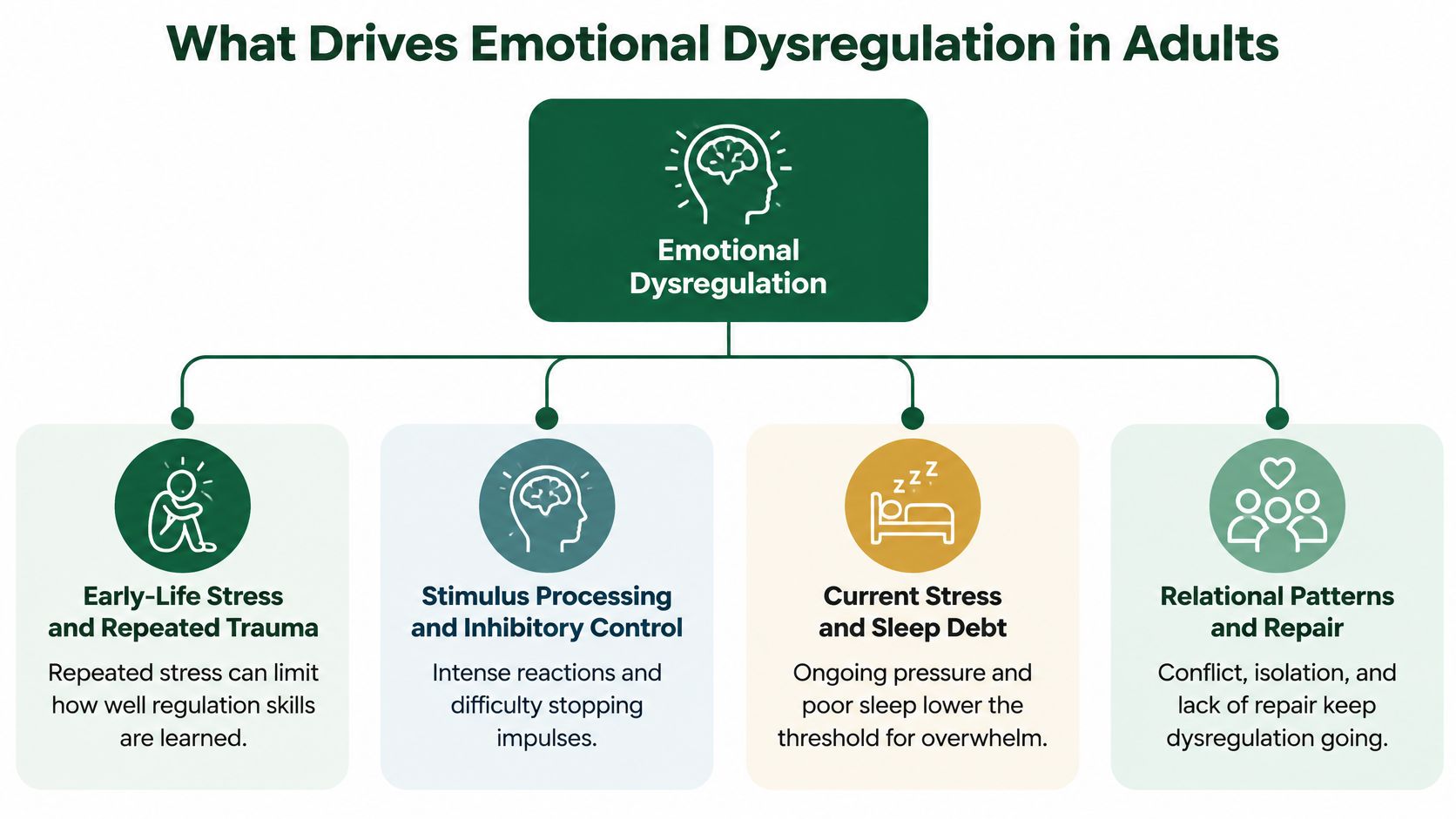
Developmental experiences, processing differences, current strain, and relationship patterns can interact rather than operate as isolated causes.
Separate Vulnerability From Overload
Baseline vulnerability includes longer-term influences such as developmental history, neurodivergence, and sustained stress. State-dependent overload describes what's happening now, such as illness, missed meals, poor sleep, or competing demands.
Useful areas to examine include:
Early-life stress and repeated trauma: These experiences can interfere with opportunities to learn and practice effective regulation skills.
Stimulus processing and inhibitory control: How someone interprets a cue and interrupts an impulse can affect how quickly a reaction becomes action.
Autonomic and hormonal activity: Bodily activation is part of emotion, not separate from it.
Current physical strain: Check sleep, hunger, illness, and workload before interpreting an episode solely as a psychological problem.
Include The Environment
Repeated conflict, sensory demands, or conversations that never reach repair can make it harder to regain your footing. Mapping mental health triggers can help distinguish a particular cue from the accumulated strain surrounding it.
An explanation can support compassion without removing responsibility for what happens next.
Trauma history may explain vulnerability, but it isn't proof of what caused a particular person's reaction. Look for patterns over time rather than assigning a single explanation to every episode.
Regulation Strategies Matched to Your Arousal Level
Choose a strategy you can use at your current level of activation. Reasoning through alternative interpretations may be manageable when you're unsettled but still thinking clearly. During intense escalation, a pause may be more realistic than a debate with your thoughts.
A systematic review of 619 studies found that clinical participants reported less acceptance (SMD −0.85), problem-solving (−0.63), and cognitive reappraisal (−0.63), alongside more avoidance (1.00), rumination (1.51), and expressive suppression (0.73) than controls. These standardized differences describe group comparisons, not percentages or proof that a particular exercise will work for everyone.
Regulation strategies by arousal level
Strategy | Best Arousal Level | How to Practise | What It Targets |
|---|---|---|---|
Naming the emotion | Low to moderate | Name the feeling in one or two words | Clarity and acceptance |
Acceptance practice | Low to moderate | Notice the feeling for two minutes without fixing it | Non-acceptance and avoidance |
Cognitive reappraisal | Moderate | Ask what else the situation could mean | Rigid interpretations |
Problem-solving | Moderate | Write one concrete next action | Helplessness and rumination |
Slow breathing with long exhale | High, before the peak | Breathe out for longer than breathing in for several minutes | Physiological escalation |
Physical pause | High | Step away from the trigger and reset for a few minutes | Impulsive reactions |
Scheduled worry window | After the episode | Set a fixed time to review concerns | Repetitive rumination |
Stating the feeling briefly | Any level | Say what you feel in one sentence, without justifying it | Expressive suppression |
When You Can Still Think Flexibly
Start with a simple label, such as disappointed or apprehensive. For the acceptance exercise, notice where you feel it without treating the sensation as a problem you must immediately eliminate. Acceptance means acknowledging what's present, not approving of unfair treatment.
Reappraisal asks whether your first interpretation is the only plausible one. A short email could reflect time pressure rather than contempt. Problem-solving then turns attention toward something actionable, such as asking which revision matters most.
When Activation Is Climbing
Try comfortable, unforced breathing with a slightly longer exhale. Don't force deep breaths, and stop if you feel dizzy or more distressed. A physical pause can include reducing noise and saying when you'll return, rather than abruptly abandoning the conversation.
The distress tolerance techniques guide provides additional coping options. For supplementary reading about body-focused practices, the Acheloa Wellness nervous system guide from Acheloa Wellness, Inc. is another resource, not a substitute for individualized assessment.
Afterward, Give Reflection A Boundary
Use a scheduled worry window to write down concerns, separate solvable problems from repeated speculation, and choose a next action. Briefly stating a feeling can also reduce the pressure to conceal everything, provided the setting is safe.
These exercises are practice suggestions, not guaranteed calming timelines. Rehearse them during ordinary moments so you're not learning every step during a crisis.
How to Recover After a Strong Emotional Episode
Recovery doesn't require a perfect explanation while you're still distressed. Begin by reducing immediate demands, then examine what happened when you're able to reflect without turning it into another round of self-criticism.
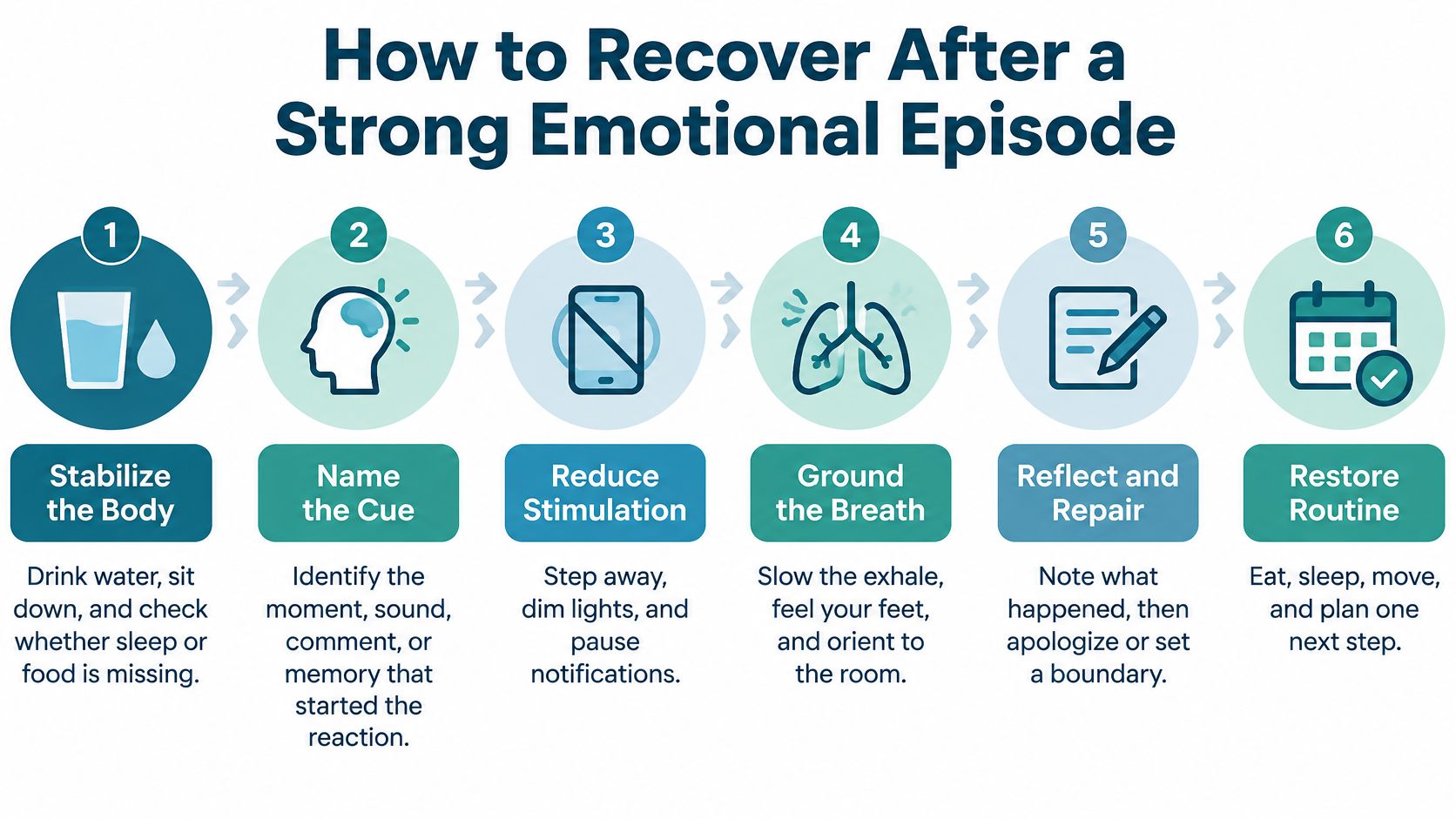
A recovery process can include bodily settling, reduced stimulation, reflection, repair, and a return to routine.
A Practical Recovery Routine
Stabilize the body. Drink water, sit somewhere safe, and check whether food or rest is missing. Lower noise or pause notifications if additional input feels difficult.
Name the cue. Identify the comment, sound, interruption, or memory that preceded the reaction. Describe what happened without deciding what it proves about you or someone else.
Map the sequence. Write cue, thought, action, and consequence on paper. This separates the event from your interpretation and shows where you might intervene.
Mark the escalation point. Notice when discomfort became overwhelming, perhaps when your voice changed or you stopped understanding what the other person was saying. That point gives you a more useful warning sign than regret afterward.
Choose a change. Try a different room, a scheduled break, or a pre-agreed pause phrase. Keep the adjustment concrete enough that you can recognize whether you used it.
Repair the impact. Acknowledge what you did and how it affected someone else, without adding a defense. Then identify what you'll do differently, while respecting that the other person may need space.
How This Looks In Ordinary Life
Say a remote worker snaps at their child after a call runs late. On paper, they identify the interrupted call as the cue and the second raised voice as the escalation point. They decide to build a five-minute buffer before school pickup and avoid scheduling calls right against that transition.
A couple might wait until the next morning, when both can engage, before sending a short repair message. One partner acknowledges that raising their voice made the conversation harder, then proposes a pause-and-return agreement for future disagreements. Repair doesn't require either person to pretend the original issue no longer matters.
Review the episode to find an intervention point, not to build a case against yourself.
As a manageable tracking exercise, record an episode each week for a month. Look for recurring cues, unmet needs, and situations where a small environmental adjustment could make the next response easier.
When ADHD and Trauma Shape the Pattern
A review of emotional dysregulation in adult ADHD summarizes estimates of clinically impairing dysregulation in approximately 34%–70% of adults with ADHD, with a later retrospective study finding an emotionally dysregulated subgroup comprising nearly 61% of 749 adults diagnosed with ADHD. Estimates differ by sample, definition, and measurement method.
Rapid escalation, irritability, low frustration tolerance, and difficult recovery can be important treatment targets. ADHD doesn't explain every episode, and emotional dysregulation alone isn't diagnostic. The ADHD and emotional regulation guide offers more context for recognizing this combination.
Match Adjustments To The Context
ADHD-related strain: Use earlier pauses, visible reminders, and clearer transitions rather than relying on remembering a strategy mid-conflict.
Trauma-linked activation: A reminder of past harm may make a present interaction feel more threatening. Develop a plan for recognizing reminders and accessing support without assuming every strong response comes from trauma.
Sensory or social overload: For autistic adults and people who identify as highly sensitive, consider quieter spaces, reduced input, and sensory breaks matched to their preferences.
Founders navigating work pressure alongside trauma may find Scott Dylan's trauma recovery insights for startup founders relevant as supplementary perspective, rather than diagnostic guidance.
Keep The Clinical Picture Broad
A 2024 BMC Psychology study of 80 adults with depression reported that 81.3% had difficulty achieving emotional clarity, 80.0% showed non-acceptance of emotional responses, and 78.8% had impulse-control difficulties. These findings concern that depression sample, not all adults experiencing distress.
A 2025 BMC Psychiatry latent-profile study of 349 clinically heterogeneous adults included 47.56% with borderline personality disorder and 50.43% with post-traumatic stress disorder, analyzing dysregulation profiles in relation to both conditions. Those are sample characteristics, not the likelihood that someone with dysregulation has either diagnosis.
Note when reactions happen, what your body feels, and whether the situation is familiar or new. That context helps a clinician investigate possibilities without jumping to labels.
Decide Whether to Get Professional Support
Consider professional support when the pattern persists for several weeks, damages work or relationships, or leaves you stuck despite consistent practice. If thoughts of harming yourself appear, seek immediate crisis support; if you might act on them or can't stay safe, contact local emergency services immediately rather than waiting for an appointment.
Professional and self-guided support options
Option | Best Fit | What to Expect |
|---|---|---|
Self-guided skills practice | Mild, short episodes | Daily strategies and a simple episode log |
Workbook or workshop | Structured, self-paced exercises | Guided exercises; workshops may include group learning |
Individual counseling, online or in person | Recurring patterns affecting work or relationships | Assessment, skill building and a personalized plan |
Group therapy | Practice with peers | Structured sessions on regulation skills |
Medical evaluation | Suspected ADHD, mood or sleep factor | Assessment that can include diagnosis or medication review |

You don't have to wait for a crisis to discuss recurring emotional difficulties.
Choose Support That Fits
Be Your Best Self & Thrive Counseling, PLLC is one option among several. We offer online and in-person counseling, workshops, group therapy, and workbooks for non-emergency concerns, working with motivated people who are ready for change and need support. We follow the American Counseling Association Code of Ethics.
Use these therapy fit considerations to discuss assessment, treatment planning, and what sessions involve with your chosen provider. Start a two-week log recording the date, cue, body feeling, reaction, and recovery time, and bring it to your first session.
Be Your Best Self & Thrive Counseling, PLLC offers individual and couples counseling with practical skill building and a mind-body-spirit approach to recurring emotional difficulties. Visit Be Your Best Self & Thrive Counseling, PLLC to explore support and request a free initial consultation about your goals and fit.