
Emotional Disconnection in Marriage: 7 Causes and Fixes
You finish cleaning up the kitchen together, confirm who is handling the morning carpool, and head to bed at the same time. Nothing blew up today. Nobody slammed a door or raised a voice. Yet as you lie beside your spouse staring at the ceiling, you feel completely alone.
That quiet ache is one of the most confusing parts of emotional disconnection in marriage. When a relationship falls apart through loud arguments or an obvious betrayal, the problem has a clear name. When a marriage looks stable from the outside and runs smoothly on logistics, partners often blame themselves for feeling empty. Daily isolation is widespread even across the general population: an August-September 2024 Gallup survey of 6,289 U.S. adults found that roughly one in five respondents experienced daily loneliness. Feeling that same isolation next to the person you married hurts in a sharper, quieter way.
Most standard marriage advice treats this distance like a simple communication flaw. It tells you to schedule date nights, polish your listening skills, or practice "I-statements." Those tools help with surface friction, but they miss a deeper truth: emotional disconnection often operates as emotional neglect inside an intact marriage, or as a mismatch in how two nervous systems and brains signal care. Rebuilding closeness takes observable markers, a clear look at what drives the distance, and small repeatable habits that restore safety.
What Emotional Disconnection Looks Like In A Marriage
Emotional disconnection is a pattern of emotional absence that can exist inside a legal, stable marriage, even when there is very little overt fighting. You still split bills, coordinate calendars, share a home, and attend family events together. Behind those working routines, though, you stop expecting your partner to notice how your day really felt. Affection starts to feel transactional or automatic, and hard feelings get swallowed because bringing them up feels pointless.
Consider an ordinary Tuesday evening. One partner mentions a tense meeting with a supervisor, hoping for a minute of warmth or curiosity. The other partner keeps scrolling on a phone, offers a quick piece of problem-solving advice, and asks whether the utility bill was paid. No argument starts, so the night looks peaceful, yet the partner who spoke pulls back a little further. Over months, those tiny misses stack into a wall of polite silence.
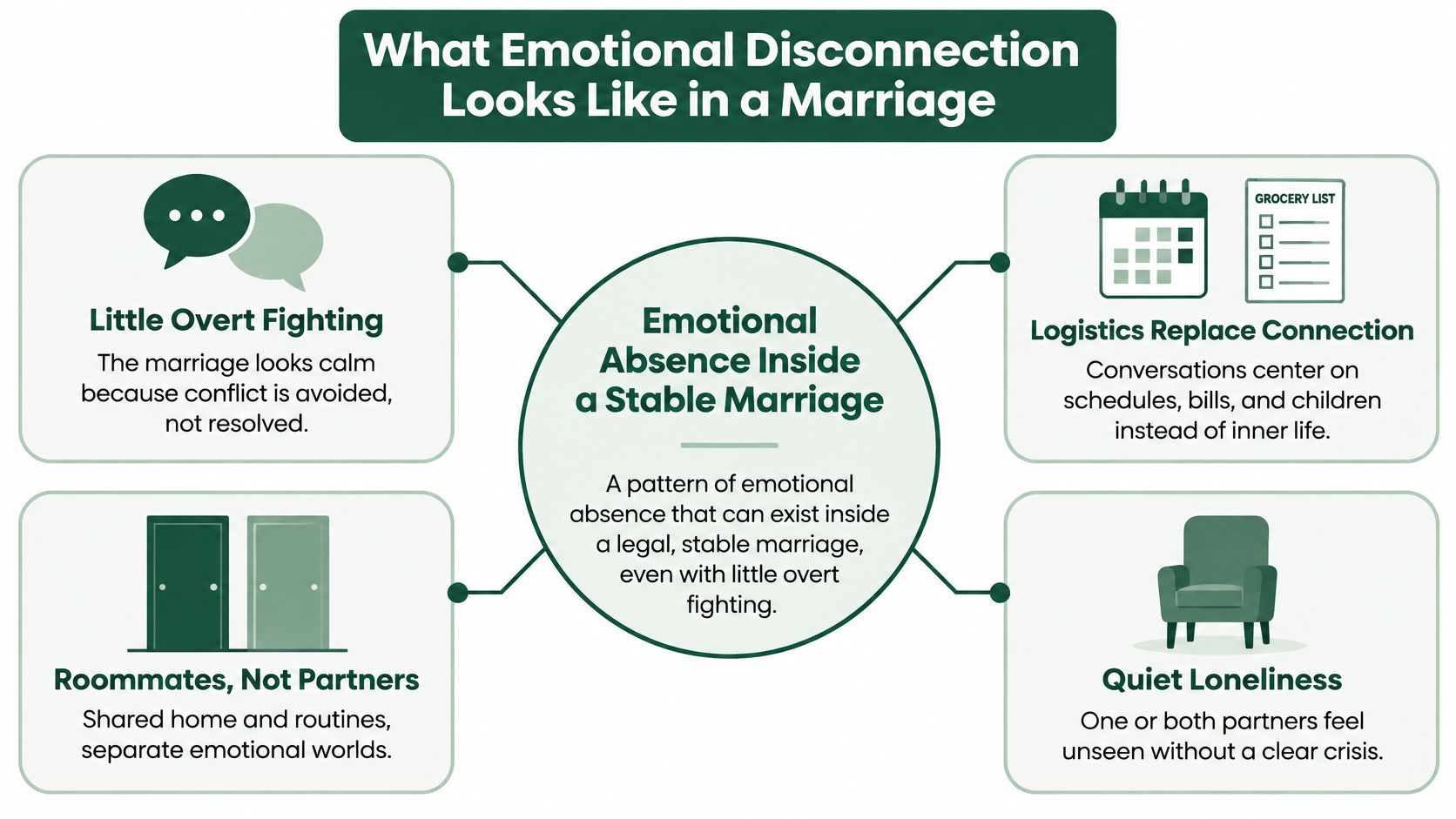
Emotional disconnection is often quiet: logistics replace curiosity, and bids for attention go unanswered.
Feeling lonely inside a committed marriage is far more common than most couples realize. A Longitudinal Aging Study Amsterdam analysis using 2001-2002 data examined 755 married adults ages 64 to 92 and found that between 1 in 4 and 1 in 5 participants reported moderate or strong emotional or social loneliness. Greater loneliness in that group was tied to receiving little emotional support from a spouse, having infrequent conversations, experiencing disagreement, and reporting an unsatisfying or inapplicable sex life. Staying married does not automatically protect against loneliness, and noticing distance isn't proof that love never existed.
Why Talking More Isn't Always The Cure
Many couples get stuck because they assume emotional closeness equals conversation volume. You might text ten times a day about groceries, school forms, and home repairs while still feeling invisible. Findings from a 2026 qualitative study on emotional neglect describe emotional neglect as a relational process marked by emotional absence, disengaged listening, suppressed expression, weakened emotional safety, and a loss of communicative trust. Adding more minutes of talk won't rebuild a bond if those conversations lack validation, responsiveness, and psychological safety.
Key distinction: High conflict and quiet distance require different repairs. Lowering the volume on arguments helps volatile couples, whereas disconnected couples need to rebuild responsiveness, curiosity, and shared meaning.
Recognizing whether you're dealing with ordinary stress, unresolved hurt, or deeper intimacy issues in relationships starts with looking at observable behaviors rather than guessing at your spouse's motives.
Warning Signs Of Emotional Disconnection And What To Track
Sign | What It Looks Like in Daily Life | What to Track This Week | What It Does Not Prove |
|---|---|---|---|
Logistics-only talk | Conversations cover schedules, bills, children, and chores but not inner life | Count days without a non-logistics conversation | That either partner has stopped loving the other |
Missed bids for connection | A comment about a hard day gets no response, or the response is advice instead of acknowledgment | Note one bid, who made it, and whether the other turned toward it | That the bidder is too needy or the responder is cruel |
No repair after small ruptures | A sharp comment hangs in the air for days; neither partner mentions it | Record the rupture, time to repair, and who initiated | That the couple never disagrees or that conflict is always bad |
Separate routines with no shared anticipation | Evenings split by screens, hobbies, or work; no plan is made together | List shared moments that were planned versus defaulted into | That separate time is unhealthy or that introversion is a problem |
Affection gap | Touch, compliments, and curiosity drop while politeness remains | Track affectionate initiations and how they are received | That low desire is permanent or that one partner owes sex |
Loneliness in company | One partner feels alone while sitting beside the other, especially after a hard day | Rate loneliness from 1 to 10 on three evenings and note what happened before | That marriage itself guarantees closeness or that loneliness is always the spouse's fault |
Defensiveness around needs | "I need more from you" is met with "You're too sensitive" or a list of counter-complaints | Note the request, the defense, and whether anyone returned to the need | That the need is unreasonable or that the relationship is over |
Tracking Patterns Without Keeping Score
Instead of trying to diagnose your whole marriage in one late-night talk, spend seven days observing four concrete moments. Each day, jot down one bid for connection, how the other partner responded, one attempt at repair after friction, and one moment of shared meaning. Keep the notes short and factual, like "Mentioned headache at 6:30, got a quick nod from behind laptop."
Resist the urge to use this log as courtroom evidence. Scorekeeping puts your spouse on trial and guarantees defensiveness, whereas pattern recognition helps both of you see where the loop breaks down. Once you can see the daily markers clearly, you're ready to identify what is driving the distance.
The Seven Causes That Turn Partners Into Roommates
Emotional distance often grows through a repeating interaction cycle: one partner reaches for reassurance, the other feels pressured and retreats, and both become more guarded. Naming the cycle makes change more concrete than deciding who cares less. Still, a shared pattern does not mean equal responsibility for every hurt. Emotional neglect can persist inside an intact marriage when needs are repeatedly dismissed, even while daily responsibilities get done.
One well-studied loop is the demand-withdraw pattern. A meta-analysis of 74 studies involving 14,255 participants found a moderate overall association (r = .360) between demand-withdraw behavior and poorer individual, relational, and communication outcomes. The association does not establish what causes any particular couple's distance. It does help explain why pushing harder and retreating further can leave both partners feeling unheard.
Seven Causes Of Emotional Disconnection And The First Repair Focus
Cause | How It Shows Up | What Keeps It Going | First Repair Focus |
|---|---|---|---|
Demand-withdraw cycle | One partner presses for a response; the other goes quiet, avoids, or leaves | Pursuit increases pressure; withdrawal increases fear of being ignored | Agree on a pause with a specific return time, then make one concrete request |
Emotional neglect | Needs are dismissed, minimized, or met with silence; sharing gradually stops | “We're fine” closes discussion, leaving unmet needs unaddressed | Name one unmet need and a specific response to practice this week |
Conflict avoidance | Money, sex, family, or hurt feelings stay off-limits | Immediate relief from avoiding keeps difficult subjects untouched | Schedule one avoided topic and prepare a clear opening sentence |
Life transitions and overload | A new baby, caregiving, job loss, or relocation crowds out affection | Logistics consume available energy; connection waits for life to settle | Protect a 10-minute daily check-in and something to anticipate together each month |
Depression or burnout | Exhaustion, irritability, flat expression, or low initiation feels like rejection | Reduced capacity limits contact; shame makes asking for help harder | Address the health concern, reduce nonessential demands, and agree on manageable contact |
Neurodivergent differences | Sensory overload, difficulty naming emotions, or attention differences resemble withdrawal | Expectations about how caring should look lead to misread cues and exhausting masking | Agree on explicit requests, sensory decompression, written messages, or parallel play |
Unresolved hurt or betrayal | Politeness continues alongside secrecy, defensiveness, or watchfulness | Everyday conversation avoids the hurt that still needs repair | Seek clear disclosure and structured help, with consistent, verifiable follow-through |
These causes can overlap. Overload may reduce someone's capacity to talk, while an established demand-withdraw cycle makes every attempt feel pressured. Unresolved hurt may sit underneath apparent conflict avoidance. Use the table as a cause-to-repair map: choose the closest match, try its first repair focus, and notice whether both partners can participate.
The response matters as much as the explanation.
Separating Intentional Neglect From Neurological Difference
Silence alone cannot tell you why someone has withdrawn. With conflict avoidance, silence may protect a fragile peace around money or intimacy. With overload, caregiving and practical demands may leave little energy for conversation. With depression or burnout, reduced initiation may reflect depleted capacity rather than rejection.
When withdrawal repeatedly follows closeness, avoidant attachment in relationships may offer a useful lens. Attachment history is only part of the picture. Neurodivergent processing differences can also change how a person expresses care, handles stimulation, or responds under pressure.
Sensory overload: Bright lights, noise, and social masking can leave a partner needing quiet before conversation. Agreeing on decompression and a return time makes that need clearer.
Alexithymia: Difficulty identifying and naming emotions can make an immediate answer hard. A written response or time to find words may make participation more manageable.
ADHD emotional regulation: Overwhelm or distraction can interrupt connection. An explicit request helps clarify what response is wanted instead of leaving both partners to infer it.
Accommodations work like a shared translation key: they help care become recognizable without requiring identical communication styles. Parallel play, for example, means spending time alongside each other in separate activities. Agree together whether that feels connecting; proximity alone may not meet both partners' needs.
To repair communication and rebuild boundaries, start with a request that names both capacity and connection: “If talking feels overwhelming, can we write, or agree on when to return?”
Neurological difference does not establish deliberate neglect, and an explanation does not erase an unmet need. Look at willingness to acknowledge the impact, discuss accommodations, and follow through. Choose the table row that best explains what happened this week, then ask for a response both partners can recognize and realistically sustain.
How Emotional Distance Changes The Marriage And Both Partners
Long periods of emotional absence don't stay neatly contained inside evening silence. Over time, living side by side without emotional responsiveness wears down relationship satisfaction, makes sexual intimacy feel performative or unsafe, and shifts conflict so it either turns colder or erupts faster. Both spouses end up lonely inside the same house, waiting for the other person to bridge the gap first.
Long-term marital data confirms that quiet erosion carries real risk. In a 14-year longitudinal study of married couples, 26.6% of the sample had divorced by 1996. Researchers identified two distinct interaction patterns tied to later divorce: a volatile attack-defend pattern filled with intense negativity, and an emotionally inexpressive pattern marked by low levels of both positive and negative emotion. Increasing distance and isolation, including the decay of the marital friendship, was the most common reason participants gave for ending their marriage.
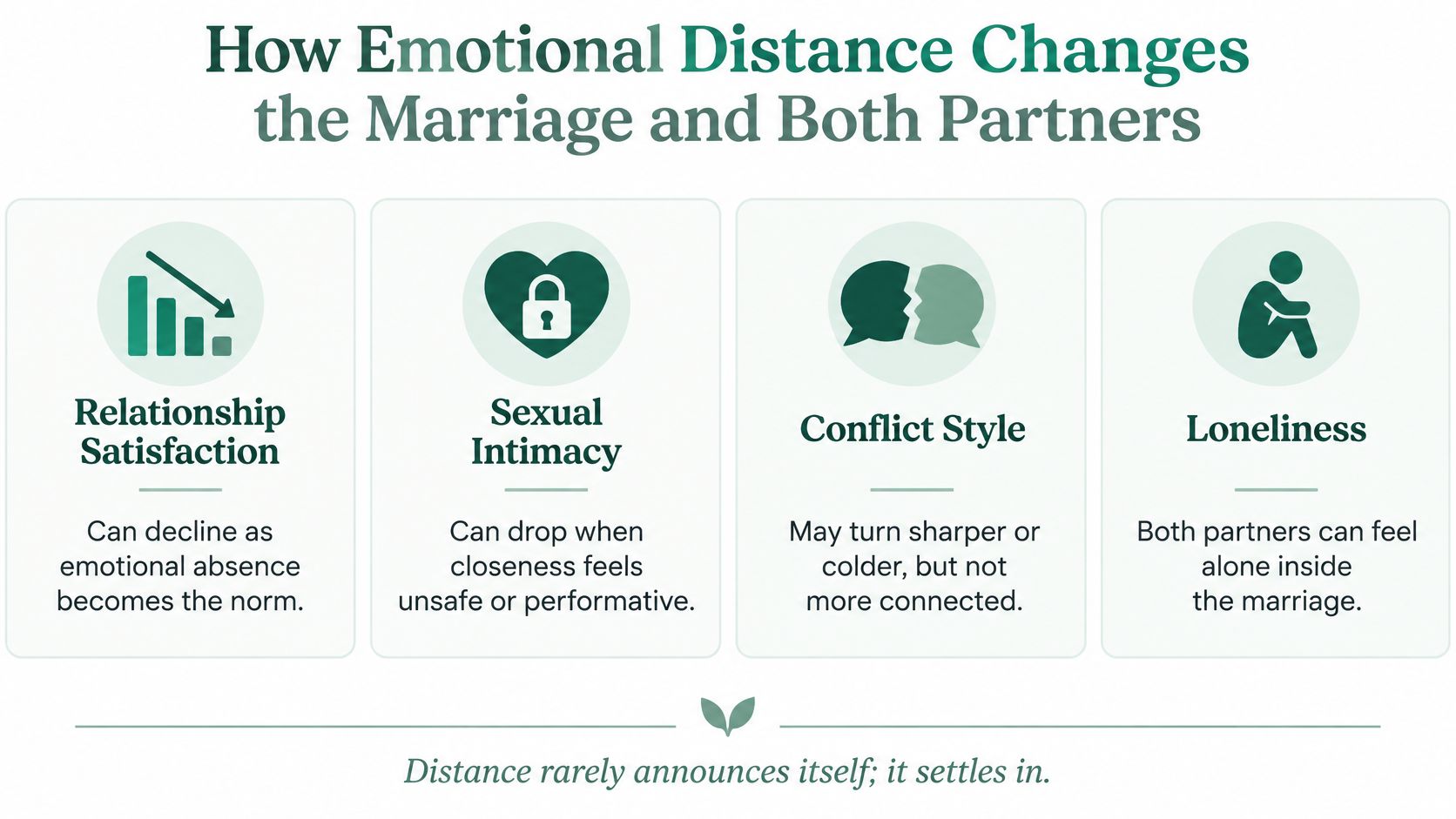
Distance erodes friendship before it announces itself as a crisis.
In everyday life, that decay shows up in quiet losses. Inside jokes vanish. You stop tackling stressful weeks as teammates and start running parallel lives where each person manages their own corner. When a normal stressor hits, like a car repair or a tough stretch at work, there's no warm buffer left to absorb the shock, so minor frustrations trigger disproportionate hurt.
How Relational Distance Registers In The Body And Home
Emotional disconnection isn't purely mental; it shows up in how partners regulate stress together. Findings from dynamic-systems couple research showed that a physiological pattern labeled "simple-disengaged" occurred more often and was linked to lower self-reported relationship quality, particularly during neutral conversations. Related couple findings cited in the same review noted that partners who typically used demand-withdraw or mutual-avoidance patterns had higher baseline interleukin-6 (an inflammatory marker), slower experimental wound healing, more negative emotion, less positive emotion, and poorer evaluations of their marital discussions. While immune findings don't prove that disconnection alone causes illness, repeated avoidance keeps relational threat active and robs couples of the calming effect of successful repair.
That low-grade stress ripples through the whole household:
Sleep and energy: Lying awake replaying unspoken resentments erodes rest, patience, and daily mood for both partners.
Children's awareness: Kids don't need loud shouting matches to sense disconnection; they read stiff posture, clipped politeness, and heavy silence across the dinner table.
Old wounds resurfacing: Chronic emotional absence can reactivate past relational pain, making it important to understand how trauma affects relationships when silence starts to feel threatening.
What Distance Is Not
Naming these effects isn't meant to frighten you or hand down a verdict on your marriage. It also helps to draw two sharp boundaries. First, ordinary introversion is not emotional disconnection: a quiet partner who needs solo recharge time yet still turns toward you, shares warmth, and repairs after conflict isn't neglecting the marriage. Second, emotional distance is distinct from abuse. If one partner uses silence as punishment alongside intimidation, coercion, or control, the issue is safety rather than simple drift.
Seeing the cost of emotional distance early is an advantage, not a sentence. Most marriages have far more room to heal before numbness hardens into years of resignation.
How To Rebuild Connection One Repeatable Move At A Time
Waiting for a weekend getaway or one sweeping late-night talk to erase months of distance almost always backfires. Too much pressure lands on a single conversation, old defenses flare up, and both partners walk away convinced nothing will work. Real closeness returns through small, predictable behaviors that teach both partners it's safe to reach out again.
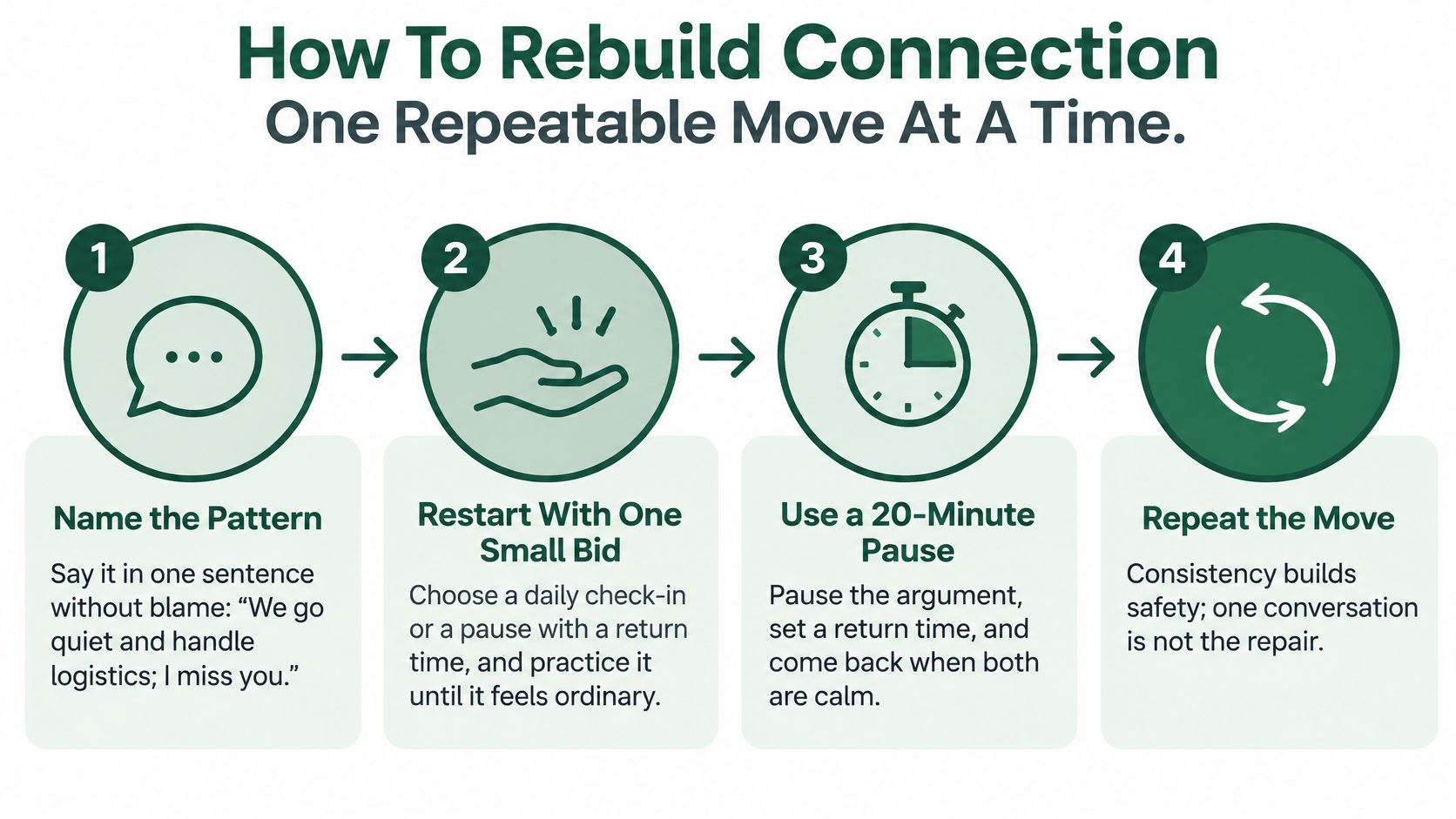
Connection grows through small, repeatable responses, not one grand conversation.
Seven Moves You Can Practice This Week
Name the pattern in one blame-free sentence. Skip the long list of past grievances and describe the loop you're both stuck in. Try saying, "We go quiet and handle logistics; I miss you." Leading with longing instead of accusation lowers your partner's guard right away.
Restart bids with a 10-minute daily check-in. Pick a consistent window, such as right after the kids go to bed or over morning coffee, with phones in another room and zero logistics allowed. No talk about bills, schedules, or chores during those 10 minutes.
Anchor the check-in with three simple prompts. Ask: What was hard today? What did you appreciate? What do you need tomorrow? Having a set script removes the awkwardness when you're out of practice sharing your inner world.
Turn toward one small bid within 60 seconds. When your spouse sighs, mentions a frustration, or shows you something on their screen, respond within a minute. Even if you're busy, a brief response like "I hear that, give me 10 minutes to finish this email and I'm all yours" protects the bond far better than silence.
Hold a weekly 30-minute repair meeting. Sit down at a calm time each week to share three specific items: one moment that felt distant, one concrete thing you appreciated, and one clear request for the coming week. Keep requests behavioral ("Sit with me for 10 minutes after dinner") rather than vague ("Be more loving").
Build a pause for demand-withdraw patterns. Agree in advance on a plain signal for feeling flooded, take a 20-minute break, and state an exact return time before walking away. Here is the rule that makes or breaks this tool: the withdrawing partner must come back at the agreed time. Without a kept return time, a pause functions as abandonment and deepens the very fear that drives pursuit.
Measure four behavioral metrics instead of argument counts. Track bids made, bids turned toward, repairs completed, and days without a logistics-only conversation. Progress doesn't mean "we argued less," because disconnected couples can easily keep things quiet by giving up. True progress looks like faster repair and more reliable responsiveness.
Weekly Connection Practices And What To Track
Practice | Minimum Time | Exact Action or Script | What to Track |
|---|---|---|---|
Daily no-logistics check-in | 10 minutes | "What was hard today? What did you appreciate? What do you need tomorrow?" | Days completed and whether both partners spoke |
Turn toward one bid | 60 seconds | "I hear that. Tell me one more thing." Or "I need 10 minutes, then I'm back." | Bids noticed and bids turned toward |
Weekly repair meeting | 30 minutes | "One thing felt distant, one thing I appreciated, one request for next week." | Repairs completed and requests repeated or resolved |
Demand-withdraw pause | 20 minutes | "I'm flooded. I'm pausing until 7:30. I will come back and finish this." | Return time kept and conversation finished |
Shared anticipation | 1 hour per month | Plan one walk, meal, class, or outing that is not logistics or a family obligation | Plans made, kept, and enjoyed |
Appreciation practice | 2 minutes daily | Name one specific behavior: "I noticed you handled the school call." | Specific appreciations given and received |
Don't try to launch all six rows on Monday morning. Pick two practices that fit your current energy, such as the daily check-in and the appreciation habit, and run them steadily for two weeks. As those small responses become ordinary, you'll build a sturdy foundation for deeper ways to build emotional intimacy that lasts through busy seasons.
What Repair Looks Like For Three Couples
Concrete habits make more sense when you can picture how they play out in real living rooms. Consider three composite scenarios that mirror the most common ways couples drift apart and find their way back.

Connection can look like parallel play, written notes, or a quiet walk, not only eye contact and long talks.
Scenario One Breaking A Demand-Withdraw Loop
Say a married couple gets stuck in the same Friday night argument. She feels shut out and opens with criticism ("You never listen to me anymore"). He feels overwhelmed, goes blank, and walks out to the garage without saying when he'll return.
To interrupt the cycle, they agree on a 20-minute pause with a firm return rule. When his chest tightens, he says, "I'm flooded, I'm pausing until 8:15, and I'll come back." While he cools down, she shifts her criticism into one clear request: "I feel lonely when we don't talk all week; can we sit on the porch for 15 minutes without phones?" They track kept return times and completed repairs for six weeks, and the panic that used to fuel both sides steadily drops.
Scenario Two Waking Up An Emotionally Inexpressive Marriage
Now picture a couple two years after a new baby and a demanding job change. They never fight, and from the outside they look like a smooth team, yet affection and humor have vanished under a mountain of errands.
Instead of waiting for their schedules to magically open up, they protect a 10-minute daily check-in right after bedtime using the three prompts. They add a 20-minute Sunday morning walk with no chore talk and put one shared anticipation on the calendar each month, starting with a Saturday lunch at a neighborhood spot they both enjoy. Within a month, they're laughing again because curiosity has a regular place on the calendar.
Scenario Three Building Neurodiversity-Affirming Connection
Consider a third couple where one partner is autistic and the other has ADHD. Every weekday at 5:30 p.m., the autistic partner hits sensory overload after hours of masking at work and struggles with alexithymia when asked "How are you feeling?" The ADHD partner, who thrives on immediate verbal processing and craves reassurance, reads that shutdown as cold rejection.
Standard marriage advice often harms couples like this by treating eye contact, spontaneous banter, and instant verbal answers as the only valid signs of love. Research backs up the need for a broader lens: a 2026 study on neuro-affirming provider training warns that traditional couple-therapy techniques applied without a neurodiversity-affirming lens may be ineffective or harmful, while a 2025 content analysis noted in the same research highlighted how sensory sensitivities, stigma, and communication barriers shape autistic romantic relationships. Emerging qualitative work with neurodivergent couples points to practical alternatives that work far better than forcing neurotypical norms:
Scheduled decompression: A 30-minute quiet buffer after work with zero expectation of small talk, paired with a clear signal when both partners are ready to connect.
Texting or shared codes: Sending a short message when spoken words feel impossible ("Low battery, not mad at you, love you").
Parallel play and explicit appreciation: Sitting side by side doing separate hobbies while touching feet, plus naming care directly instead of expecting a spouse to guess hints.
Working with a neurodiversity-affirming therapist helps this couple stop pathologizing neurological differences and focus on what builds safety: reliable responsiveness, agreed accommodations, and honest repair. Which of these three scenarios looks most like your past week, and what is one small move from it you could try before Sunday?
When Couples Counseling May Help And What To Do Next
Self-guided habits work well when both partners still have enough safety and goodwill to practice together. Sometimes the distance has dug too deep a groove to shift on your own. Your seven-day tracking notes give you honest data on whether home practices are gaining traction.
Rising numbers of bids turned toward, faster repairs after minor friction, and pauses that reliably end at the agreed return time all point toward repairability. By contrast, pauses that drag on without a return, repeated withholding when a partner asks for closeness, or four to six weeks of consistent practice with zero movement signal that outside structure is worth bringing in.
When Couples Counseling Is Worth Considering
Situation | First Step |
|---|---|
Abuse, coercion, or fear is present | Individual safety planning comes before any couples work |
Distance persists after four to six weeks of daily and weekly practices | Book a couples counseling consultation |
Contempt, stonewalling, defensiveness, or criticism dominate | Start couples counseling focused on the cycle |
Betrayal or an affair | Start couples counseling with a trust-repair structure |
Depression, anxiety, burnout, or substance use shapes withdrawal | Address the health issue, then add couples work |
Neurodivergent accommodations keep stalling | Seek a neurodiversity-affirming couples provider |
One partner keeps asking while the other keeps leaving | Counseling to structure the pause and return time |
Safety always comes first. If fear, intimidation, or coercion is part of your marriage, individual support and safety planning must happen before sitting in a room together for couples sessions. Couples work requires two people who feel free enough to speak openly, and that freedom cannot exist under threat.
What Effective Counseling Looks Like
Good couples counseling doesn't hand out generic communication scripts and call it a day. It assesses your interaction cycle directly, names emotional neglect without shaming either spouse, restructures demand-withdraw loops, and tracks measurable progress like turning toward bids and completing repairs. If you're weighing whether structured help pays off, reading about whether couples counseling is effective can clarify what to expect before you book.
Before committing to a therapist, ask how they track progress beyond "we argued less," and whether they have specific training for your cycle or neurodivergent communication needs.
That quote matters because quieter arguments can hide the same disconnection. Two partners can stop fighting entirely and still feel like roommates. A skilled therapist measures warmth returning, not just conflict shrinking.
At Be Your Best Self & Thrive Counseling in St. Petersburg, we see both individuals and couples, combining evidence-informed methods like Gottman Therapy with mind-body-spirit care. Our team includes clinicians specializing in high-conflict couples, trauma, burnout, and neurodivergence, so partners don't have to squeeze into a one-size-fits-all mold. We offer a free initial consultation to explore fit and set clear goals together; for ongoing couples sessions with Jamie Molnar, a 50-minute session is $155 and a 90-minute session is $225. Reaching out before quiet distance hardens into permanent resentment gives both of you the best chance to rebuild a marriage that feels warm and alive again.
If you and your spouse are tired of coexisting on logistics and want structured, blame-free support to rebuild real closeness, Be Your Best Self & Thrive Counseling, PLLC offers individual and couples counseling in St. Petersburg focused on emotional reconnection, high-conflict cycles, trauma recovery, and neurodivergent partnerships. Schedule a free initial consultation to discuss your goals and find the right therapist fit by visiting Be Your Best Self & Thrive Counseling, PLLC.