
Intimacy Issues in Relationships: Causes, Signs, and Repair
After dinner, one partner scrolls through a phone at one end of the couch while the other answers a message at the other. They're not fighting. They're polite, practical, and tired. Yet the conversation stays on errands, schedules, and bills, while eye contact, affection, and the easy warmth they once shared feel increasingly out of reach.
Many couples notice the drift before they can explain it. Sex becomes absent, predictable, or obligatory. A hand on the shoulder feels surprisingly difficult to receive. Small disagreements repeat because the true subject remains untouched. Intimacy issues in relationships often begin as quiet disconnection, not dramatic conflict, and recognizing that pattern without shame is a meaningful first step.
When Closeness Starts to Feel Out of Reach
A couple may still function well on paper. They get the children where they need to go, manage work, pay bills, and make decisions. But when the house grows quiet, they discover they have little to say that feels personal. One partner reaches for touch and gets a distracted response. The other feels pressure before the touch even happens. Both begin protecting themselves from rejection.
That protection can look ordinary. Someone stays late at work, keeps a television show running in the background, or checks a phone during every pause. Someone else raises a small complaint because anger feels safer than saying, “I miss you.” Over time, the relationship can become an efficient household with two lonely people inside it.
A useful starting point: Notice the distance without assigning a villain.
The question isn't, “Which partner caused the intimacy problem?” A more productive question is, “What happens between us when one of us reaches and the other pulls back?” That shift turns blame into observation. It also makes room for the fact that both partners may be hurting, even when their coping strategies look opposite.
One partner may pursue conversation, reassurance, or sex to feel secure. The other may withdraw because closeness feels demanding, unsafe, or overwhelming. Neither response automatically reveals a lack of love. Both may represent an attempt to manage fear, exhaustion, shame, or disappointment.
You don't need to solve the entire relationship in one evening. Start by naming two observable changes, such as “We rarely talk after dinner” or “Touch has started to feel tense.” Specific language reduces defensiveness and gives the couple something real to work with.
What Intimacy Really Means in a Relationship
Intimacy is the experience of being known, received, and emotionally present with another person. Sex can be part of it, but it isn't the whole structure. A relationship can have physical contact without vulnerability, or emotional affection without sexual desire.
Think of intimacy as a house with several connected rooms:
Emotional intimacy means sharing inner experiences, fears, hopes, disappointments, and needs without expecting ridicule or dismissal.
Physical intimacy includes nonsexual touch, cuddling, holding hands, sitting close, and feeling comfortable in one another's bodily presence.
Sexual intimacy includes desire, erotic connection, consent, pleasure, curiosity, and the ability to discuss what feels welcome or unwelcome.
Relational safety is the broader sense that conflict won't automatically lead to punishment, abandonment, coercion, humiliation, or emotional disappearance.
These dimensions influence one another, but they don't move in lockstep. A couple may have frequent sex while avoiding emotionally honest conversations. Another couple may feel strongly bonded while medical concerns, pain, medication effects, stress, or desire differences make sexual connection difficult. “Just have more sex” fails when the actual problem is fear, resentment, fatigue, or a body that doesn't feel safe enough to soften.
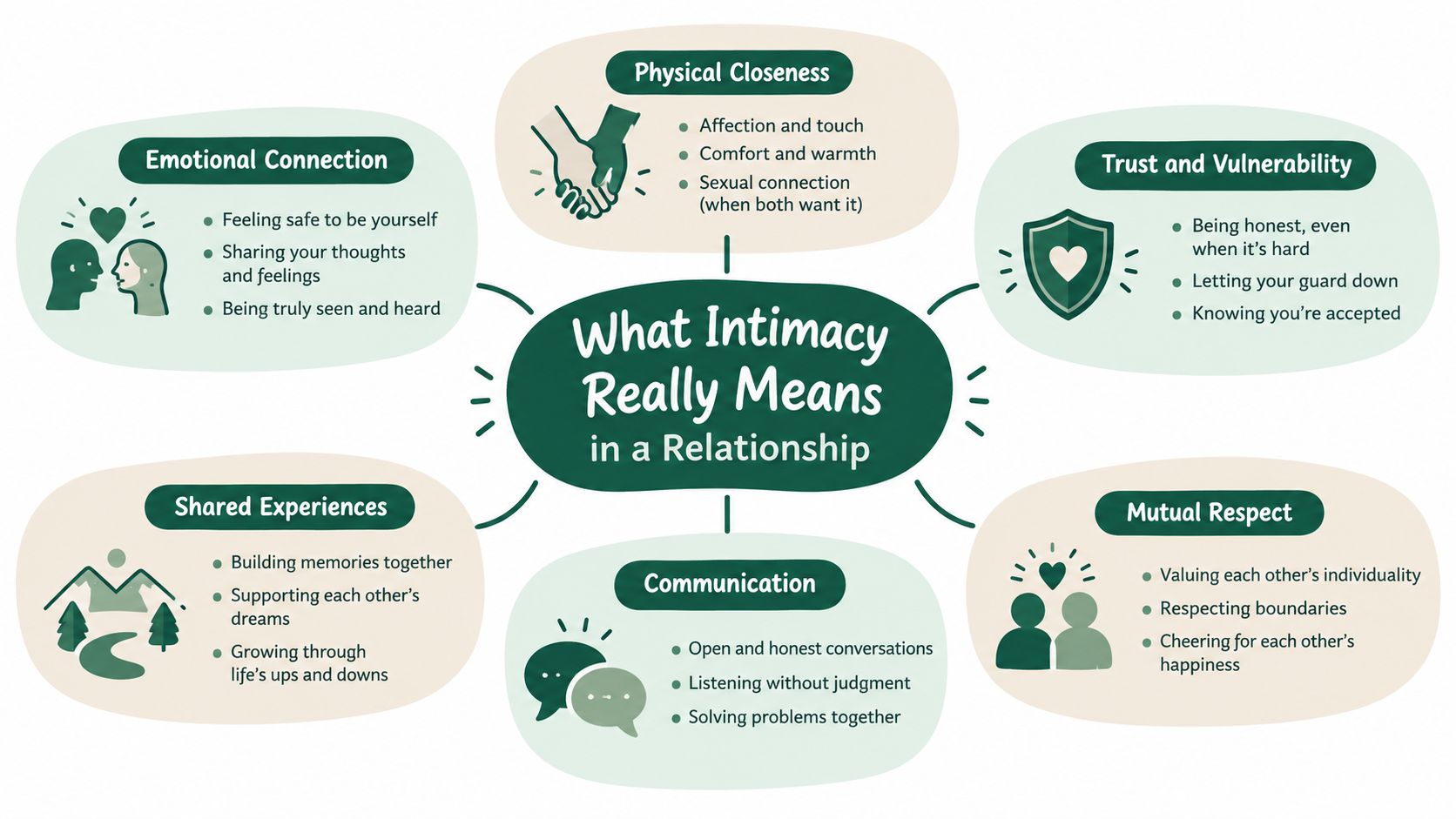
Caption: A mind map showing how emotional connection, communication, trust, and other dimensions contribute to relationship intimacy.
Before trying to repair closeness, identify which room needs attention. Ask each partner separately:
What kind of closeness do I miss most?
What kind of closeness currently feels difficult?
What would help my body and mind feel more at ease?
What small gesture would feel meaningful this week?
This exercise prevents a common mistake. One partner may ask for more sex when what they need is reassurance, while the other may ask for less pressure when what they need is rest and emotional safety. Naming the underlying need creates more useful choices.
Captions also make visual content more understandable for readers, while synchronized captions for audiovisual material can support people using assistive technology, as explained in the W3C caption guidance. When an image's surrounding caption already describes its meaning, Arizona State University's accessibility guidance recommends leaving redundant ALT text empty for that implementation context.
The Real Causes Behind Intimacy Problems
Intimacy rarely declines because of one isolated cause. A qualitative analysis identified five interacting clusters, individual, partner, relational, life-course, and sociocultural factors, that can combine to reduce closeness and sexual relationship quality (qualitative analysis of declining sexual intimacy).
Cluster | What It Covers | Everyday Example |
|---|---|---|
Individual | Anxiety, depression, shame, low self-worth, trauma, health, and body concerns | A partner wants connection but becomes tense or self-conscious during touch |
Partner | Different needs, desire patterns, health conditions, communication styles, and attachment responses | One person seeks frequent affection while the other needs more transition time |
Relational | Broken trust, unresolved resentment, criticism, defensiveness, and weak repair | A disagreement about sex becomes evidence that neither person feels valued |
Life-course | Parenthood, career strain, illness, aging, relocation, grief, and major transitions | A new parenting routine leaves little energy for private connection |
Sociocultural | Culture, religion, identity, gender expectations, family history, and social messages | Partners carry different beliefs about who should initiate, disclose, or compromise |
Current couple data also illustrates how ordinary life pressures enter the bedroom. A 2026 survey reported that 55% of couples identified different energy levels or conflicting sleep schedules as major intimacy obstacles, while 52% pointed to stress and mental health concerns (Paired's survey of American couples). The same survey reported that 59% describe themselves as mismatched in sexual desire, and 17% aren't at all satisfied with their current level of sexual intimacy.
Parenthood can alter the relationship's rhythm, identity, privacy, and energy. A reported 45.2% experienced a significant decline in sexual intimacy after becoming parents, from the same survey. That doesn't mean parenthood causes permanent disconnection. It means couples often need deliberate renegotiation rather than assuming their old patterns will return automatically.
A partner who withdraws may be responding to overload, not indifference. A partner who pursues may be asking for reassurance, not trying to control. Resources such as holistic healing with Lake City PT can also help readers consider how bodily experience and sexual concerns fit within wider wellbeing. For couples who recognize a distancing pattern, this discussion of avoidant attachment in relationships may offer useful language, but a label shouldn't replace careful assessment.
Signs That Intimacy Is Slipping
Intimacy problems become easier to address when partners describe patterns instead of character judgments. “You don't care about me” invites an argument about intent. “We haven't shared anything personal all week” identifies an experience that both people can examine.
Look for combinations of these signs:
Emotional checking out: Conversations stay logistical, and one or both partners stop volunteering inner thoughts.
Polite disconnection: The household runs smoothly, but warmth, curiosity, playfulness, and spontaneous affection have faded.
Vulnerability avoidance: A partner changes the subject, jokes, becomes analytical, or leaves the room when feelings arise.
Touch becoming loaded: A hug is interpreted as a request for sex, or ordinary touch triggers pressure, fear, or resentment.
Recurring micro-conflicts: Arguments about dishes, timing, spending, or phones repeat because the underlying need remains unspoken.
Unequal emotional labor: One partner initiates every check-in, apology, date, or repair attempt and eventually stops trying.
Escape through screens or busyness: Devices, work, errands, or constant entertainment create distance from uncomfortable presence.
These signs don't prove that a relationship is failing. They show where the connection system is under strain. A couple can use them as shared data by asking, “Which pattern do we both recognize, and what usually happens immediately before it?”
“We are on opposite sides of the same cycle” is often more useful than “You are the problem.”
Choose a calm time, not the middle of a rejected sexual advance or an active argument. Each person can complete three sentences: “I notice...,” “I feel...,” and “A small change that would help is....” Keep the first conversation short enough that both partners can remain present.
For more language around recurring disconnection, the guide to marriage communication problems can help couples distinguish a communication habit from the deeper attachment or safety concern underneath it. If either partner feels afraid, coerced, or unsafe, prioritize safety and individual support rather than treating the issue as a simple communication exercise.
Evidence-Informed Strategies to Rebuild Closeness
Repair works better as repeated practice than as one emotionally intense conversation. Research on married couples found that intimacy-related disagreements were more recurrent and judged more important over both the short and long term, even though they were less likely to occur alongside other common conflict topics (dyadic conflict research). Couples need a process that can survive repetition.
Begin With Structure
Set aside a predictable check-in when neither partner is rushing. Each person answers:
What felt connecting this week?
Where did I feel distant or guarded?
What did I need but fail to say?
What is one specific bid for connection I can make or receive?
Add an appreciation round, but keep it concrete. “I appreciated that you put your phone away while I talked” builds more trust than a vague compliment. A bid can be small, such as asking for a ten-minute walk, a longer hug, or attention during a story. The receiving partner doesn't need to perform enthusiasm. They do need to show that the bid was noticed.
Regulate Before You Resolve
Hard conversations become less productive when either person is flooded, numb, or rushing to defend. Try a brief pause that includes slow breathing, looking around the room, noticing contact with the chair or floor, and naming the next manageable step. A co-regulation ritual might be sitting side by side, lowering voices, or agreeing to return at a specific time after a break.
The purpose isn't to avoid the topic. It's to help both people bring enough steadiness to hear what the other person means. Never use a regulation exercise to pressure someone into sexual contact or disclosure.
Let Trauma-Informed Care Set the Pace
Trauma-informed repair treats consent, choice, and predictability as essential. A partner may need to describe a body response before discussing its history. Another may need to stop when a conversation becomes overwhelming and return later with support.
Don't force eye contact, touch, forgiveness, or a full account of painful experiences. Safety grows when partners can say “not yet,” explain what would help, and trust that a boundary won't become retaliation.
Caption: An infographic summarizing practical strategies for communication, regulation, safety, and rebuilding closeness.
Match the Tool to the Pattern
Emotionally Focused Therapy can help couples identify attachment cycles and express the vulnerable needs beneath protest or withdrawal. The Gottman Method offers structured practices for friendship, conflict management, and repair. Integrative mind-body work may be useful when partners understand the issue cognitively but remain tense, shut down, or disconnected during actual contact.
At home, use these approaches as tools, not scripts. If a technique becomes another way to prove that one partner is failing, stop and reassess. The measure of progress isn't a perfect conversation. It's a growing ability to notice the cycle, pause, speak more candidly, and return after disconnection.
Special Considerations Couples Often Overlook
Standard relationship advice often assumes that both partners experience touch, time, language, and social contact in similar ways. Neurodivergent couples may need a more precise conversation about sensory load, executive function, transitions, and communication preferences. A partner with ADHD may struggle to initiate or remember connection without intending neglect. An autistic partner may experience unexpected touch, indirect hints, or rapid emotional shifts as overwhelming. The other partner may interpret those differences as rejection.
Practical accommodation can be intimate rather than clinical. Partners can agree on direct requests, predictable transition time, preferred types of touch, and a shared system for remembering plans. These adjustments don't lower the standard of connection. They make connection more accessible.
Affair recovery requires a separate level of care. The injured partner may need information, consistency, and time to evaluate whether trust can be rebuilt. The partner who broke the agreement must take responsibility without demanding quick reassurance or treating repeated questions as punishment. Transparency, boundaries, grief, and sexual reconnection often develop at different speeds. The resource on couples counseling after infidelity offers context for why betrayal repair can't be reduced to “communicate better.”
Expand the Definition of Sexual Connection
Sexual intimacy doesn't have to mean intercourse. Couples may need to address pain, medication effects, hormonal changes, illness, body image, orientation, gender identity, desire discrepancy, or differing meanings attached to initiation. Consent remains active and specific. Affection shouldn't function as a contract that obligates someone to continue.
Cultural and family-of-origin expectations also shape intimacy. Some people learned that love is shown through duty rather than disclosure. Others learned that conflict should stay private, that desire is shameful, or that one partner should always initiate. The discussion of mental load in relationships can help couples examine how invisible planning and responsibility reduce the energy available for affection.
A trauma-informed therapist should understand these contexts rather than pathologize them. Couples may also benefit from reading about how trauma affects relationships before deciding which concerns belong in joint sessions and which need individual support.
Caption: A couple considers future goals, responsibilities, and the practical pressures that can shape closeness.
The Digital Intimacy Economy No One Is Naming
Intimacy decline isn't always a sex problem. It can also reflect a relationship economy shaped by financial pressure, screen habits, reduced social exposure, and the availability of lower-risk digital contact.
A 2026 survey of 2,373 U.S. adults ages 18 to 29 found that 29% had zero partners in the past three months, while 19% had never had a partner (survey coverage on younger adults and the sex recession). The same source reported that 43% said financial concerns made dating or maintaining relationships harder, and 37% said financial stress hurt their sex life. About one in four said online interactions, including messaging, social media, and AI companions, met some emotional or intimacy needs, while 28% said screen time reduced motivation for in-person sexual connection.
The important clinical question isn't whether digital connection is “real.” It can provide comfort, recognition, play, and companionship. The harder question is whether it is replacing opportunities to practice the physical presence, negotiation, vulnerability, and repair that embodied partnership requires.
Caption: A visual representation of digital connection, screen habits, and the wider pressures influencing modern intimacy.
For couples, this reframes repair as capacity building. Put phones outside the bedroom if they interrupt presence. Create low-cost shared rituals that don't depend on elaborate dates. Practice sitting together without filling every silence, and notice whether either partner becomes restless, guarded, or emotionally absent.
The practical challenge: Build tolerance for real-life closeness without shaming the digital support that helped someone cope.
Digital tools aren't automatically the enemy. They become a problem when they consistently make embodied connection feel harder, less rewarding, or too risky to attempt. Therapy can help couples examine that trade-off without moral panic.
When and How to Seek Professional Help
Self-guided practices can help when both partners feel safe enough to be honest, stay engaged, and try again after discomfort. Professional support is warranted when repair attempts keep collapsing, conflict escalates, numbness continues, desire differences cause ongoing distress, betrayal has occurred, or trauma responses take over during closeness. These patterns often reflect an overloaded nervous system and relationship pressures that are difficult to change without structured help.
Seek individual support promptly when there is coercion, intimidation, violence, active addiction affecting safety, or fear of a partner's reaction. Couples therapy is not the appropriate first setting in every case. A qualified clinician can assess whether joint therapy, individual treatment, or coordinated care offers the safest and most useful starting point.
Choose a Therapist With the Right Lens
Ask a prospective therapist how they work with:
Attachment cycles: EFT can help couples caught in pursue-and-withdraw patterns or struggling to express vulnerable needs beneath anger, distance, or criticism.
Conflict structure: The Gottman Method may suit partners who need concrete practices for communication, friendship, conflict management, and repair.
Trauma and body responses: Trauma-informed and somatic approaches can address shutdown, hypervigilance, dissociation, or disconnection from physical experience.
Betrayal: Specialized affair-recovery work gives couples a clearer structure for accountability, disclosure, boundaries, grief, and rebuilding trust. If infidelity is part of the story, review this guide to couples counseling after infidelity.
Neurodivergence: Ask whether the therapist understands ADHD, autism, sensory differences, masking, and executive-function strain without treating these differences as character flaws.
In an initial consultation, describe the pattern rather than building a polished case against your partner. Explain what happens before, during, and after difficult moments. Ask how the therapist protects consent, responds to escalated conflict, and tracks progress. You should leave with a clearer sense of fit, even without an immediate solution.
Repair rarely returns a relationship to its earliest stage. Early connection often depended on novelty and fewer shared pressures. Mature repair creates something more honest, flexible, and embodied. Partners learn to notice distance sooner, ask directly, respect limits, and return after rupture.
Be Your Best Self & Thrive Counseling, PLLC offers individual and couples counseling in a trauma-informed, mind-body framework for intimacy concerns, communication patterns, stress, and relationship transitions. If you are ready to discuss what is happening, visit Be Your Best Self & Thrive Counseling, PLLC to learn about the practice and request a free initial consultation.