
How to Build Emotional Intimacy Step by Step
It's a Tuesday night. One of you walks in, sets a bag on the counter, and says the day was awful. The other looks up and offers a fix: reschedule the meeting, email the manager, take a different route home. It's good advice. It's also the moment the room gets a little colder, because the person who wanted to be heard now feels handled.
Nobody did anything wrong. That's the frustrating part. Two people who care about each other just missed each other, and that's how closeness usually drains out of a relationship, not in one big betrayal but in a hundred small misses where someone reaches and nobody quite arrives.
Emotional intimacy is the felt sense that another person knows a real part of you and treats that part as important. It isn't sexual chemistry, constant agreement, or a single dramatic late-night confession. It's a set of ordinary moves you repeat until they become the way you live together. This guide gives you those moves in the order that works, plus a two-week practice you can start tonight.
What Emotional Intimacy Actually Requires
Back to the kitchen. Say the person with the bad day tries again: "I just felt invisible in that meeting." The partner who wants to help has a choice. They can solve, or they can turn toward.
The turning is the whole thing. In a 2022 experiment with 253 participants, people assigned to higher-intensity self-disclosure reported greater perceived partner responsiveness than those in the lower-intensity condition, and that increased responsiveness was in turn associated with greater intimacy. Read that chain carefully, because it's where most couples get stuck. Sharing openly is only half. The other half is whether the listener makes what is shared feel received.
The study doesn't claim that disclosure alone creates closeness, and it doesn't suggest unloading old trauma before trust and safety exist. It points to something more usable: intimacy grows when vulnerability meets a response that says your inner world matters.

A couple pauses mid-evening so one person can finish a feeling before anyone offers advice.
The Four Moves, In This Order
Share something manageable. Today's stress, a hope, a fear, an appreciation, or a need in the relationship. Not your deepest wound yet. Manageable first builds the muscle.
Listen without correcting or solving. No reframes, no "but you also," no plan. The advice can wait and usually gets better when it does.
Reflect what you heard in a sentence or two. "So you felt invisible, and the part that stung was feeling like your work didn't count."
Show care or ask one curious question. "That sounds lonely. What do you wish had happened?"
Notice what this sequence isn't. It isn't a performance of empathy and it isn't a debate with better manners. It's a small loop of honesty and reception, run often enough that both people start to trust it.
Everything ahead is that loop applied to real conditions: a two-week plan you can start tonight, a timed conversation for after dinner, a plan for when someone floods, and a way to stay connected when the same fight comes back for the tenth time.
The takeaway: intimacy grows when honesty meets a response that says your inner experience matters. Not when honesty meets a solution.
A Two-Week Intimacy Practice You Can Start Tonight
Practice | When and how long | What you do | Sign it worked |
|---|---|---|---|
Daily bids | Every day, at least 3 bids each | Share an observation, ask for a 2-minute check-in, or invite affection without a demand | Partner gives warmth, attention, or an honest limit |
Listening turn | Most days, 10-15 minutes | One concrete story plus a feeling or need, then switch | Closeness rating from 0-10 rises after the turn |
Soft start-up | First sign of conflict, 1-2 sentences | Name the observable issue, one feeling, and one specific need without blame | Talk stays on the issue instead of character attacks |
Quiet pause | When either person is flooded, about 20 minutes | Stop, separate, and return only after both have settled | Humor, affection, or clear thinking comes back |
Repair | After a miss or sharp moment, brief | Offer a short return to contact and ask if it lands | Partner accepts the repair and contact resumes |
Two-week log | 14 days, a few minutes after practice | Record bids made, bids received, repair accepted, and recovery time | You can see patterns without chasing perfection |
Start with one row tonight. You don't need a crisis to build closeness and you don't need a dramatic confession saved for a bad year. You need repetition and repair.
Why Bids Come Before Deep Talks
Everyday bids are the small requests for attention that pass between two people all day: a comment about a bird on the fence, a request for a two-minute check-in, a hand on a shoulder. In research summarized by the Gottman Institute's relationship guidance, couples who stayed together responded positively to those everyday bids about 86% of the time, compared with about 33% among couples who later divorced.
That 86% is an association from relationship research, not a score that guarantees anything. It's also not a standard you can fail. It points to where small moments matter. Many couples wait for a big conversation to feel close, while closeness is shaped by whether you look up when your partner walks in.
How to Mark One Row a Day
Keep the log simple enough that you'll fill it in. Four entries, a few minutes, after the practice rather than during it.
Bids attempted and received. Three each, and mark what the other person did: warmth, attention, or an honest "I'm running on empty until 7."
Closeness rating. Rate 0-10 before and after the listening turn. You're looking at direction, not the number itself.
Repair accepted. Yes or no, with one word about what the repair was.
Time to recover. Roughly how long it took before humor or clear thinking came back after a pause.
Set your own baseline before you judge the week. Fourteen days is enough to see a pattern and too short to declare the relationship fixed.
A Plan Without a Partner in the Room
Plenty of readers are doing this alone, or with a partner who isn't ready. Keep the same 14-day log with one willing friend or in therapy: three clear, non-demanding bids a day, one 10-minute turn where you share one concrete moment plus the feeling or need underneath it while the listener only summarizes and checks it, and a yes-or-no note about whether you felt understood. Don't score a friend who never agreed to the exercise. Consent is what makes it a practice rather than an ambush.
Practical rule: a missed day is data, not failure. Write it down and run the next row.
The traps that undo this practice are well known and worth naming once: criticism, contempt, defensiveness, stonewalling, chasing a partner who just asked for a pause, and turning the log into a report card on your partner.
Keep Support Mutual Instead of One-Sided
There's a person in many relationships who is always the listener. They notice the mood first, ask the question, hold the worry, and explain the feeling to the partner who can't name it yet. They're good at it. They're also tired in a way a nap doesn't fix.
Existing advice rarely addresses that exhaustion. It emphasizes empathy, responsiveness, and frequent emotional check-ins without asking who is doing all of it. A 2025 qualitative study on emotional work in intimate relationships distinguished unpaid emotional work at home from workplace-style emotional labor and found that caregiving expectations can make emotional support feel performative rather than authentic. The recurring parts of that cycle were monitoring the other person, offering empathy or self-empathy, and modulating one's own expression.
Read that list again. Monitoring, empathizing, modulating. That's a job, and when one partner holds all three, intimacy starts to feel like customer service.
What Changes When Support Is Consent-Based
The fix isn't less warmth. It's warmth with an agreement around it. Try asking before a heavy conversation instead of opening one: "Do you have ten minutes, or should we pick another time?" That single question respects the other person's capacity and protects you from delivering something important to an audience that isn't there yet.
Then limit reassurance so one worry isn't reopened all evening. You can say, "I've told you where I land. I'd like to stop here for tonight," and mean it without contempt.
Three Limits You Can Say Out Loud
"I can listen after I eat." Physical state first. Nobody listens well hungry.
"I won't be insulted and stay in the talk." A boundary about treatment, not a threat to leave the relationship.
"I want closeness and I also need time alone." Both are true. Naming them together prevents the second from reading as rejection.
If you want more language for these, this guide to setting healthy boundaries walks through how to hold a limit without turning it into a punishment.
One Partner Is Not the Whole Support System
Research with sexual-minority men found that intimacy depended not only on partner vulnerability and reciprocity but also on acceptance and connection with family, friends, and community. The implication stretches well beyond that group: social belonging, identity safety, autonomy, and distributed support all matter. Friendships, family, a faith community, a therapist, or a running group are not distractions from your relationship. They're load-bearing.
This matters most for couples whose support network is small or whose communication style draws comments from relatives. Neurodivergent, LGBTQ+, caregiving, and high-stress couples are especially likely to have a different pace or a smaller social world misread as not loving enough.
Love and total availability are not the same thing. Reciprocity means both people take a turn at care, not that you match word counts every night.
How to Run a Fifteen-Minute Listening Turn
Set a timer for 10 to 15 minutes and agree that advice waits until it's invited. That's the whole premise. Everything below is what to do inside the timer.
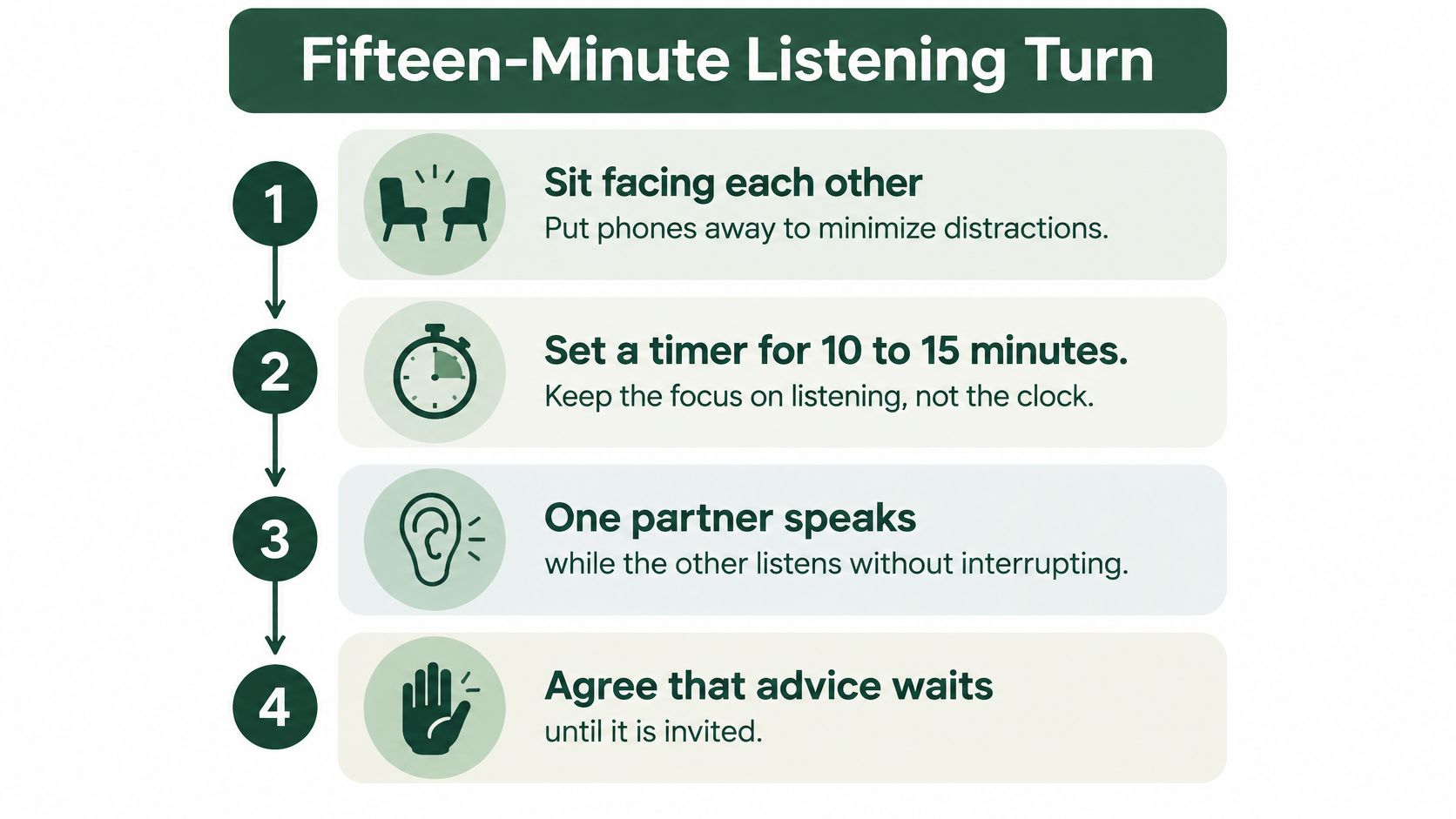
Timer, two chairs, and a shared card showing share, summarize, validate, one question, switch.
Set the room. Sit where you can see each other, phones face down or in another room, and each rate felt closeness from 0 to 10 out loud. Saying the number breaks the ice faster than any question.
Partner A shares one concrete moment. About two minutes, one story from today plus the feeling or need underneath it. "At the family visit I kept waiting for you to back me up and I felt alone." Not a summary of the last six months.
Partner B summarizes in their own words and checks it. "So you felt alone in the kitchen and wanted me to step in. Did I get that?"
Partner B validates the emotional logic even if they remember the facts differently. "It makes sense you'd feel exposed. I didn't see the moment you saw." Validation isn't agreeing. It's saying the feeling follows from the experience.
Partner B asks one curious question, not a cross-examination. "What would have helped in that minute?" is useful. "Why didn't you just tell me then?" is a trap with a question mark.
Switch roles and repeat. Same rules, same timer, no re-litigating what partner A said.
Name one appreciated quality or supportive action each. Specific beats sweeping. "You texted me before the meeting" lands better than "you're great."
Rate closeness again and jot down whether you finished the turn. That's your log entry for the day.
Why the Order Matters
The point of the structure is accurate responsiveness, meaning the speaker ends the turn feeling understood, valued, and supported. Not maximum exposure. A 42-day diary study of 96 married couples found that both self-disclosure and disclosure by the partner independently predicted same-day intimacy, and that perceived partner responsiveness partially explained why disclosure improved intimacy. That's the mechanism the turn is built around.
Because the diary study was observational, treat the turn as a practice target rather than a promised success rate. You're training attention, not running a treatment protocol.
The Difference Between a Feeling and an Accusation
Compare two openers. "I felt dismissed when the plan changed without a heads-up, and I need a text before it shifts," gives the listener something to work with. "You always ignore me" hands them a defense attorney's brief. Same hurt, opposite outcome.
For the listening side, tools that force you to reflect before responding help more than willpower. Coachful's active listening tools are a practical place to practice summarizing and checking before you add your own story, which is exactly the skill step three and four depend on. If you want the broader skill set behind this exercise, this piece on active listening techniques covers the habits in more depth.
What to avoid: using a disclosure later as ammunition, demanding a talk when someone is already overwhelmed, and offering solutions before you've summarized.
Slow the pace for trauma history, ADHD, autism, high sensitivity, cultural differences, or consent boundaries. Shorter turns, written prompts, or a walk side by side can work when face-to-face feels like too much. Stop and involve a qualified clinician if a conversation brings dissociation, coercion, or any question about safety.
What to Do When a Conversation Floods You
You ran the turn. Somewhere around minute four, your chest went tight, your jaw locked, and you either started arguing or went completely blank. That is a flooded nervous system, and it changes what will help next.
The common advice is to push through and stay vulnerable. The research points in a different direction. A study on cognitive flexibility and emotional intimacy found that cognitive flexibility shaped emotional intimacy through both direct and indirect paths, with emotion dysregulation acting as a main link between them. In plain terms: a rigid, activated mind blocks closeness even when the person inside it is trying hard to be honest.
The same study drew on a diary sample of 217 cohabiting couples and found that understanding predicted less withdrawal after conflict better than self-disclosure did. Intimacy was also tied to reduced withdrawal after conflict, unless the communication turned contemptuous. Feeling understood reconnects people. Saying more, on its own, does less.
That ordering matters on a flooded day, because a loud nervous system cannot take in a confession, however heartfelt. Settling comes first so that everything after it can land.
A Staged Order for Hard Days
Notice activation. Fast heart, the urge to yell, going blank, or the sudden need to win the point.
Pause and settle. Change something sensory: cold water, a short walk, dimmer light, the agreed quiet break. Integrative Psychiatry of America's self-soothing guide gives you options beyond "calm down," a phrase that has never once worked on anyone.
Seek understanding with a summary before adding your own story.
Disclose one specific internal experience, need, or fear.
Repair if either of you got defensive or shut down.
Notice where disclosure sits: fourth, after settling and understanding, because a flooded listener hears even a gentle share as an attack. If you want a clearer picture of how much activation a person can hold while staying relational, this explanation of the window of tolerance is a good starting point.
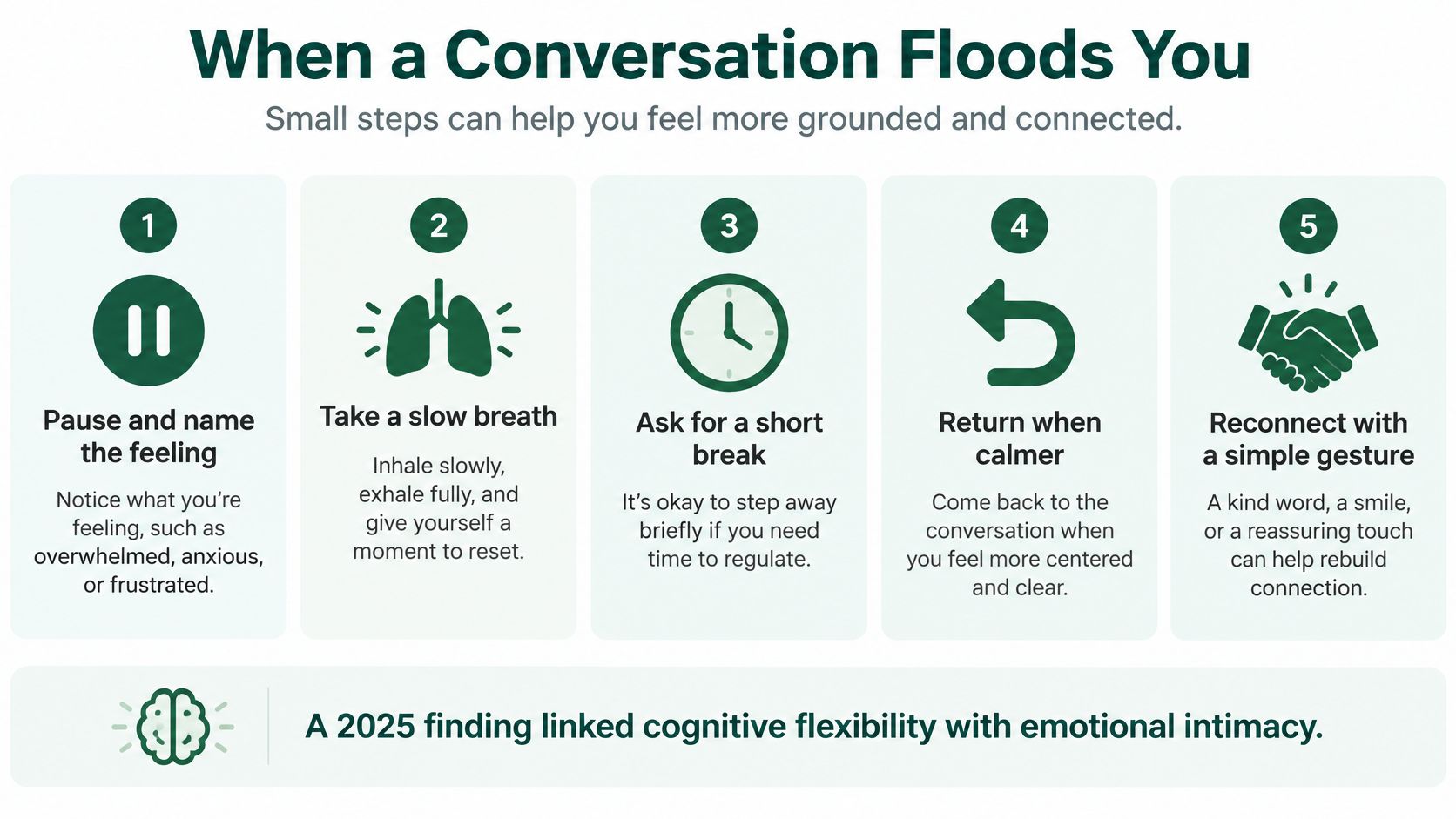
Four cards in order, settle, understand, share, repair, with a pause symbol on the first card.
Frame It as Yours, Not as Their Crime
When you do reach step four, the wording carries the weight. A self-focused disclosure sounds like this: "I get scared we're drifting, and I need ten minutes of real attention." A partner-blaming version of the same feeling sounds like this: "You make me feel unloved." The first invites contact. The second assigns guilt, and guilt tends to provoke defensiveness. A defensive listener can no longer offer the responsiveness the share was asking for.
The stakes are measurable. In a study of 82 cohabiting couples who took part in randomly assigned, video-recorded vulnerability discussions, participants perceived lower responsiveness and reinforcement, and higher punishment, when they disclosed specific vulnerabilities that implicated their partner compared with vulnerabilities focused on themselves alone, as reported in this study of vulnerability disclosures in couples. Partner-involving disclosures are high-stakes moments. They deserve extra settling beforehand and a careful, self-focused frame.
Adapt the Pace, Not the Goal
Flooding changes the dosage while the order stays the same. If your system activates easily, the pause may need to happen before a single sentence is exchanged, and the summary may work better in writing the next morning than spoken in the moment. A break is allowed to last an hour, an evening, or overnight. The exercise measures mutual understanding, and there is no prize for reaching it in one sitting.
When to stop: if the agreed break no longer brings activation down, if one of you starts dreading the exercise itself, or if safety is in question, close the practice and involve qualified clinical support. Flooding that repeats on the same schedule is information about the load, and some loads need a trained third person in the room.
Stay Connected When the Same Fight Returns
Some fights don't have a final answer. Money, tidiness, in-laws, how much time the kids spend on screens. You solve it, it returns, you solve it again, and both of you start to believe something is wrong with the relationship because the problem won't die.
Nothing is wrong with the relationship. The Gottman Institute's couples research program, summarizing longitudinal work associated with John Gottman and Robert Levenson, followed couples for as long as 20 years and reported roughly 80% stability in interaction patterns during conflict discussions separated by three years. The same program reported that 69% of marital problems were perpetual, meaning recurring differences tied to personality, preferences, or enduring circumstances rather than problems that get permanently solved.
Read that number as relief, not resignation. If most disagreements are structural, then the goal was never victory. The goal is dialogue with warmth still switched on. Closeness survives through responsiveness and repair, not through one more bigger confession or one cleaner argument.
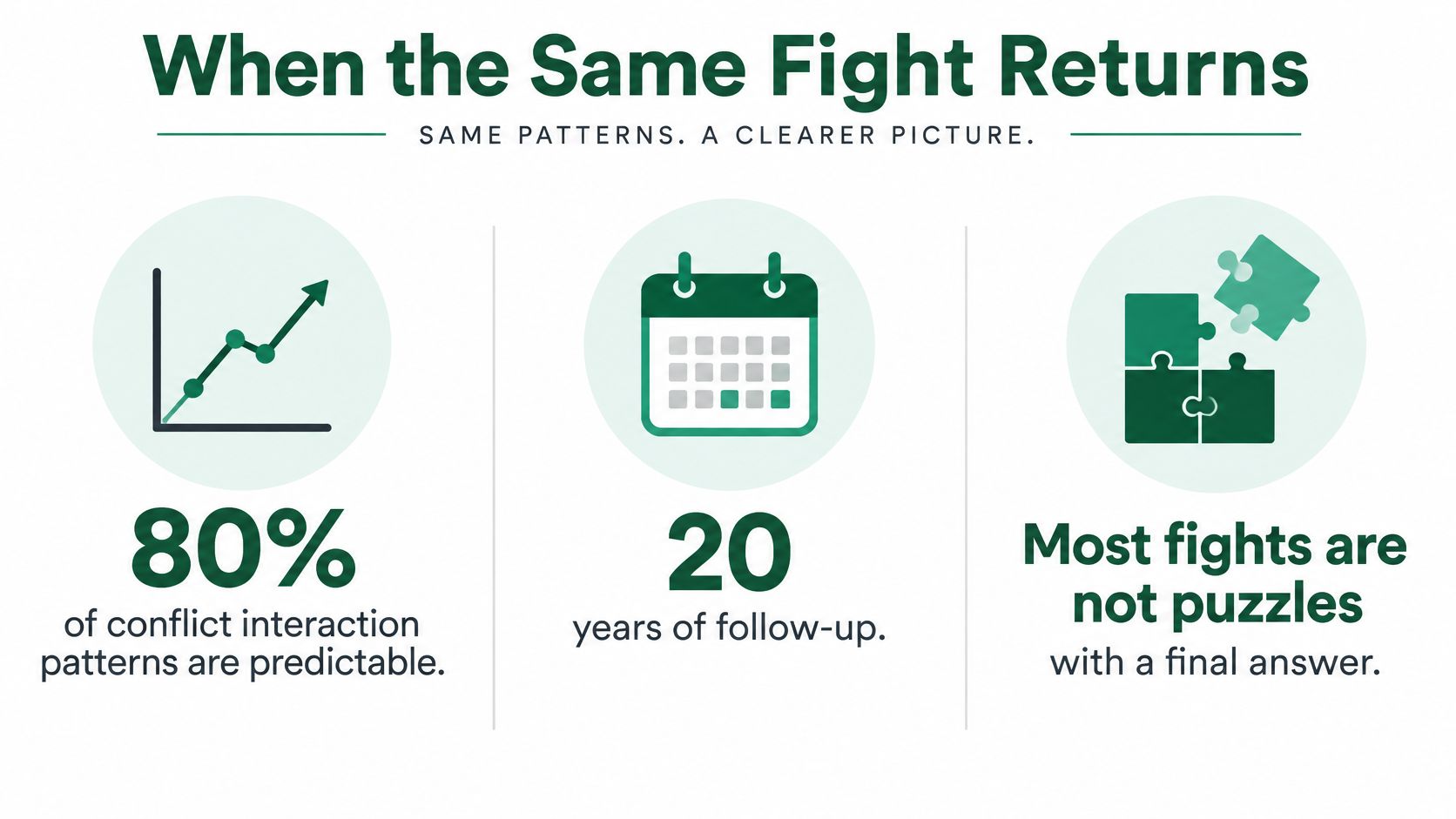
Two timelines showing earlier divorce with hostile conflict and a longer slide when warmth disappears.
What Disengagement Costs Over Time
Related Gottman findings describe two distinct failure routes, and they end marriages on different timelines. One is hostile conflict, the so-called Four Horsemen pattern of criticism, contempt, defensiveness, and stonewalling, which tends to burn a marriage down relatively early. The other is emotional disengagement, defined by an absence of positive affect during conflict: reduced interest, affection, humor, and empathy. Disengaged couples tend to stay married much longer before divorcing, because a cold marriage is easy to mistake for a stable one.
That second route is the quieter danger. Hostile conflict is loud enough to demand attention. Disengagement looks like peace, so couples let years of parallel lives pass before anyone names the distance. Intimacy, then, is less about avoiding disagreement and more about preserving contact during it.
The Five-Minute Return After Gridlock
When the familiar fight shows up again, run this instead of the full argument. The order matters: settle first, understand second, disclose third.
Name the gridlock without contempt. "We're in the money thing again. I don't think we solve it tonight."
Acknowledge their view in one sentence. "You're worried we're being reckless, and I get why."
State what still matters to you. "I need to know we can still spend on the kids without a negotiation every time."
Offer one small compromise or a time to revisit it. "Let's set the kids' budget once a month and leave the rest alone."
Close with a bid. A hand, a joke, a thank you. Contact matters more than resolution.
Compare a cold shutdown to a short repair. Cold: "Fine. Whatever you want." Repair: "I got sharp. I still want to understand your side." That second line takes eight seconds and changes the rest of the evening.
Staying responsive is a shared job, not a task assigned to whoever talks more. In a study of 144 heterosexual couples aged 26 to 60, men's attachment-related avoidance was associated with their own intimacy, and avoidant attachment in both spouses was associated with the other spouse's intimacy, according to this dyadic coping and attachment study. Withdrawal is a couple pattern, not a flaw in the partner who wants to talk. In the five-minute return, the more self-contained person says one inner line: "I go quiet when I feel cornered, and I still want to stay." The other person accepts a requested pause without chasing, and neither partner becomes the relationship's full-time therapist.
Measure this for a month: fewer contempt moments, faster return after a pause, and at least one moment of humor or affection inside a hard topic.
A repeatable sequence helps more than a new personality. This conflict resolution framework lays out the steps so you're not inventing them mid-argument.
Decide Whether Home Practice Is Enough
After two weeks of the log, you'll have something to look at. Make the decision on a calm afternoon, not on a bad night. Look at direction: are most bids landing, are closeness ratings creeping up, are repairs getting accepted, and can either of you call a pause without paying for it later?
Stay with home practice when the trend is upward even if individual days are rough. Bring in outside help when the same flood repeats without change, when one person carries all the emotional work, when contempt or shutdown is the default rather than the exception, when disclosure brings dissociation, or when either person feels unsafe or coerced.
What Support Actually Looks Like
Be Your Best Self & Thrive Counseling, PLLC in St. Petersburg works specifically with non-emergency issues and with motivated people who are ready to change but need a bit of help building the life and relationships they want. The practice sees individuals and couples, and its specialties include Couples Counseling, Gottman Therapy, Marriage Counseling, Codependency, Trauma, Anxiety, ADHD Therapy, and HSPs & Empaths, along with several others. Sessions are available online or in person, and the practice also offers workshops, group therapy, and workbooks. A free initial consultation is the low-pressure way to test fit and goals before committing. If you're weighing whether it's worth it at all, this piece on whether couples counseling is effective is a fair place to start.
Individuals can use every skill in this guide with a friend or in individual therapy, even without a partner in the room. The sequenced conversation, the bids, the repair lines, and the log all work with one willing participant.
Your Next Three Moves
Keep the three daily bids. Run one listening turn this week, with the timer, the phones away, and the ratings. And if the log shows repeated flooding or care that only ever flows one direction, use a consultation to talk through pacing, boundaries, and repair with a counselor rather than pushing harder at home.
Closeness is a practice you can start tonight, and you don't have to be the only one holding it.
If you're in St. Petersburg or the Tampa Bay area and want help putting this into practice, Be Your Best Self & Thrive Counseling, PLLC offers individual and couples counseling built around exactly these skills: naming feelings and needs, listening without solving, repairing after conflict, and sharing the emotional load instead of leaving it to one person. Our therapists work with couples using Gottman-informed and attachment-focused approaches, and we blend in tools such as breathing, mindfulness, and nervous-system regulation when they help. Reach out for a free initial consultation and visit Be Your Best Self & Thrive Counseling, PLLC to see who on the team fits what you're working on.