
Holistic Integrative Therapy: What Clients Can Expect
You tried talk therapy, yet still wake at 3 a.m. with a tight jaw and dread about Sunday. Or you booked “whole-person healing” and left with encouragement and a supplement suggestion, but no plan for checking whether it helped.
Integrative therapy considers how thoughts, the body, relationships, daily habits, and meaning can affect one another. Worldwide, 170 of 179 World Health Organization Member States had acknowledged traditional and complementary medicine by 2018, according to the WHO's 2019 global report.
The label alone does not tell you what happens in counseling. A grounded approach connects each practice to a specific concern, agrees on a reasonable way to assess progress, and is candid about where evidence is limited. Before booking, ask what a session might involve, how the counselor will track whether it is helping, and what additional costs or referrals may be involved.
What Holistic Integrative Therapy Means
Say a client arrives with three complaints that don't look related: a mind that races at 1 a.m., a shoulder that aches most weeks, and a marriage that has gone quiet. A symptom-by-symptom system turns that into three referrals and a long wait. Integrative therapy keeps all three on one page, treating the problem as an interaction among thoughts and feelings, the body, relationships, daily habits, and meaning rather than pulling out one symptom and calling it the diagnosis.
What happens in the room is less mysterious than the name suggests. The counselor asks how the shoulder pain and the sleep loss track together, whether the quiet at home started before or after the insomnia, what the client believes about asking for help, and what a typical Tuesday really contains. Then comes the step that many whole-person pages skip: choosing what to work on first and agreeing on how you'll both know whether it helped.
The Four Parts of a Whole-Person Picture
Four domains get mapped at intake, and they're connected, not stacked in a list.
Mind: thoughts, emotions, attention, and the story a client tells about themselves. The 1 a.m. loop that says "I'm going to fail at this" lives here.
Body: sleep, movement, breath, food, pain, and the physical side of stress. So does the shoulder, and so does the fact that two glasses of wine at 10 p.m. are propping up the sleep the anxiety is already wrecking.
Spirit: values, meaning, faith, or a sense of something larger, with no religion required. Someone who says "I don't know what any of this is for anymore" is working in this domain whether or not they use the word spiritual.
Relationships and daily context: the people, money, work, caregiving, and culture the other three live inside. A breathing exercise can't fix a schedule with no room in it.
The most common confusion is the assumption that integrative means the therapist manages all four domains at the same time. It doesn't. A good plan picks one or two targets, holds the rest in view, and says plainly which parts are being addressed now and which are being monitored.
A question worth asking on day one: Which of these four are we tracking first, and what would tell us in eight weeks that it moved?
Why Whole-Person Care Moved Into the Mainstream
This isn't a niche. An analysis of nationally representative physician data found that 53.1% of U.S. office-based physicians recommended at least one complementary health approach in the previous 12 months, according to the National Center for Complementary and Integrative Health. The specific recommendations were massage therapy at 30.4%, chiropractic or osteopathic manipulation at 27.1%, nonvitamin herbal supplements at 26.5%, yoga at 25.6%, and acupuncture at 22.4%.
The same source explains why so many people come to this work through physical pain. Chronic pain affects roughly 1 in 5 Americans and is the most common reason people reach for complementary and integrative practices, which is exactly why pain so often arrives in counseling tangled with broken sleep and low mood. Organized integrative medicine in U.S. healthcare traces back to the American Medicine Association in 1978 and the American Nurses Association in 1979.
Internationally, the picture is the same story with different paperwork. The World Health Organization's 2019 global report, drawing on information from 179 Member States, found that 170 countries had acknowledged using traditional and complementary medicine by 2018. Institutional infrastructure followed: 98 countries reported a national policy, 107 had a national office, and 75 had a government-funded or partly government-funded research institute. Legal or regulatory frameworks rose from 79 countries in 2012 to 109 in 2018.
That growth tells you integrative care is now a subject of policy, professional regulation, and research funding across major markets. It does not tell you that every practice inside the category works. Policy adoption measures interest and infrastructure, not clinical trial results, and the two should never be confused.
What Integrative Does Not Mean
Integrative does not mean every natural method is proven, and it doesn't mean counseling replaces medication, trauma-focused therapy, or crisis care when those are what's needed. A counselor who treats the label as a promise will eventually oversell something.
The useful test is narrower. If your counselor can name what a practice is for, how many sessions count as a fair try, and what would make you stop, you're in evidence-informed territory. If the answer to "how will we know it's working" is "you'll feel more aligned," you're paying for atmosphere.
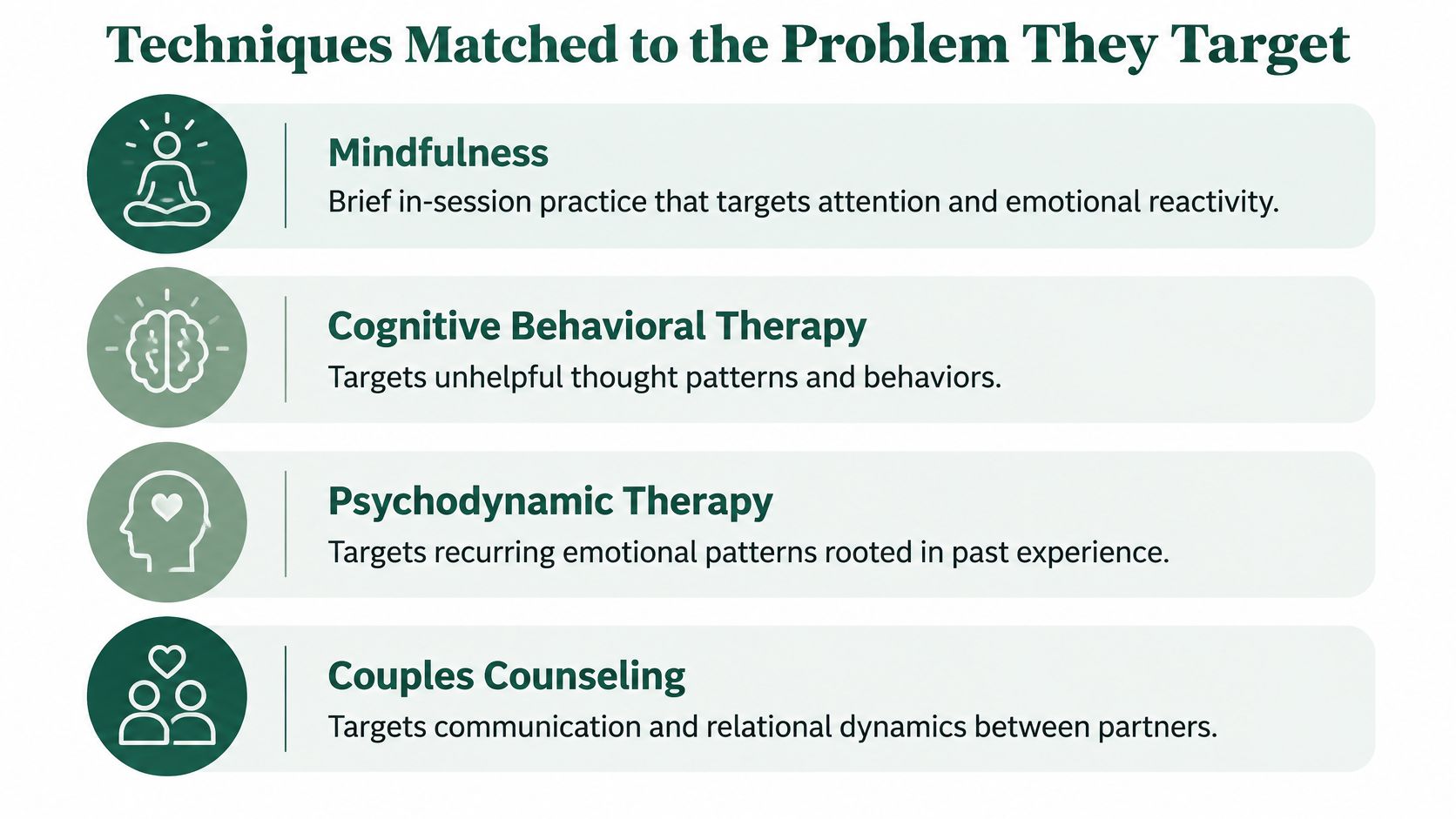
Techniques Matched to the Problem They Target
The skill in this work isn't collecting modalities. It's matching one tool to the job in front of you, then saying out loud why that one and not another. A counselor with forty techniques and no matching logic is running a souvenir shop.
Mindfulness is the clearest example of a practice with a defined job. It targets attention and emotional reactivity, and it's measurable. A meta-analytic review of 39 studies with 1,140 participants found moderate pre-to-post improvements in anxiety (Hedges' g = 0.63; 95% CI 0.53 to 0.73) and depressive symptoms (g = 0.59; 95% CI 0.51 to 0.66), as reported in this review of mindfulness-based interventions. In samples with diagnosed anxiety or mood disorders the estimates were larger, g = 0.97 for anxiety and g = 0.95 for mood symptoms, though those rested largely on before-and-after comparisons and can overstate benefit against controlled trials.
A counselor guides a short breath practice while talk therapy stays the main work of the hour.
In session, that looks like three minutes of breath-focused attention or a short body scan, followed by a functional analysis: what set off the spike, what happened in the body, what the client avoided, and what they'll try next time. The practice is brief on purpose. It's a rehearsal, not the performance.
One Tool, One Job
Every other technique earns its place the same way, by naming the problem it treats.
Yoga or gentle movement fits when pain, restlessness, or shutdown makes pure talk hard, because it gives the session somewhere to go that doesn't require a sentence. Sleep, nutrition, and lifestyle changes target energy and mood stability, not a diet identity; the goal is a steadier week, not a label. Spiritual inquiry, prayer, or values work belongs in the plan only when the client wants it, and a counselor who introduces it uninvited has overstepped. Art, sound, or meditation helps when feelings stall exactly where words stall, usually with clients who can describe their week in detail and their grief not at all.
Use is uneven and often self-directed. In a 2024 study of 123 participants, 7.3% reported using meditation and 8.1% reported using therapeutic massage in the previous six months, per the published survey results. Plenty of people arrive already practicing something, which makes it worth asking what they've tried before adding anything new.
Technique | Problem it targets | Plan label |
|---|---|---|
Mindfulness (breath-focused attention, short body scan, observing thoughts) | Attention, emotional reactivity, stress-related symptoms | Adjunctive |
Yoga or gentle movement | Pain, restlessness, or shutdown that makes talk hard | Supportive |
Sleep, nutrition, and lifestyle changes | Energy and mood stability | Supportive |
Spiritual inquiry, prayer, or values work | Meaning and direction, only if the client wants it | Supportive |
Art, sound, or meditation | Feelings that stall when words stall | Supportive |
That plan label is the part clients rarely hear and should. Adjunctive means it supports the main treatment. Supportive means it helps tolerability and engagement. Clinically established means the method itself carries the change. If everything on your plan is labeled the same, nothing is.
Progress gets tracked with validated anxiety and depression measures, not with how calm the room felt. When body-based work is the entry point rather than a supplement to it, the distinction matters, and the difference between somatic therapy and talk therapy is a useful place to see where the line sits.
Benefits the Research Supports and Its Limits
The honest version of the benefit claim is "real and modest," and the number that keeps it honest is a Hedges' g of 0.28. A systematic review and meta-analysis of mindfulness-based interventions found that small average advantage across comparison conditions, rising to g = 0.35 when studies involving fewer than eight sessions were excluded, according to the Psychological Medicine review.
The same review found benefits were most consistently superior to non-active controls, while evidence against active treatments was more limited. That single sentence reshapes how you should hear any claim about breathwork, movement, spiritual practice, or lifestyle change.
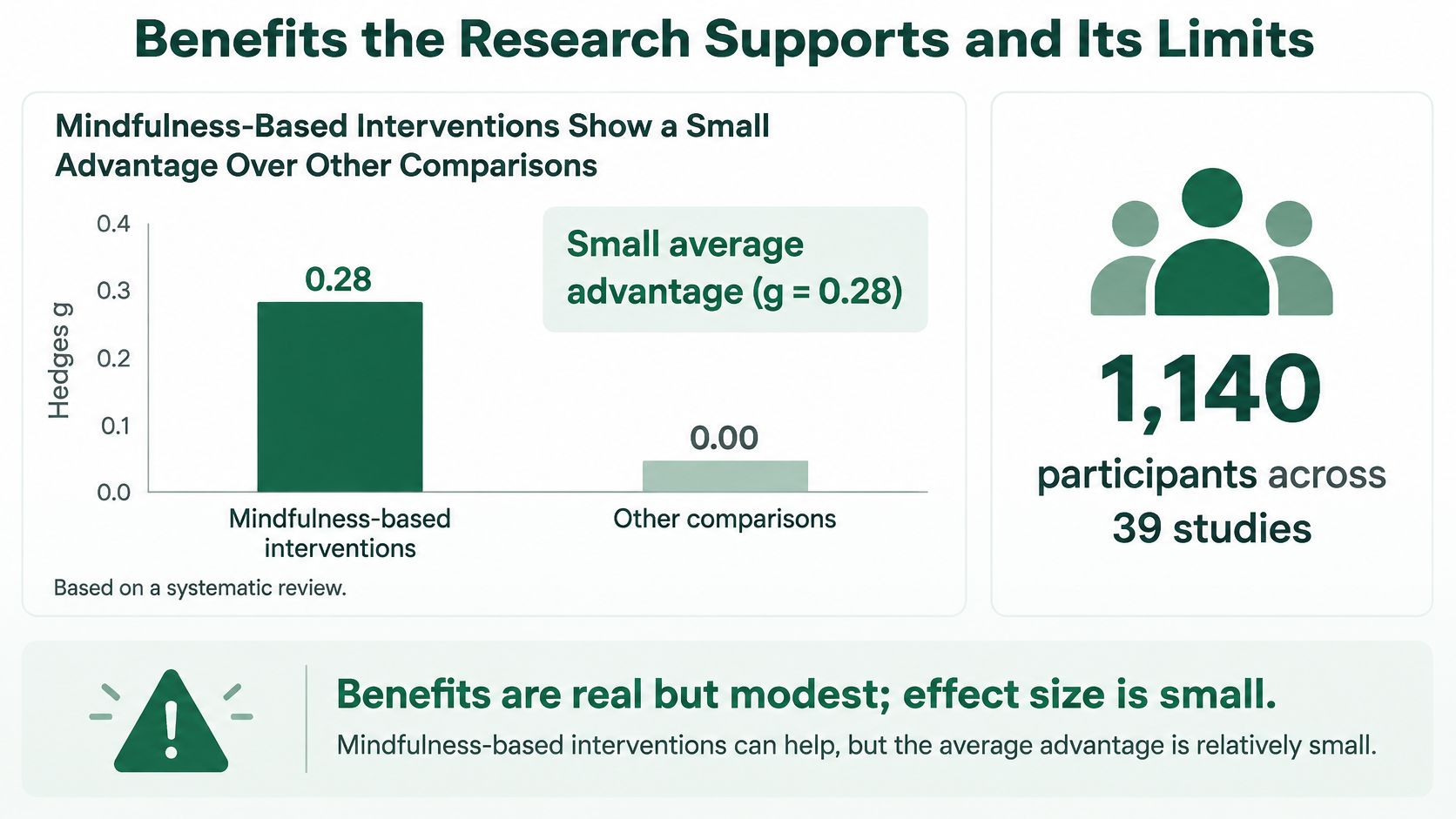
A small average advantage in the research, shown against the larger claims often made for mind-body practice.
Comparison or dose rule | Hedges g | Reading |
|---|---|---|
Mindfulness-based interventions across all comparisons | 0.28 | Small average advantage |
Excluding studies with fewer than eight sessions | 0.35 | Larger effect with a fuller course |
Non-active controls | Not reported separately | Most consistently superior |
Active treatments | Not reported separately | Evidence more limited |
Two design rules fall out of that table. First, dose. A practical course specifies eight or more therapist-supported sessions before anyone calls the approach a failure, because the shorter studies are where the effect shrinks. Second, targets. Name one or two measurable ones, such as panic episodes per week or nights of broken sleep, so "I feel better" has a comparison point.
A fixed-length format is one way to hold that dose steady, and the overview of mindfulness-based stress reduction shows what a structured course looks like from the inside.
What the effect size means for you: an advantage of this size is worth having inside a treatment plan and is not large enough to carry a plan by itself.
State change is the other trap. Feeling calmer at minute forty of a session is regulation in the moment. Change that lasts is measured between sessions, in the days when nobody is guiding your breath. Keeping those two apart is how you avoid celebrating a mood that evaporates in the parking lot.
For clients with trauma histories, grounding and present-moment orientation come before any exercise that asks for intense body sensation or strong emotion, with explicit consent and a pace the client can stop. Titration isn't caution theater; it's how you avoid a session that ends with someone dissociated on the drive home.
Supplements deserve their own warning line. Herbal products can interact with prescribed drugs, and product quality varies between brands and batches, so a prescriber should know everything being taken. Natural and spiritual do not automatically mean low risk, and delaying needed medical or psychiatric care because a practice feels gentler can cause real harm.
What to Expect from a Course of Counseling
Sunday nights have been loud for months. You book, then sit down unsure whether the hour will be talk, a breathing practice, or a stack of unrelated tools. A structured course names the order before that first month: fit, a full map, one or two scored targets, one skill at a dose you can use, then a review that includes referral when a need sits outside counseling.

A therapist and client sit in a quiet office during a short mindfulness exercise.
A prescription works the same way. It names the medicine, how often, and when someone else should take over. A loose menu of extra add-ons skips those labels. The sequence below is what you can ask to see.
A short consultation. Fifteen to thirty minutes to check fit, clarify goals, and confirm whether individual or couples counseling is the right door. The wrong door spends weeks you needed for the work itself. Reading what actually happens in a first session with a therapist before you book makes the questions concrete. You should leave knowing the fee, how often you meet, and the counselor's general approach.
An intake that maps the whole picture. Symptoms, health conditions, current medications, sleep, relationships, culture, and what you already tried and dropped. The forms carry that map. Their job is to catch medical and medication factors that look like anxiety and will not move if they are treated only as anxiety.
One or two targets, plus a measurement. You and the counselor agree on what changes first and how it gets scored: a validated symptom measure, a frequency count such as panic episodes or nights of broken sleep, or both. That agreement is what separates a plan from an open-ended conversation.
Early sessions mixing talk with one body-based skill. Often a breathing technique or a brief mindfulness practice, plus one between-session try that fits a real Tuesday. One skill. Five at once leave you nothing clear to judge.
Middle sessions tied to an actual trigger. The skill meets the Sunday-night spiral or the argument that starts in the car. If the practice overwhelms, the pace slows. At this stage the hour starts to look like your week, not a technique demo.
A later review and a coordination plan. Scores get compared, you decide together what to keep, and any sharing with a physician or psychiatrist happens only with your written consent. Referral belongs in that plan when sleep, medication, or another need sits outside the counselor's scope.
Sessions can be online or in person. People arrive with anxiety, depression, trauma, burnout, life transitions, ADHD, or a relationship stuck in the same argument. The hour is not a tour of every tool in the building. You should leave with one repeatable practice and a clearer read on your symptoms and your week.
Be Your Best Self & Thrive Counseling follows the American Counseling Association Code of Ethics and sees individuals and couples. Clinicians keep regular healing practices of their own and do not teach a technique they have not tried themselves. A licensed counselor stays inside professional ethics and scope, and refers out what belongs elsewhere.
Cost, Access, and Coordination Questions
Money and logistics derail more care than motivation does. These are the questions worth asking before the first appointment, in the order they tend to matter.
What does it cost, and is insurance involved? A large share of complementary and integrative care is paid out of pocket rather than reimbursed. Ask for the full fee, the cancellation policy, and whether a superbill is available, all before booking. We're a self-pay practice, so you'll know the number up front rather than after a claim is denied.
How long is the wait, and can a referral be arranged? Access is the quiet crisis in this field. According to integrated behavioral health data on whole-person care, 67% of people with a behavioral-health disorder do not receive behavioral-health treatment, and 30 to 50% of primary-care referrals to outpatient behavioral health never result in a first appointment. Ask directly how soon you'd be seen and what happens if the answer is six weeks.
Online, in person, or both? The two formats differ in privacy at home, travel time, and how connected the hour feels. Ask which options exist and whether they can be mixed week to week. There's real evidence on the comparison, summarized in whether online therapy is as effective as in person.
What gets shared, with whom, and on whose say-so? A physician or a partner should hear only what you approve in writing. Ask what the counselor typically shares, how, and with which releases on file.
Who else is on the team? Much mental-health care is managed in general practice. A 2024 Norwegian study analyzed more than 350 million general-practice patient encounters collected over 14 years, published in the peer-reviewed study, which is a reminder that coordination with a primary-care clinician is usually part of good care rather than an exception.
Does the intake screen? ADHD, autism, trauma, medical conditions, and medication effects can look like anxiety or depression from across the room. A careful intake screens for them and refers out rather than guessing. Ask whether your counselor works well with your background, language, and values, too. Fit isn't politeness; it's a predictor of whether you stay long enough to benefit.
Safety Boundaries and How to Choose a Counselor
Three mix-ups cause most of the trouble in this corner of the field, and naming them is the fastest way to protect yourself.
Integrative isn't a credential. It describes a philosophy, not a license. Confirm the counselor's licensure, the ethics code they follow, and which technique targets which symptom before you book.
Natural and spiritual don't mean low risk. Herbs and supplements can interact with prescribed drugs, and product quality varies between brands. Tell your prescriber what you're taking, and never stop a prescribed medication because a practice feels gentler.
More modalities don't make care more whole-person. The most whole-person model is often the one that reduces friction and connects you to the right level of care, not the one with the longest menu. A careful counselor names contraindications, promises no cure, and refers promptly for severe depression, suicidal crisis, psychosis, or unexplained medical symptoms.
Ask before booking: How will we measure progress beyond how I feel in the room, and what do we do if a practice makes me worse?
Then check the practical layer. Bring a current medication list and one goal you can state in a single sentence, and use a free consultation to test fit rather than to be persuaded. Fit is something you can evaluate rather than a feeling you wait for, and this guide to therapy fit is a place to start.
Be Your Best Self & Thrive Counseling, PLLC is one example of how this can look: we work closely with a network of integrative practitioners so care stays coordinated, our sessions often include breathing techniques, yoga, and mindfulness, and we provide mental health counseling in St. Petersburg and Sarasota, Florida. Our offerings include online and in-person counseling, workshops, group therapy, and workbooks.
Before you commit anywhere, ask the three questions that reveal how a counselor thinks. How will progress be measured? What happens if a practice makes me worse? Who else is on my team, what gets shared, and only with my consent? A vague answer to any of those is information.
If you are in immediate danger or thinking about suicide, contact local emergency services or call or text 988 now. Don't wait for a consultation to sort that out.
Whole-person care works best when it's specific, measured, and honest about its limits, and that's how we practice at Be Your Best Self & Thrive Counseling, PLLC. We offer integrative mental health counseling for individuals and couples in St. Petersburg and Sarasota, Florida, blending talk therapy with breathing, mindfulness, yoga, and values work, and coordinating with the practitioners already on your team. If you'd like to know which approach fits your problem, how progress would be measured, and what a fair trial looks like, start with a free consultation at Be Your Best Self & Thrive Counseling, PLLC.