
How to Fix a Marriage After Infidelity: A Recovery Plan
80%. That's the share of couples whose infidelity stayed secret who had divorced within five years of starting behavioral couple therapy, compared with 43% of couples whose affair had been revealed, according to the five-year follow-up in Couple and Family Psychology.
The affair itself didn't sort those couples. Secrecy did.
So the work of fixing a marriage after infidelity starts in an unglamorous place: ending the lie, making the truth checkable, and keeping the injured partner steady enough to hear it. Conversation, closeness and forgiveness come later, and they come in a fixed order.
It's honest about odds. Some marriages recover well. Some don't, and nobody can tell you in advance which one yours will be.
Where Recovery Starts and What the Odds Look Like
Repair has a sequence, and couples who skip a stage usually end up circling back to it. The four stages below are the ones most couples work through. Each has a goal and an observable sign it's working, which matters because "it feels better this week" isn't a measurement.
Stage | Main Goal | Sign It Is Working |
|---|---|---|
1. Stabilize | Stop deception and any third-party contact | No new secrecy, contact has ended, and both partners agree on it |
2. Disclose | Make a structured, truthful disclosure | The injured partner can ask questions without punishment or minimization |
3. Identify vulnerabilities | Name relationship gaps without using them as excuses | Both partners describe their own part without shifting blame |
4. Negotiate agreements | Set explicit rules for transparency, boundaries, communication and relapse prevention | Agreements are written down and kept consistently over time |
Stage one is the only stage one partner can finish alone, and it's the fastest. Stage four is the slowest, and most couples renegotiate it more than once.
Can a Marriage Survive Infidelity
Sometimes, yes, and the evidence is narrower than most internet answers suggest. A five-year follow-up of couples who received behavioral couple therapy examined 19 couples who had experienced infidelity inside a larger randomized clinical trial of 134 couples, comparing them with couples who reported no infidelity. Divorce across those five years reached 43% when the affair had been revealed, 80% when it stayed secret, and 23% among couples without infidelity, per that follow-up study.
The same study found that couples who stayed together after an affair eventually reported relationship satisfaction and marital stability that were not significantly different from couples who had no infidelity. Satisfaction also increased over time among those who stayed married, whether or not an affair had happened.
Treat those percentages as a description of a small, therapy-seeking sample, not a forecast for your marriage. Nineteen couples can't tell you what will happen in your kitchen.
The first lever you control: not whether the affair happened, but whether secrecy is still running today.
Disclosure status is the one variable in that study a couple can still change. If you want to calibrate expectations before you begin, this explanation of marriage counseling success rates shows how outcome research is usually measured, and why "it worked" needs a definition before anyone claims it.
Decide which of the four stages you're in before you read further. If any secrecy or third-party contact is still active, stage one is your starting point, whatever else has already happened.
Stabilize, Disclose and Avoid Repair Pitfalls
The first week is where most repair attempts succeed or collapse. Couples tend to try everything at once: a confrontation, an apology, a therapist, a promise made at 2 a.m. A staged approach moves faster because each step makes the next one possible.
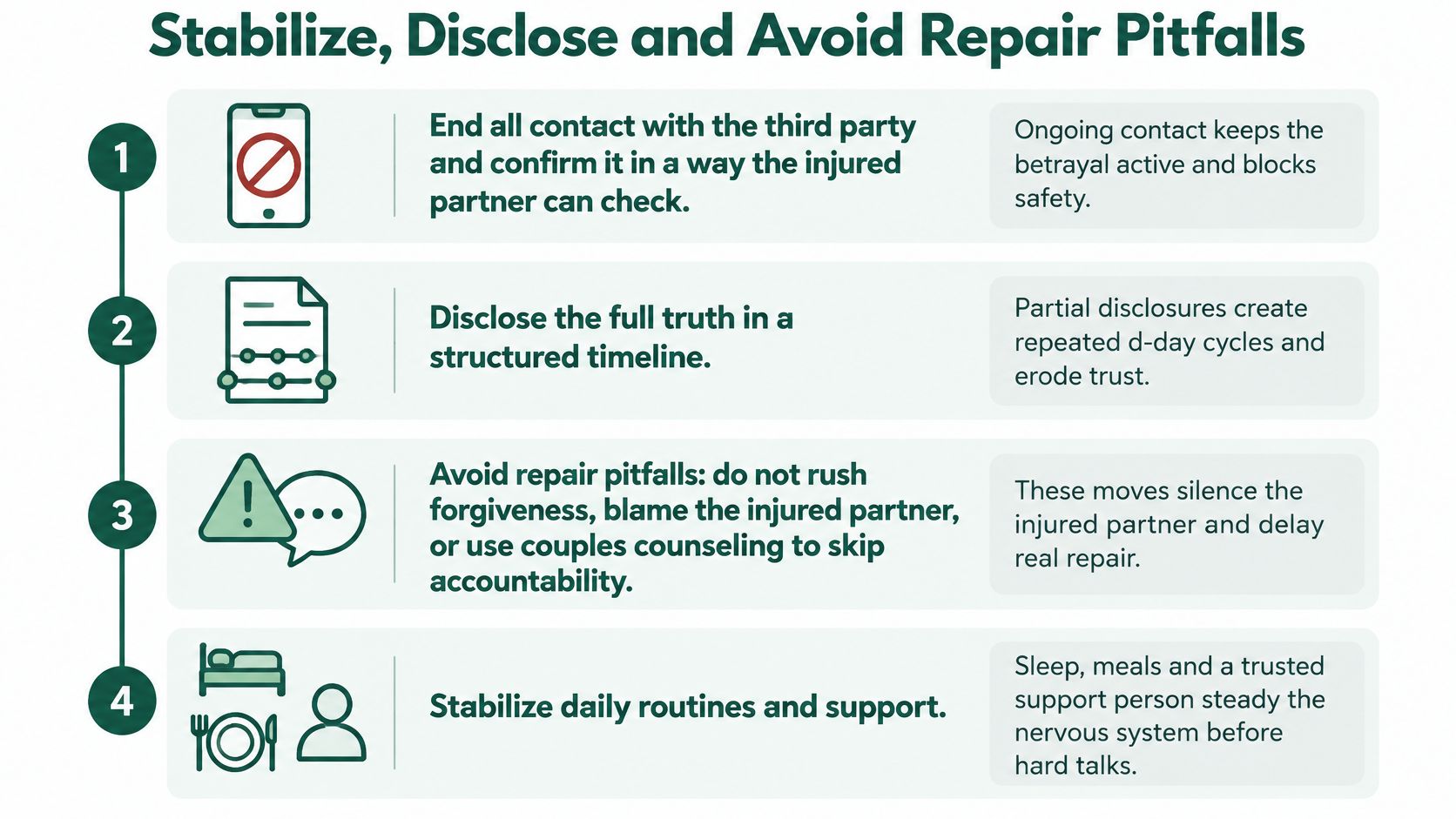
Caption: The first week of affair repair has an order. Contact ends before conversations begin, the disclosure is structured, and daily routines steady before the hard talks.
This order isn't improvised. A staged affair-recovery protocol published in The Family Journal puts stabilization and a clinically contained disclosure ahead of exploring contributing factors, and puts all of that ahead of any decision about whether to continue together. Its authors are equally clear that the injured partner's safety and emotional stabilization must come before detailed problem-solving.
The First Week in Five Steps
End contact and make it checkable. Ongoing contact with the third party keeps the betrayal active, so the wound can't begin to close. Confirmation should be something the injured partner can see, not a promise: blocked numbers, a final written message, a plan for the places they might still cross paths.
Stabilize before you solve. Panic and rage aren't obstacles to the conversation. They're the reason to delay it. Agree on a phrase either partner can use to stop a conversation, and a time to return to it. When one partner's system floods mid-argument, more talking usually makes it worse, which is why understanding emotional flooding is worth an evening before your next attempt.
Plan the disclosure with a counselor in the room. The session needs a scope: the timeline, the extent of contact, and anything touching money, health or safety. Send written questions ahead so the session doesn't become an interrogation.
Cut the graphic sexual detail. Disclosure has to be truthful and complete enough for informed decisions. Highly graphic or repetitive sexual details are generally clinically counterproductive unless they bear on health, consent, finances or safety, because they replay the injury without informing a decision. That rule saves couples weeks.
Write the session agreement first. Its length, who speaks first, what happens when someone escalates, and when you stop.
If transparency means shared calendars or monitoring software, settle what you're both agreeing to before you install anything. Guidance on app safety and privacy safeguards covers the practical side of keeping devices and accounts secure while you rebuild openness, and it's a useful read before access gets one-sided.
Pitfalls That Stall Repair
Forgiveness on a deadline. Pressure to "be past this by spring" produces compliance, not repair.
Blame shifted onto the marriage. Marital dissatisfaction can be part of the picture without becoming the excuse. The moment "we were already broken" becomes the explanation, the injured partner hears that their pain is a logistics problem.
Unstructured truth sessions. Late-night retellings and drip-fed details retraumatize instead of informing.
Joint sessions while coercion or violence is present. Couples work isn't the right setting for that, and the partner causing fear needs separate accountability first.
What therapy adds is worth measuring. A 2024 pilot study comparing Gottman Method Couples Therapy with treatment as usual reported broader gains for the Gottman condition in four named areas: trust, conflict management, relationship satisfaction and sexual quality, per the 2024 pilot study. It was a pilot, so treat the result as promising rather than settled.
The early benchmark: not restored trust. A measurable drop in hostile escalation, agreements kept one at a time, and the injured partner increasingly able to ask a question without being punished or minimized.
Our practice works with non-emergency issues and with motivated people who are ready to change but need a bit of help building the life and relationships they want, and we see individuals and couples. Structure is the part a counselor adds: someone who holds the frame when a session starts to slide into the same twenty minutes.
Before the disclosure conversation, write down the three facts you most need in order to make an informed decision. Not the three you're most curious about. The three that affect your health, your money, your safety or your decision to stay.
Rebuilding Trust Through Five Measurable Dimensions
Trust doesn't return in a single moment of sincerity. It returns in pieces, and the pieces are observable.
Dimension | Type | What Repair Looks Like |
|---|---|---|
Risk identification and prevention | Personal | Recognizing what could threaten the relationship and acting to reduce it |
Predictability | Personal | Reliable behavior repeated until it becomes expected |
Belief | Personal | Growing confidence in the partner's credibility |
Intimacy | Relational | Renewed emotional closeness |
Reciprocity | Relational | Balanced investment from both partners |
A qualitative study of trust rebuilding after disclosure sorted recovery into exactly these five dimensions and split them into two families: three personal, two relational.
Personal Dimensions Come First
Risk identification means the injured partner can name what still feels dangerous and see their partner act on it. Predictability means behavior repeats until it stops being a surprise. Belief means the partner's word starts carrying weight again.
Picture an ordinary Tuesday. A partner says they'll be home at 6:30 and walks in at 6:25, and that's predictability work whether or not anyone calls it that. A partner answers a hard question with a plain answer instead of a deflection, and that's belief work. A partner mentions a worry out loud before it turns into a secret, and that's risk identification.
Relational Dimensions Come Later
Intimacy is closeness returning, slowly and unevenly. Reciprocity is both people investing, which is where many couples stall: one partner does all the repair work while the other keeps score, and the ledger never balances.
Trust gets rebuilt through repetition, not through one apology delivered well. A kept promise in week six doesn't erase a broken one in week two, and a promise that only holds while someone is watching isn't a promise yet.
The limit matters. This was qualitative research, so it maps the mechanics of rebuilding trust. It doesn't give success rates, and it can't prove any single behavior will work for your partner.
This week, choose one observable behavior for each personal dimension, say it out loud, and review it at the next calm conversation:
Risk identification: "I'll tell you when I'm going somewhere you wouldn't expect."
Predictability: "I'll text when I leave the office, every day this week."
Belief: "If you ask about that night, I'll answer directly and I won't sigh first."
Closeness often runs into the same patterns that made the marriage feel distant long before the affair, which is the territory emotional disconnection in marriage describes.
Restoring Communication When Emotions Run High
Most advice about repairing communication after an affair tells couples to talk more, deeper, sooner. That advice fails the couples whose conflict is driven by trauma symptoms, neurodivergence, or a nervous system that won't settle on command.
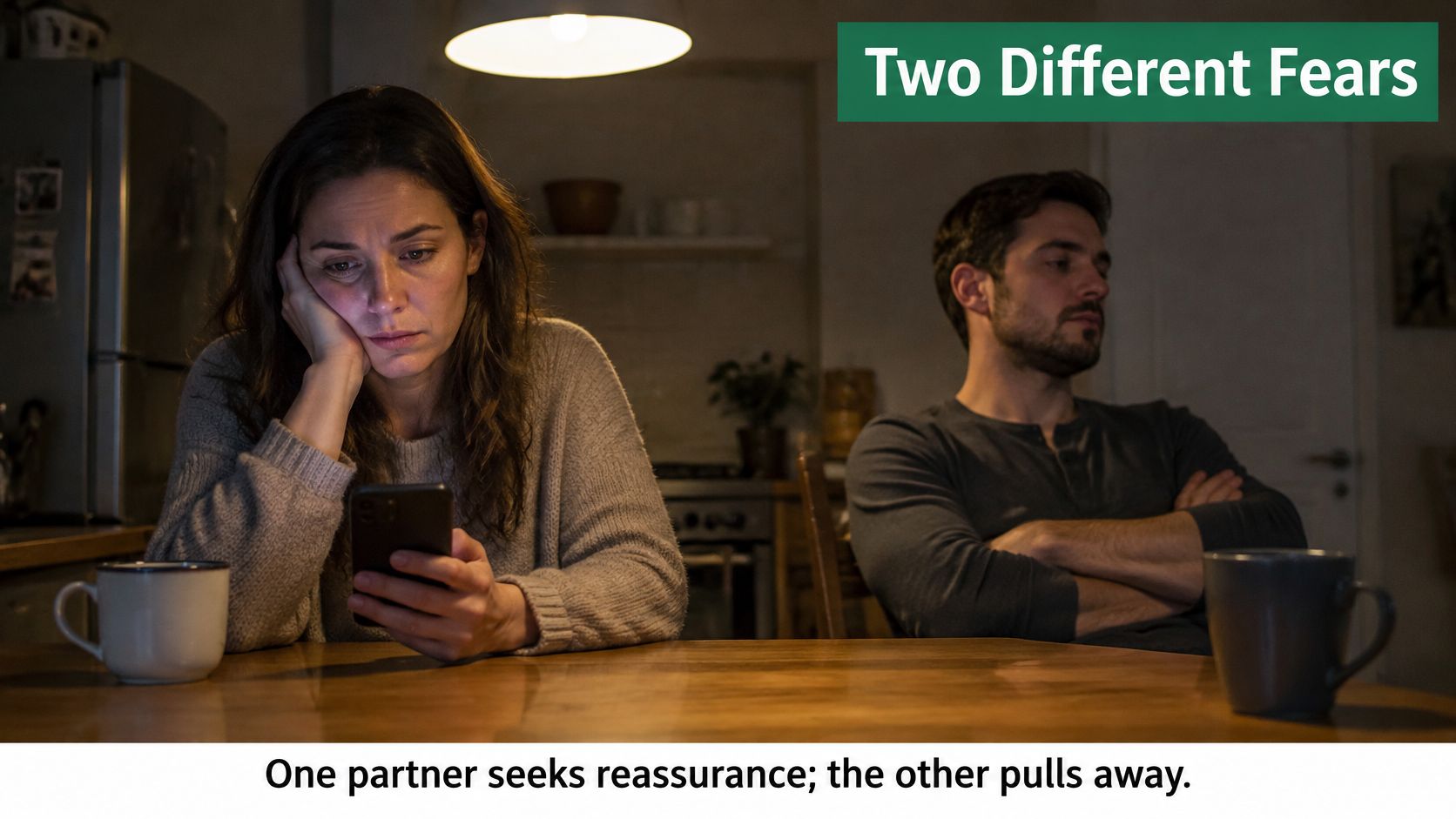
Caption: Distance at the table is often regulation, not indifference. Both partners may be managing more internally than the conversation shows.
The mismatch is the part standard advice skips. The injured partner may show panic, constant checking, disrupted sleep, sexual avoidance or the same question asked forty times. The unfaithful partner may answer with shame, defensiveness or a flat shutdown. Both sets of reactions are physiology, not character, and research on why infidelity recovery is relational and multidimensional treats resilience as something shaped by context and repeated repair rather than a single forgiveness decision.
Check-Ins Instead of Surveillance
Regulation comes before depth. Set a standing time to ask questions, keep a shared list of topics so nothing has to be raised in ambush at 9 p.m. on a Tuesday, and agree on a way to step out of a conversation with a time to return. Monitoring that fills every quiet moment crowds out the relationship it's meant to protect.
Adapting for Different Needs
ADHD: written summaries after hard conversations and one topic per sitting, because working memory drops under stress.
Autism: explicit wording, advance notice of difficult topics, and no sarcasm as shorthand.
Sensory sensitivity: a quiet, low-light room and shorter sessions beat a loud kitchen at the end of a long day.
Trauma histories: slower pacing with an explicit right to stop, and a plan for what happens after the conversation ends. If panic symptoms dominate, trauma therapists serving Kelowna explain how trauma-focused work differs from couples work, which helps you decide which one you need first.
Accountability Without Humiliation
Name the harm, the lies and the impact. Leave out the insults, the sarcasm and the repeated punishment. Humiliation doesn't produce honesty, it produces hiding, and hiding is the thing you're trying to end.
Intimacy, forgiveness and any decision about staying usually arrive after regulation, not before it. When the two of you can hear each other without escalating, active listening techniques become usable instead of theoretical.
Before the week ends, write one pause phrase you both agree on, and put the first check-in on the calendar with a day and a time.
When Couples Counseling Helps and When Repair Stalls
Bring in a counselor when trauma symptoms do not settle, depression or hopelessness appears in either partner, conflict escalates into shouting, threats or fear, or repeated breaches keep surfacing through new contact with the other person or fresh details. Each one changes the job of therapy. Some couples need help putting facts on the table. Others need enough safety and regulation to hear those facts without turning every disclosure into another fight.
Counseling works best as a scaffold. A loose conversation after betrayal can feel like carrying boxes uphill in the dark. A structured session gives the work rails: what gets said, who speaks, what gets written down, and how progress gets reviewed. Progress is measured through reduced escalation, clearer disclosure, and follow-through on agreed behaviors. Trust may grow from those changes, but it does not appear all at once.
The research is promising, not settled. Outcome research on couples dealing with infidelity describes couples who began treatment with more relationship distress and more depressive symptoms, yet continued improving through follow-up. That kind of finding supports careful hope. It does not promise that every couple will rebuild, forgive, or stay together.
If you want a clearer picture of relational work before making the first call, these relational therapy basics in Fort Lauderdale explain how sessions are commonly structured. That context can make the first conversation feel less like walking into a room where everyone already knows the rules except you.
Sometimes the couples work needs individual support beside it. One partner may need a place to talk without managing the other person's reaction. Another may need focused help with trauma, anxiety, depression, boundaries, or shame before they can take in what the injured partner is saying. Be Your Best Self & Thrive Counseling, PLLC sees individuals and couples, and Jamie Molnar's listed focus areas include couples and marriage counseling and high conflict couples.
When Repair Stalls
Repair stalls in recognizable ways. Contact continues. Transparency stays partial. Details arrive only after being caught. Apologies turn into arguments about tone. The injured partner's distress does not ease after sustained, consistent work from the other partner. Each pattern tells you that repeating the same conversation will likely produce the same result.
In those cases, reassess with a counselor instead of staging another late-night confrontation. Individual support may fit one or both partners better for a season. Separation can also be weighed without shame, especially when fear, coercion, or ongoing deception keeps the couple system unsafe.
This short checklist for whether couples counseling is effective is a way to test the fit. Ask whether contact has ended, disclosure is complete enough to guide decisions, both people can follow agreed behaviors, and safety holds outside the session. If those basics are missing, counseling should address that first.
If anyone is in immediate danger, call emergency services first. Counseling comes after safety.
Take the First Step This Week
Pick the stage you're in today and take one action in the next seven days. That's the entire assignment.
If contact is ongoing: end it and confirm it before anything else.
If disclosure hasn't happened: schedule a structured session with a counselor instead of a late-night confrontation.
If both of you are ready: choose one observable trust behavior and one standing check-in time.
Be Your Best Self & Thrive Counseling, PLLC in St. Petersburg, Florida offers counseling in person and online, along with workshops and group therapy. Jamie Molnar's listed focus areas include couples and marriage counseling and high conflict couples, and a 50-minute couples session is $155.
Counseling supplies the structure. Results still depend on disclosure, physical and emotional safety, both partners' willingness to change, and honesty that continues after the sessions stop.
Write down the single action you'll take in the next seven days, and the date you'll take it. One action. One date.
Be Your Best Self & Thrive Counseling, PLLC works with couples across St. Petersburg and Tampa Bay who are rebuilding after betrayal, pairing Gottman-informed couples work with trauma-informed, nervous-system-aware care. Whether you need a structured disclosure session, help ending contact, or a steady frame for the months after, we see individuals and couples in person and online. Visit Be Your Best Self & Thrive Counseling, PLLC to book a session or start with a free initial consultation about fit and goals.