
Couples Therapy No Secrets Policy: What to Clarify First
Your partner is at the stove. Your phone lights up with a message from your couples therapist answering something you asked privately the night before, and you turn the screen face down on the counter. Nothing about that moment feels dramatic. It feels like ordinary privacy.
That reflex is what a couples therapy no secrets policy exists to settle. It is a written answer, agreed before the first session, to a question most couples never ask until the answer suddenly matters: what happens when one of you tells the therapist something the other doesn't know?
It's easy to assume couples therapy works like individual therapy with two chairs in the room. It doesn't. The therapist holds information belonging to two people who share a home, a bank account and a bedtime, and how that information moves between them has to be decided in advance and in writing.
What a No-Secrets Policy Means in Couples Therapy
House rules taped inside a shared kitchen cupboard end arguments about shelf space, because the agreement happened before anyone started cooking. A no-secrets policy works the same way with information: it states what will happen to a private disclosure before there is any private disclosure to fight about.
The moment a private message arrives is the wrong time to negotiate that rule.

A message between sessions is exactly the kind of contact a written policy is meant to cover.
Three Terms Worth Pinning Down
Individual session. Any contact with one partner alone, whether in the office, on the phone, or by message.
Joint session. A meeting with both partners present, where the couple is the unit of treatment.
Disclosure. The act of bringing something learned in an individual contact into the couple's work.
The policy is not a blanket waiver of confidentiality. It is a treatment-structure agreement, and the difference matters more than it sounds. Confidentiality governs what the therapist shares with the outside world. This policy governs what moves between the two partners inside the therapy itself, and it is a document you negotiate and edit with the provider before intake, not a formality you sign unread.
Where the Policy Came From
Professional ethics codes historically offered limited, specific guidance about what a therapist should do when one partner privately disclosed something the other did not know. Bass and Quimby's 2006 article in The Family Journal proposed closing that gap through informed consent established at the start of treatment, with a written document clarifying whether relationship-relevant secrets may be withheld or must eventually be disclosed. Their framing moved the question from an improvised, case-by-case judgment to an explicit term of the treatment contract. The stakes are concrete: infidelity, divorce intentions, paternity, sexually transmitted infections, financial misconduct and safety concerns all bear on the other partner's autonomy and on the therapist's clinical obligations. The professional literature continues to debate the ethical and clinical trade-offs of each model, which is exactly why the written agreement, rather than the therapist's improvising, carries the weight.
Three Questions Every Policy Must Answer
Does private information enter joint work at all? Some policies route it in, some keep it out, and some draw a line at information that blocks treatment.
Who decides, the rule or the therapist? A fixed rule removes judgment in the moment. A discretionary policy hands judgment to the clinician, and you should know which one you're signing.
What happens if a partner refuses? Silence on this question is how couples end up blindsided in session twelve.
A rule tells you what will happen. A discretionary policy tells you who will decide. Those are different documents, and couples often sign one while expecting the other. Before your first session, you should be able to point at a written sentence answering each of the three questions, and if any answer is missing, that gap is the first thing to raise with the provider.
Strict, Selective and Limited Secrets Policies Compared
Four models cover nearly every couples practice you'll interview. They differ on one axis: what happens to information one partner shares alone.
Policy model | What happens to individual disclosures | Who decides | Best fit |
|---|---|---|---|
Strict no-secrets | Relevant individual disclosures are brought into joint sessions | Set by the written policy at intake | Couples who want full transparency and accept that private information will be shared |
Selective disclosure | The therapist decides which disclosures must come into joint work | The therapist, using stated criteria | Couples who want clinical judgment rather than a fixed rule |
Limited secrets | Most individual disclosures stay private; information that blocks effective treatment must be addressed | Shared, with a defined threshold in the policy | Couples who want individual privacy with a clear limit |
Separate individual boundaries | Individual sessions stay private unless the person gives prior written permission | Each individual, through consent | Partners who want individual therapy kept distinct from joint work |
Read the third column twice. In two of these models a person decides in the moment; in the other two the document decides in advance. That is the choice in front of you, and it is a choice about authority, not about how much the therapist cares.
Risk doesn't disappear with whichever row you pick. A dissertation survey of 160 randomly selected Clinical Members of the American Association for Marriage and Family Therapy, using a 38-question instrument, reported that approximately one-quarter of respondents had experienced a client concern or complaint alleging mishandling of a secret, and about 1 in 20 had encountered such a complaint or concern at least six times during their careers (dissertation on couples therapists' secret-handling policies). The reported frequency of complaints did not appear to vary according to the therapist's general approach to secrets.
That last finding is the one to carry into your search. A disclosure-oriented model and a nondisclosure-oriented model both generate complaints, so the label on the door tells you less than the consistency behind it. A written, consistently applied policy matters as much as the policy's substantive position.
The limited-secrets row deserves a closer look because it is the narrowest shared policy in common use. Most individual disclosures remain private, but information that makes effective couples treatment impossible must be addressed (overview of no-secrets and limited-secrets policies).
When you interview a provider, ask which row describes their practice. Ask them to put that row in writing, in the consent document, before intake. Ask what happens at the boundary of that row, since the boundary is where couples get hurt. A therapist who can't name their own model in one sentence hasn't finished deciding.
How Therapists Handle a Private Disclosure
A policy tells you what a therapist may do. The pathway tells you what happens, and in what order, once a disclosure lands.
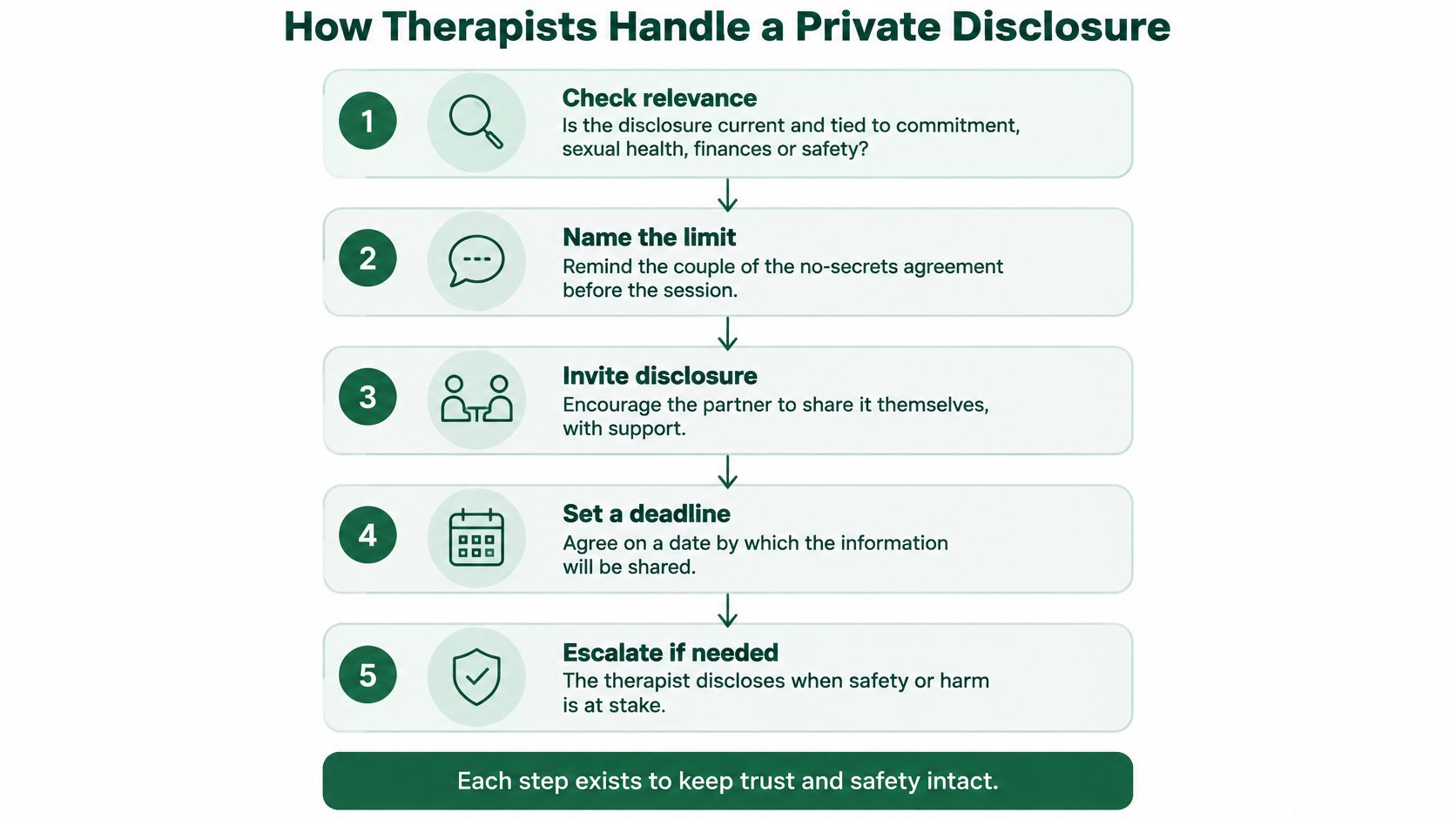
Each step exists to keep trust and safety intact.
The sequence below is the one a careful clinician follows. It exists because the alternative, reacting in the moment, is how therapists end up triangulated between two people who both believe they have an ally.
Step | Action | Reason | What each partner can expect |
|---|---|---|---|
1 | Check whether the disclosure is current and relevant to commitment, sexual health, finances or safety | Sets whether the policy is triggered at all | Both partners hear the policy restated before any action |
2 | Restate the policy and its consequences to the partner who disclosed | Keeps the consent agreement live | The disclosing partner knows what will happen next |
3 | Encourage voluntary disclosure in an individual session | Preserves the disclosing partner's agency | The other partner is not told yet |
4 | Set a defined process or timeframe for supported disclosure | Converts a vague rule into a schedule | Both partners know the deadline |
5 | Screen for coercive control, violence and retaliation risk before arranging disclosure | A rigid requirement can increase danger | Safety decides the format, not the rule alone |
6 | If disclosure cannot happen safely or the partner refuses transparent work, consider referral, suspension of conjoint treatment or a different format | Keeps the therapist from becoming a tool for concealment | Both partners learn the treatment format may change |
Why the Order Matters
Steps 1 and 2 come first because relevance is the trigger. Not every private remark activates the policy; a disclosure about a birthday gift doesn't. What activates it is information that is current and tied to commitment, sexual health, finances or safety. Restating the policy before acting keeps the consent agreement live rather than theoretical, and it gives the disclosing partner a chance to choose the timing of their own honesty.
Step 5 is where the sequence earns its keep. A rigid disclosure requirement can increase danger, so screening for coercive control, violence and retaliation risk comes before any arrangement is made.
What Changes When the Information Arrives Sideways
Therapists sometimes learn a secret from a third party, from a shared document, or from a record rather than from the partner directly. A workable policy says whether that information is treated the same way and who hears about it first. Without that clause, the therapist improvises at the worst possible moment.
Vague rules create an expectation mismatch. One partner assumes individual-session privacy while the therapist assumes relational transparency, and the gap surfaces later as perceived betrayal, premature termination or an ethics complaint. AAMFT guidance on managing client information in couples, family and group treatment separates the confidentiality owed to each individual from information-sharing within the treatment unit, and notes that a therapist generally should not pass one partner's confidence to the other without prior written permission unless the couple has agreed to a policy governing shared information. That is why the signed document matters. It makes the therapist's role, the boundaries and the foreseeable uses of information explicit.
Consultation with clinical supervisors or other treatment team members is part of how client health information is used for treatment, so a disclosure may be reviewed inside a clinical team. If you want to know how that looks across the first few meetings, this guide to what couples counseling is actually like walks through the room itself.
Practical rule: the deadline belongs in the policy, not in the therapist's memory.
When a Secret Involves Infidelity, Money or Safety
A no-secrets policy works like the triage chart in an emergency room. Patients do not all receive the same response, and the category determines what happens next. When you sit down with a provider to edit this document before intake, the categories are the part worth reading slowly, because each one triggers a different decision pathway.
Secret type | Why it matters to the other partner | Typical clinical response |
|---|---|---|
Ongoing infidelity | Affects sexual health, commitment and informed relationship decisions | Confirm it is current, encourage voluntary disclosure, set a defined timeframe |
Intent to divorce | Affects timing of shared decisions and planning | Explore voluntary disclosure within a defined process |
Paternity question | Affects family identity and parenting decisions | Assess relevance to the couple's decisions, then encourage voluntary disclosure |
Sexually transmitted infection | Affects health decisions and testing | Address promptly, after screening for safety |
Financial misconduct | Affects shared finances and decisions | Address where relevant to treatment and record it under the policy |
Safety concern or coercive control | Affects physical safety | Screen first; disclosure may be paused or handled individually |
The Infidelity Row
Couples often assume a no-secrets policy means the therapist repeats everything immediately. Research on relational therapists reports a conflict between the unfaithful partner's confidentiality rights and the other partner's autonomy to make relationship decisions with access to materially relevant information, and clinicians commonly view facilitated disclosure as more supportive of healing and attachment security than indefinite concealment (study on secrecy, disclosure and infidelity in relational therapy).
In practice, that means the therapist confirms the affair is current, explains the policy and its consequences, encourages the disclosing partner to reveal it voluntarily, and sets a defined process or timeframe for supported disclosure. The therapist does not announce it on the partner's behalf at the next session unless the safety analysis and the written policy both point that way.
The timeframe is the part you negotiate before signing. Ask how many sessions the policy allows between a private disclosure and the supported conversation, and write the answer into the document itself. A policy that says "timely disclosure" without a number leaves the hardest decision to the worst moment.
The Safety Row
Safety outranks every other row in that table. Screening for coercive control, violence and retaliation risk comes before any disclosure is arranged, because a rigid requirement can put someone in danger. Where disclosure can't happen safely, or a partner won't take part in transparent couples work, referral to individual therapy, temporary suspension of conjoint treatment or a different format may be clinically indicated.
That response keeps therapy from becoming a mechanism for maintaining deception, which is the failure mode that makes the whole policy necessary.
The middle rows run on the same logic at lower intensity. A paternity question and a financial misrepresentation both affect decisions the other partner is making right now, so the therapist assesses relevance and then works toward voluntary disclosure. A sexually transmitted infection moves faster because the health consequence is time-sensitive. Money and parenting questions can tolerate a process; a health risk can't.
Couples who arrive after an affair has already surfaced often need a structured recovery process rather than one honest conversation, and a therapist can help them decide whether that work fits their situation. Reading about what affair recovery counseling involves before the consultation gives you concrete questions to ask, so the disclosure clause you sign reflects the situation you are in rather than the one you hoped for.
Legal and Ethical Limits Your Policy Must Name
A policy that promises absolute secrecy is not a stronger promise. It's a promise no licensed therapist can keep.
Florida's confidentiality statute for licensed mental-health professionals is Florida Statutes section 491.0147, which addresses the disclosure of client records and information. A written policy in a Florida practice should name the therapist's confidentiality obligations, the client's authorization for permitted disclosures, and the applicable legal exceptions. It should also state whether both partners are treated as members of one couple-therapy treatment unit, whether separate individual sessions are included, and what happens if a partner refuses to disclose information the therapist believes prevents productive joint treatment.
The Ethical Floor Underneath the Policy
The AAMFT Code of Ethics is explicit that in couple, family or group treatment a therapist must not reveal one individual's confidences to other members of the treatment unit without that person's prior written permission, and that confidentiality and its limits must be explained at the start of services (AAMFT Code of Ethics). A policy can establish in advance that private disclosures may affect the joint work. It does not erase the informed-consent requirement before an individual confidence is shared.
What Varies by State, License and Record Type
Four things set the limits: law, professional license, the signed consent agreement, and immediate safety concerns. None of them is uniform across providers.
Neutral ethics guidance asks clinicians to clarify at the outset who the clients are, what the therapist's role is with each person, and how information may be used (APA Ethics Code). Transparency isn't automatically ethical care, either. Professional literature supports therapist judgment in some cases rather than mandatory disclosure of every secret.
Read the fine print on contact: email and text are not completely secure or confidential, and messages received plus the counselor's replies become part of the client's legal medical record.
Health information may also be disclosed to close family members or friends directly involved in treatment, based on the client's consent or as necessary to prevent serious harm. Confirm the statute and rules that apply to your provider's license and state before you sign anything, because policy wording is built on them.
When one partner's private disclosure involves controlling behavior toward the other, the limits in the policy matter even more, and this guide to couples counseling with a narcissist explains how those dynamics change what a therapist can safely do.
What to Clarify With a Provider Before Your First Session
Bring the checklist to the intake call, not to the first joint session. The answers change what you're willing to say in the room.
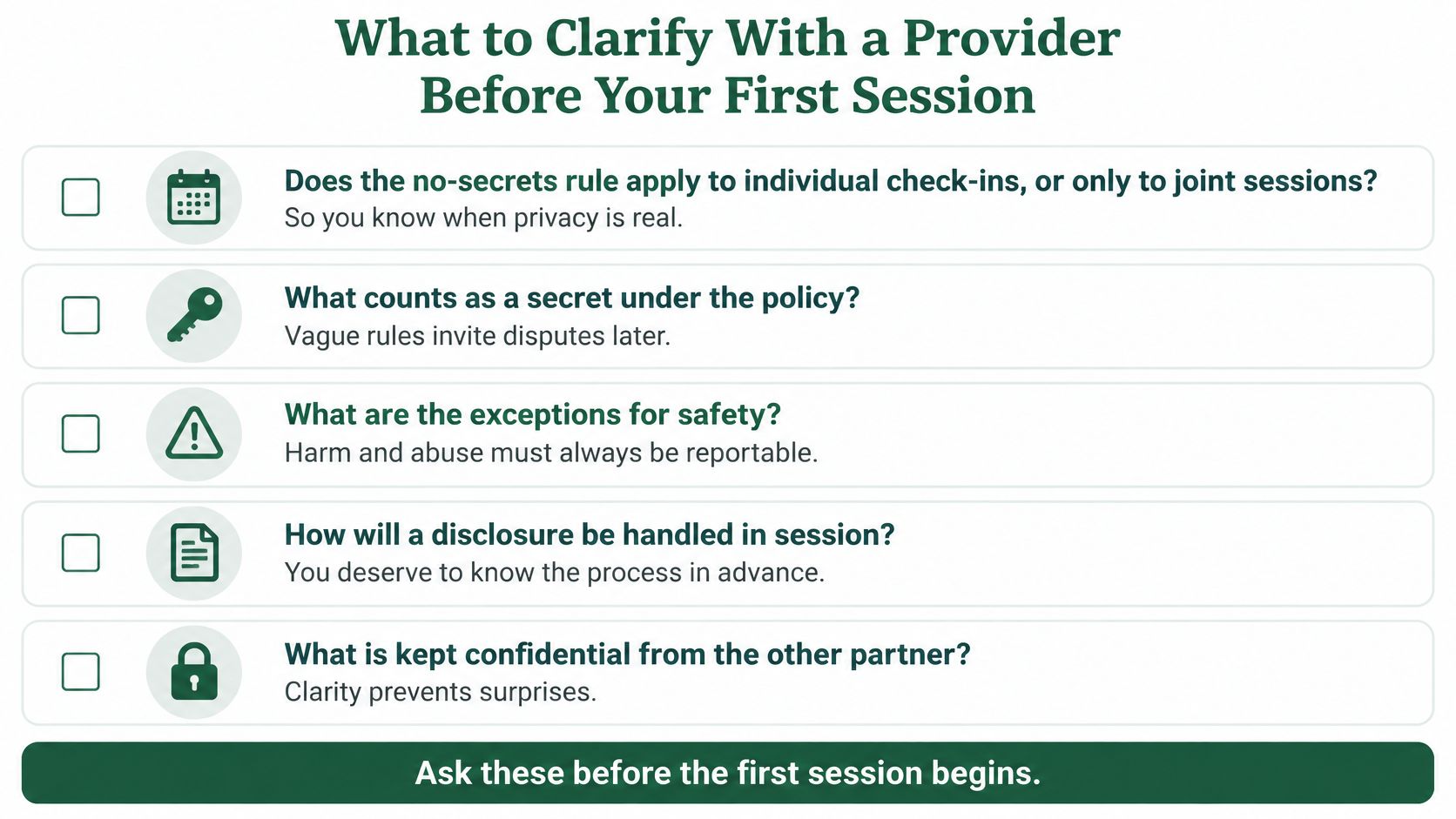
Ask these before the first session begins.
Scope of the rule. Does it apply to individual check-ins, or only to joint sessions? If private contact stays private, you know where the boundary sits.
The definition of a secret. Ask what counts. A policy that can't define the term invites a dispute later.
The hard scenarios. Ask what happens if an affair, financial deception, substance use or sexual information comes up. Ask specifically, because a generic reassurance hides the process.
Options short of disclosure. Can the therapist pause, help the person disclose safely, or refer one partner elsewhere?
Treatment unit and individual sessions. Is the couple the client, and are individual sessions inside the agreement or outside it?
Refusal. What happens if a partner won't share something the therapist considers clinically material?
Records and contact. How are notes, emails and texts handled, and where does between-session contact belong?
Some practices answer those last questions in their own paperwork. In our practice, we don't view clients' online content outside the therapy hour, and we ask clients not to email or text content related to counseling sessions unless we've discussed it first. Between sessions, the best way to reach a counselor about anything related to session content is by phone.
Those details sound administrative. They aren't. They tell you how much of your relationship the therapy can see, and what happens to a message you send at eleven at night. If you're still assembling your list, this guide to questions to ask before couples counseling covers the wider set.
Request the policy in writing before the first joint session. Reading it together is faster than discovering it separately.
Confirm the Policy Before You Book a Session
Treat the document as a signed consent form you read before the first session, not after a sensitive disclosure. Ask the checklist questions, get the answers in writing, and read them aloud together so neither of you is guessing about what the other understood.
Two things should stop you. A provider who can't explain the policy in plain language, and a policy that promises absolute secrecy. Neither survives contact with a real secret.
Choose a provider whose policy you can accept in advance, because the moment a secret appears is the wrong moment to negotiate the rule that governs it. Be Your Best Self & Thrive Counseling, PLLC is a St. Petersburg, Florida practice that offers couples counseling and a free initial consultation to explore fit and goals, so you can ask these questions before committing to anything. If you're weighing whether this therapist is the right match for both of you, this guide to finding the right therapy fit is worth reading before you call.
Write down the three answers that matter most to you both: what counts as a secret, who decides whether it enters the room, and what happens on the day one of you refuses. Then schedule the consultation.
If you want a therapist who will walk through the consent document with both of you before the first joint session, Be Your Best Self & Thrive Counseling, PLLC offers couples and marriage counseling in St. Petersburg with a free initial consultation to explore fit and goals. You can bring the questions above, get the policy in writing, and decide together which model you're both willing to sign. Visit Be Your Best Self & Thrive Counseling, PLLC to schedule that conversation.