
Trauma Informed Care Training Explained for Clinicians
If you can name the principles of trauma-informed care but still rush a distressed client through intake, what has your training changed? A certificate records completion. Trauma informed care training should also prepare you to make different decisions with clients, especially when time is short, emotions are high, or a routine procedure doesn't feel safe to the person receiving it.
For a counseling student, that distinction matters. You're learning both clinical knowledge and habits: how to ask permission, explain limits, notice distress, and respond without assuming you know someone's history. A useful course connects those habits to supervision, organizational policies, and a practical way to assess whether care changed.
Trauma Informed Care Training Formats Compared
A two-hour workshop and a year-long supervised program can carry the same catalog label, yet they prepare you for different work. One gives you vocabulary for trauma responses. The other gives you supervised chances to change what you do with clients. The table below maps the common formats so you can match one to the skill gap you have.
Trauma informed care training formats by length and purpose
Format | Typical length | What it builds | Best fit |
|---|---|---|---|
Single introductory workshop | About 2 hours | Awareness of trauma signs and basic principles | Staff new to the concept |
Multi-session course | Several weeks | Principles plus case-based application | Students and interns building skills |
Self-paced online module | Self-paced | Knowledge and attitudes | Licensed clinicians needing continuing education |
Extended program with supervision | Up to 12 months | Practice change, reflective supervision, and team reinforcement | Practicum students and agencies |
Group consultation | Ongoing sessions | Applying principles to live caseloads | Clinicians with foundational training |
These are typical planning formats, not a required standard. The AHRQ systematic review of trauma-informed care describes training ranging from a single two-hour session to initiatives lasting up to 12 months, which is where the shortest and longest entries come from. The middle lengths describe common course arrangements rather than proven effectiveness thresholds.
Reading about trauma responses works like reading about swimming: useful preparation, but it will not keep you steady in a hard session. An introductory workshop gives a team shared language for recognizing distress. A multi-session course adds rehearsal, instructor feedback, and the chance to return with questions after a skill falls flat in the room.
Self-paced modules solve a scheduling problem, so judge them by what they ask you to do. Watching a video and passing a quiz differ from having an educator observe and coach your communication. For licensing questions, review therapist continuing education requirements before enrolling, and confirm that any course is accredited, accepted for your credential, and relevant to the population you serve. Clinicians who work with pregnancy and postpartum clients can browse accredited perinatal CE courses as one starting point for that check.
Match the format to the task
Extended programs earn their length through supervised application and team reinforcement, the conditions most likely to change what happens in sessions. Group consultation assumes a foundation already exists and applies it to current caseloads. Neither format guarantees a client outcome, and a longer course is not automatically a better one. The useful question is what each format requires you to practice, and whether anyone observes that practice.
Before enrolling, answer these questions:
What is your role? Reception staff, counseling interns, and clinical directors need different practice activities.
How many hours can you commit? Count assignments and supervision time, not just attendance.
Will you sit with clients within three months? If so, choose a format that lets you rehearse the situations you will face.
How will you know it worked? Prefer formats that include observation, feedback, or a way to compare your sessions before and after training.
The Six Principles Behind Trauma Informed Care
Trauma-informed care is an organizational approach to recognizing trauma and shaping services to reduce avoidable harm. It isn't a single therapy technique or a synonym for trauma processing.
The Substance Abuse and Mental Health Services Administration's October 2014 framework describes an organization that recognizes trauma's widespread impact, understands possible recovery pathways, identifies signs and symptoms, and integrates that understanding into policies, procedures, and practices. It establishes six core principles and 10 implementation domains, connecting individual interactions with organizational responsibility.
Think of a building designed with ramps, suitable lighting, and clear signage from the outset. That's different from adding a temporary ramp when a particular visitor arrives. The clinical equivalent is designing intake, appointments, communication, and complaints processes with safety and access in mind.
Trauma-informed care changes how the whole service operates, not just how a therapist speaks.
Principles that guide decisions
Safety: Attend to physical and emotional safety, including privacy.
Trustworthiness and transparency: Explain what happens, why it happens, and what the limits are.
Peer support: Value connection and knowledge grounded in lived experience.
Collaboration and mutuality: Share decision-making and address differences in power.
Voice and choice: Recognize strengths and offer meaningful participation.
Cultural, historical, and gender issues: Consider identity, historical harm, and the context in which care occurs.
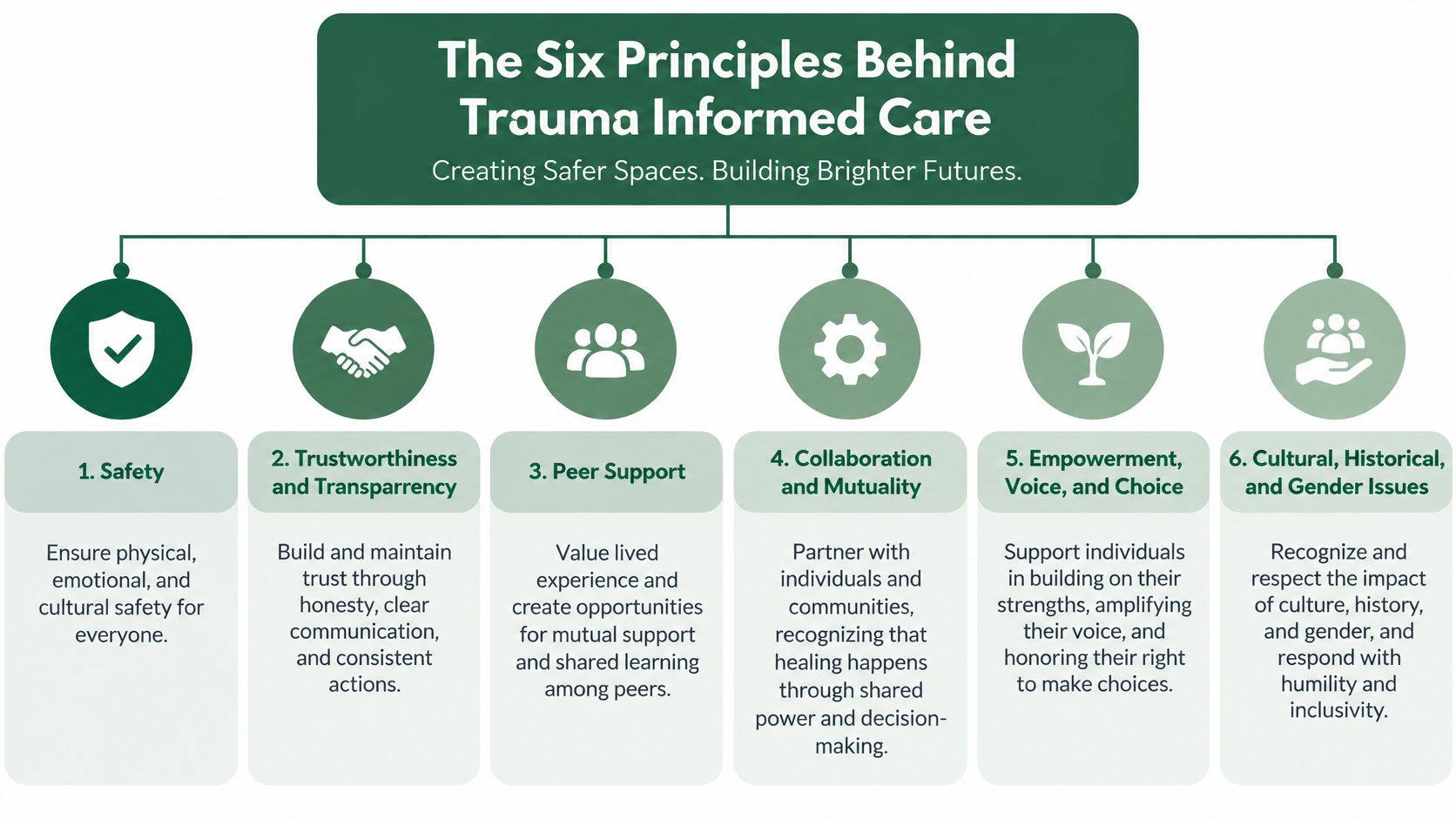
The principles connect safer relationships with changes to organizational practice.
Where organizations apply them
The implementation domains are governance and leadership; policy; physical environment; engagement and involvement; cross-sector collaboration; screening, assessment, and treatment services; training and workforce development; progress monitoring and quality assurance; financing; and evaluation. Training belongs within this larger structure, rather than replacing it.
Consider a clinic that uses an appropriate trauma screening form but asks the questions aloud in a shared waiting room. The tool may be suitable, yet the process undermines privacy, safety, and choice. Teaching staff to administer the form accurately won't resolve the environmental problem.
For a trainee, the practical lesson is straightforward: use the principles as a lens for decisions. Memorizing their names is preparation, not implementation.
Core Skills Training Should Build
Recognition comes before interpretation. A client who freezes, becomes irritable, avoids a question, or watches the exit may be distressed, but no single behavior establishes a trauma history or diagnosis. Learn to notice what's happening, ask respectfully, and consider alternative explanations.
The National Child Traumatic Stress Network's systems framework connects recognizing trauma with integrating knowledge throughout a system and resisting retraumatization. Although written for schools, its operational focus helps clarify why training must examine ordinary procedures, environments, and power dynamics, not just staff empathy.

Skills practice should connect classroom discussion with specific workplace routines.
Practice a trigger-reduction routine
Map potentially distressing routines. Walk through intake from the client's perspective. Notice personal questions at reception, blocked exits, sudden transitions, disciplinary rules, documentation practices, and who controls the pace.
Explain before proceeding. Before an assessment, describe its purpose, how information will be used, and any relevant limits. Don't assume a signature means the person understood.
Offer meaningful choices. Ask whether the client would prefer to sit nearer the door or pause before continuing. Offer only choices you can honor.
Write a response plan. Agree on what staff should do if distress appears. Include how to pause, whom to contact, and what the client finds helpful.
Debrief after a difficult session. Examine the interaction without blaming the client. Identify what staff can change and whether a policy contributed.
Communicate without surrendering boundaries
Collaborative language doesn't mean every request can be granted. Practice naming limits calmly: explain what you can offer, what you can't, and which options remain. Avoid presenting a requirement as a choice when refusal isn't permitted.
Documentation deserves the same attention. Describe observable behavior and relevant context rather than using labels such as uncooperative without explaining what happened. A note that records a client's request for a break is more useful than one that treats the request as a character flaw.
Include clinician self-care and burnout awareness in skills practice. Notice when you're rushing, becoming defensive, or struggling to remain curious, then use supervision and workload discussions rather than relying on willpower alone.
Your next practice task: write a trigger map for a room or intake process you use each week. Identify an avoidable stressor, a possible adjustment, and the person authorized to make it.
Measuring Whether Training Changed Practice
A positive course evaluation answers whether participants liked the experience. It doesn't tell you whether they explain consent differently, respond more respectfully to distress, or complete appropriate referrals.
The AHRQ executive summary describes a scoping review in which 53% of primary-care training programs assessed behavior change, reporting increased trauma screening and trauma-sensitive communication without corresponding increases in referrals; only 12% assessed patient-level outcomes. Its broader conclusion is cautious: evidence is insufficient to determine effects on patient or client health outcomes.
A systematic review of trauma-informed healthcare implementation also identifies inconsistent evaluation and limited system-level information, including adoption, fidelity, cost, and sustainability. Promising findings don't justify treating attendance as proof of improved care.
Build an evaluation chain
Start with a theory of change, a plain explanation of how an activity should lead to an improvement. For example: practicing consent conversations should improve how clinicians explain options, which should help clients participate more meaningfully.
Evaluation levels for trauma informed care training
Evaluation level | What to measure | Example indicator |
|---|---|---|
1. Reaction | Whether participants found the training useful | Post-session survey score |
2. Learning | Knowledge and attitude change | Pre and post knowledge and attitude scores |
3. Behavior | Observed practice and screening use | Standardized case ratings or supervision notes |
4. Results | Client safety, choice, complaints, and retention | Missed referrals and retention rate |
Use the table as a menu, not a demand to collect everything. A small practice might begin with a role-play rating, a client feedback question about choice, and a referral follow-through log. Define what counts before collecting results so different supervisors aren't scoring different behaviors.
Measurement safeguard: More disclosures or more completed screens aren't automatically better care. Check whether people received a safe response and appropriate follow-through.
Look beyond immediate learning
Use trauma-informed supervision to observe communication and review actual decisions. Track staff burnout and compassion fatigue alongside client-reported safety, complaints, missed referrals, retention, and coercive events where applicable.
Separate results by staff role and review them over time. Reception staff and therapists have different responsibilities, so a combined average can hide important gaps. Interpret changes cautiously: staffing, access, and referral availability can affect results independently of training.
Satisfaction surveys belong in an evaluation plan, but they can't establish practice change on their own.
Adapting Training to Culture and Disability Access
A standardized course can assume that everyone experiences the same environment in the same way. That assumption fails when a quiet room feels isolating to one person, a brightly lit office overwhelms another, or a routine demographic question raises concerns about discrimination.
A 2025 American Family Physician editorial on trauma-informed care highlights uncertainty in how the approach is defined and evaluated. Don't interpret a course's standardized presentation as proof that its examples fit every population or setting.
Consider a neurodivergent client who becomes quiet during intake. A trainee might interpret the silence as comfort or agreement. It could instead reflect sensory overload, uncertainty about the question, fear of disagreeing, or culturally grounded mistrust. Ask rather than assigning meaning.
Adapt the example, preserve the ethics
Calm behavior doesn't necessarily mean felt safety. Training should leave room for differences involving race, disability, neurodivergence, migration, poverty, gender, intimate-partner violence, and community understandings of safety.
Invite people from affected communities to help develop examples and review processes. Compensate participation where possible, explain how feedback will be used, and report which changes were made. Don't ask a participant to represent everyone who shares an identity.
Practical adaptations can include:
Sensory access: Discuss lighting, noise, seating, and waiting arrangements without requiring disclosure of a diagnosis.
Communication access: Offer readable forms, appropriate language support, and alternatives to rapid verbal questioning.
Scheduling access: Consider how transport, caregiving, work, and fatigue affect attendance.
Contextual understanding: Use culturally sensitive therapy practices to explore meaning without treating mistrust as pathology.
Accessibility isn't a reward for clients who explain their needs convincingly. Build options into routine care, then ask what else would help. Individual enthusiasm also can't compensate for unsafe policies, inadequate supervision, or a referral list with no available appointments.
Bring these questions to case discussion:
Safety: What does safety look like to this client?
Process: Which form or procedure could feel unsafe?
Continuity: Where can this client go if the referral offered is full?
Training Examples for Counselors and Clinicians
Consider a hypothetical 12-week practicum course, not a required curriculum or a claim about a particular provider's program. Its design combines foundational concepts, role-specific practice, reflective supervision, case consultation, and continuing reinforcement.
During weeks 1 to 2, students learn the framework and examine a fictional client's route from scheduling through the first appointment. They identify who controls each decision and practice explaining confidentiality, consent, and service limits in plain language.

Supervised application helps trainees turn general principles into moment-to-moment clinical decisions.
From rehearsal to case consultation
During weeks 3 to 5, students role-play intake and assessment. A simulated client declines to answer a question, asks why a form is necessary, or becomes uncomfortable with the room arrangement. The educator observes the student's response and offers specific feedback.
Each week ends with supervision around a real clinical moment discussed under applicable confidentiality requirements, or a carefully anonymized scenario. The useful question isn't merely whether the student was empathic. It's what they noticed, what they decided, and how the client could participate.
During weeks 6 to 12, case consultation adds treatment planning and service coordination. Students can examine trauma-informed therapy interventions while distinguishing an intervention's clinical purpose from the conditions needed to offer it respectfully. A short end-of-term follow-up asks students to demonstrate an applied skill and identify where they still need support.
Why supervision belongs in the design
The Texas Health and Human Services guide connects trauma-informed supervision with acknowledging staff stress, supporting wellbeing, modeling positive behavior, and fostering professional development. Supervision should therefore make room for both clinical decisions and the trainee's response to difficult work.
Concepts alone don't rehearse intake habits. A supervisor can pause a role-play, ask the student to explain their reasoning, and let them try a more collaborative response. That's a different learning task from remembering a definition.
At our practice, the owner and founder has extensive experience and training in therapy and individually trains and supervises all clinical team members. Our clinical team places particular value on ongoing training and education to stay current with the field.
When comparing curricula, look for observable practice tasks, specific feedback, and a clear supervision arrangement. A lecture list tells you what educators intend to cover, not what you'll learn to do.
Choose a Training Path Before You Enroll
Choose a course for the clinical task you need to perform, not just the certificate you'll receive. A thoughtful enrollment decision connects your current responsibilities, available time, practice opportunities, and evaluation needs.
Before adding another course to your calendar, use this checklist:
Name your role. Are you a practicum student, registered intern, licensed clinician, or agency leader? A student may need feedback on an intake conversation; a director may need help changing policy and assigning implementation responsibility.
Set a realistic time budget. Decide whether you can support a single session, a sequence of classes, or an extended program. Include preparation, consultation, and practice time rather than counting presentation hours alone.
Inspect the application component. Find out whether you'll rehearse a skill, receive observation-based feedback, or bring cases to supervision. For independent online study, arrange a suitable way to discuss application afterward.
Examine the evaluation plan. Look for a stated connection between course activities and intended changes. Useful plans distinguish participant satisfaction from demonstrated learning, clinical behavior, and client-centered indicators.
Schedule follow-up. As a practical planning choice, put reviews at three and six months on your calendar. Decide what you'll examine, who will help, and what would prompt a change in your approach.
Check readiness as well as course content
The SAMHSA practical implementation guide recommends assessing organizational readiness and capacity, including leadership, policies, workforce development, and feedback from people with lived experience. If your workplace can't provide private assessment space or an appropriate referral pathway, include those constraints in your learning plan.
Before enrolling, name the workplace decision you want to handle better and the evidence you'd accept that you're handling it differently.
For broader comparisons, review mental health training programs with attention to audience, learning activities, and support after instruction. Don't assume every advanced-sounding course is appropriate for your current scope or level of preparation.
The BYBS Training Institute is one option for practicum and internship students, registered interns, and fully licensed clinicians. We center education on integrated mind-body-spirit approaches, with online courses and group consultation reaching providers across and beyond Florida. Our practice follows the American Counseling Association Code of Ethics.
This week, compare two providers using the checklist. Ask each for its evaluation plan, an example of a role-specific practice activity, and a clear description of what support is included after instruction. Choose the option that lets you apply, examine, and refine a relevant skill, rather than leaving you with information alone.
Be Your Best Self & Thrive Counseling, PLLC offers holistic clinician education, online courses, and group consultation for students, interns, and licensed professionals. Visit Be Your Best Self & Thrive Counseling, PLLC to explore training options and discuss how they align with the trauma-informed skills you want to strengthen.
