
Your Guide to Culturally Sensitive Therapy
You may have entered therapy hoping to feel understood, only to leave wondering whether you explained yourself badly. Perhaps your therapist focused on individual coping skills while overlooking racism, immigration stress, family expectations, religion, gender identity, disability, or the language you use to describe distress. You shouldn't have to translate your life into a version that feels acceptable before you can receive care.
Culturally sensitive therapy starts from a different premise. Your culture, identity, relationships, beliefs, and social conditions aren't side notes to your mental health. They shape how you understand suffering, healing, safety, family, privacy, and support. Effective therapy makes room for that context while still using clinical knowledge responsibly.
When Therapy Feels Like It Is Missing Something
A client may describe exhaustion after repeated discrimination at work, and the therapist may respond only with breathing exercises. Another client may talk about pressure from extended family, while the therapist frames family involvement as a failure to separate. A neurodivergent client may struggle with eye contact, fast conversation, or vague homework, then get labeled resistant instead of supported.
These moments can feel subtle. The therapist may be kind, qualified, and well-intentioned, yet still miss the meaning beneath the words. You might find yourself explaining why a religious practice matters, correcting assumptions about your family, or teaching your counselor how a community experiences stigma. Therapy starts to feel like another place where you must prove that your reality is real.
That experience can affect trust. If you already worry that mental healthcare won't understand you, an unexamined assumption can confirm the fear. Barriers such as cost, access, language, stigma, and mistrust often overlap, as discussed in this resource on barriers to mental health treatment.
Start with the feeling of fit
Culturally sensitive therapy doesn't mean finding a therapist who shares every part of your identity. It means finding someone willing to understand how your identities and circumstances influence your life, without reducing you to a category.
A culturally responsive therapist might ask:
Meaning: “What does this experience mean to you and your family?”
Context: “How have racism, migration, faith, disability, gender, or economic pressure shaped this problem?”
Preferences: “What would make therapy feel safe and useful for you?”
Repair: “If I misunderstand something, how would you like us to address it?”
Those questions signal respect. They also give you permission to correct, clarify, and participate in treatment decisions.
Practical rule: You don't need to convince a therapist that your culture matters. A suitable therapist will make space to learn how it matters to you.
The first step isn't finding a perfect clinician. It's noticing whether the relationship allows your whole self to enter the room. When therapy acknowledges your lived reality, coping strategies can become more relevant, goals can become more personal, and healing can stop requiring you to leave important parts of yourself at the door.
What Culturally Sensitive Therapy Really Means
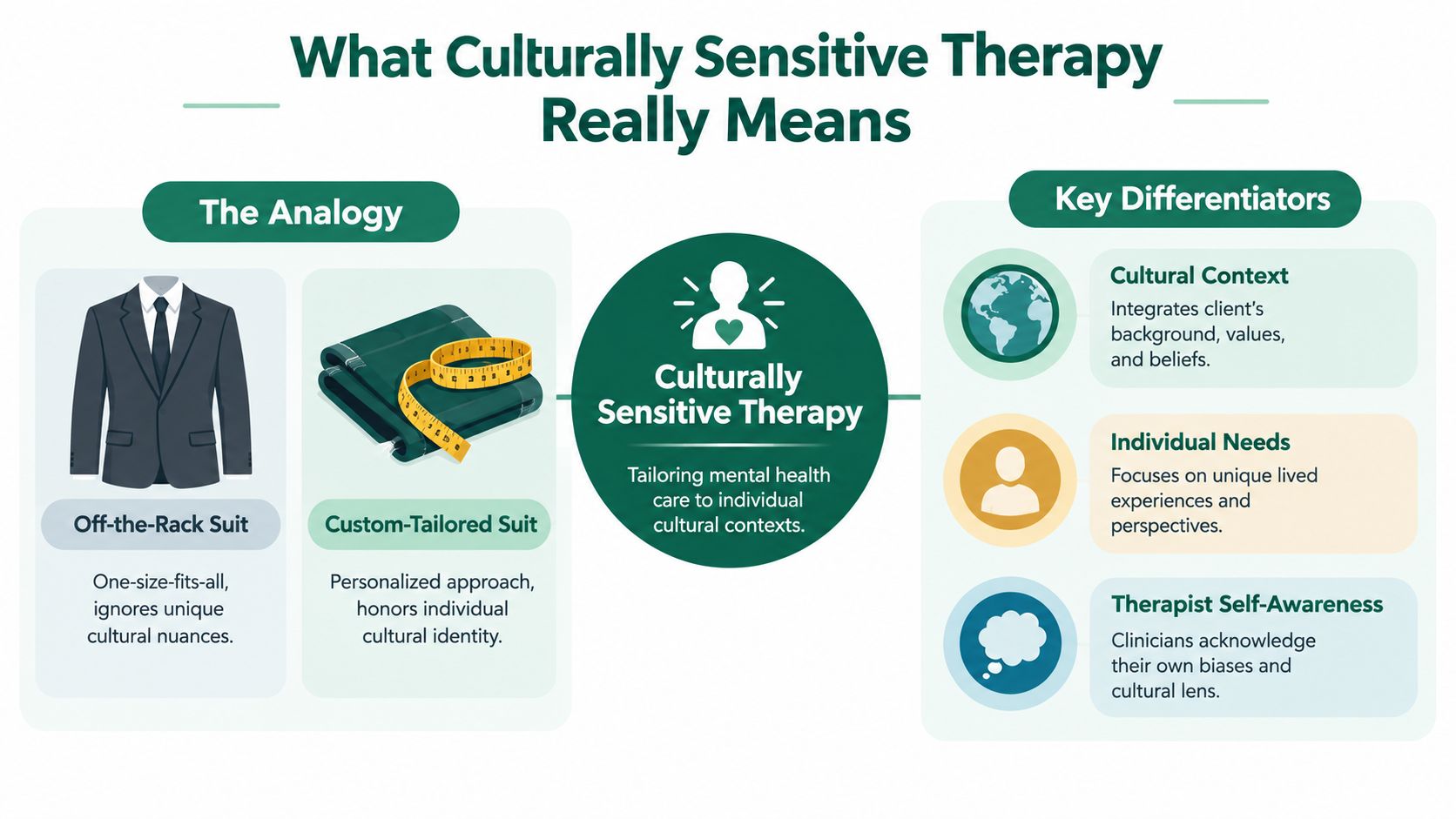
Think about an off-the-rack suit. It may be well made, but the sleeves, shoulders, and waist are based on an average shape. If the fit is wrong, the wearer gets blamed for discomfort. A custom-fitted suit starts with measurements, preferences, movement, and purpose.
Therapy works similarly. A standard treatment model can offer useful structure, but culturally sensitive therapy adapts that structure to the person receiving it. The therapist considers your cultural context, language, values, family system, spiritual beliefs, social position, and communication style. The approach remains clinically thoughtful, but it isn't forced into a shape that ignores your life.
Competence is not the finish line
Cultural competence can involve learning knowledge and skills related to cultures different from your own. That foundation matters, but it can become rigid if a therapist assumes that information about a group automatically explains an individual client.
Culture isn't a checklist. People within the same ethnic, religious, racial, or national group can hold different beliefs about privacy, family responsibility, emotional expression, healing, and professional help. A therapist who relies on broad generalizations may replace one kind of misunderstanding with another.
Cultural humility is more active and self-reflective. The therapist recognizes that they have a cultural lens, personal assumptions, and areas of limited knowledge. Instead of presenting themselves as an authority on your identity, they remain curious, accountable, and open to correction.
That shift matters because recent reviews note that ethnic disparities in mental healthcare remain largely unchanged despite wide adoption of cultural competence training. The review suggests that cultural humility, system redesign, and anti-racist practice may matter more than one-off training, as described in the recent review of cultural competence and ethnic disparities.
What the therapist practices
A culturally humble clinician may:
Examine assumptions: Notice how personal beliefs about independence, family, gender, success, or emotional expression affect clinical decisions.
Share power: Explain treatment options and invite your preferences instead of treating one model as automatically correct.
Ask before interpreting: Explore what a behavior means in your context rather than assigning a diagnosis from appearance alone.
Repair mistakes: Apologize, listen, and adjust when a comment or interpretation causes harm.
Keep learning: Seek supervision, education, community perspectives, and feedback beyond a single training.
Communication deserves special care, especially when clinicians work across languages or professional cultures. A practical guide for international professionals' communication can support broader reflection on how language, expectations, and professional interaction shape understanding.
Culturally sensitive therapy also includes intersectionality. A client's experience may be shaped by race, sexuality, gender identity, religion, class, disability, immigration history, and neurodivergence at the same time. An affirming approach, including LGBTQ-affirming therapy, doesn't assume which identity matters most. It asks the client.
Key Principles of This Approach in Practice
A therapist's approach becomes clearest in small moments. Consider a client who says, “My family expects me to be available for everyone, and I feel guilty when I say no.” A culturally sensitive therapist doesn't immediately prescribe emotional distance. They might ask what family responsibility means, which obligations feel chosen, which feel imposed, and what kind of boundary could protect the client without dismissing important relationships.
The therapist and client then build a goal that fits the client's values. The aim might be clearer communication, shared responsibility, or a respectful way to decline certain requests. The therapist isn't treating family loyalty as pathology. They're helping the client create more choice within a meaningful relationship.

Curiosity comes before interpretation
A client may describe prayer, ancestral connection, traditional healing, or community gatherings as part of coping. The therapist doesn't need to share those beliefs to respect them. They can ask how the practice supports the client, whether it ever creates conflict, and how it might fit alongside clinical care.
The same principle applies to symptoms. Quietness may reflect respect, caution, language processing, trauma, depression, or neurodivergence. Direct eye contact may feel unsafe or unnatural. A culturally responsive clinician gathers context before drawing conclusions.
Social conditions belong in the clinical picture
Suppose a client feels anxious after racial harassment, workplace exclusion, immigration uncertainty, or repeated dismissal by institutions. Therapy can address emotional responses and practical coping, but it shouldn't pretend the stress exists only inside the client.
A therapist might validate the external harm, explore safety, identify supportive people, and help the client decide what action feels possible. This doesn't mean every session becomes political discussion. It means the clinician doesn't ask the client to solve a systemic problem through self-blame.
Adaptation should remain collaborative
Evidence-based methods can be useful without being treated as inflexible scripts. A therapist might adapt written exercises for a client who prefers verbal reflection, clarify metaphors that don't translate well, include family when the client wants that, or adjust pacing for a neurodivergent client.
Trauma-informed care also benefits from cultural humility. Questions about what trauma-informed care involves can help clinicians and clients consider safety, choice, trust, collaboration, and the client's own understanding of healing.
Effective adaptation doesn't dilute therapy. It removes unnecessary barriers so the client can actually use it.
The client should know why a technique is being suggested and have room to say whether it fits. A therapist may offer a model, but the relationship should allow negotiation. That shared process turns culture from a problem to manage into a source of meaning, strength, and direction.
What to Expect and Look For as a Client
You don't need specialist knowledge to evaluate a therapist's cultural responsiveness. Pay attention to how the clinician speaks about identity before you share anything vulnerable, then notice how they respond when you bring your own experience into the conversation.
Studies highlight language barriers, different concepts of illness, social marginalization, and mistrust of therapists as core barriers for many clients, while standardized approaches can fail to fit communities' lived realities, according to this review of cultural adaptations and barriers in mental healthcare.
Green flags during a consultation
Look for behavior, not just labels on a profile.
Specific language: The therapist explains how culture, race, religion, sexuality, disability, migration, or family context may enter treatment.
Respectful curiosity: They ask what identity means to you instead of assuming they already know.
Flexible communication: They discuss language access, pacing, sensory needs, telehealth preferences, and ways to make sessions easier to follow.
Shared decisions: They describe treatment as collaborative and invite you to discuss goals, methods, and concerns.
Accountability: They can acknowledge limits and explain how they seek consultation or continued education.
Contextual thinking: They recognize that discrimination, marginalization, and social conditions can affect mental health.
An inclusive website can be a helpful initial signal, but it isn't proof of fit. Read the therapist's actual words. Look for concrete descriptions of who they work with, how they adapt care, and whether they discuss intersecting identities rather than presenting culture as a list of holidays or food traditions.
Questions you can ask directly
You can keep the tone conversational:
“How do you adapt your approach when a client's cultural values differ from your own?”
“How do you work with clients who describe distress through spiritual, physical, relational, or community language?”
“What experience do you have with my cultural background or community?”
“How would you respond if I told you that a problem is connected to racism, discrimination, or immigration stress?”
“Can we discuss language, an interpreter, or communication preferences?”
“How do you adapt structured approaches when they feel too rigid?”
“What happens if you misunderstand something important about my identity?”
You aren't testing the therapist for perfection. You're learning whether they can listen without becoming defensive.
Red flags deserve attention
Be cautious if a clinician makes broad claims about your group, treats family involvement as automatically unhealthy, dismisses discrimination as unrelated to symptoms, or insists that one standardized method must work for everyone. A therapist who minimizes language needs, rushes past mistrust, or interprets your hesitation as noncompliance may not be prepared to build the safety you need.
A free consultation can help you explore these questions before committing. You can learn how a free consultation works and use that conversation to assess respect, clarity, access, and emotional comfort.
You can also leave. Finding a poor fit doesn't mean therapy has failed or that you're difficult to help. It means the relationship wasn't meeting your needs.
How to Find a Culturally Sensitive Therapist
Begin with the identities and experiences you want a therapist to understand, not with a vague search for someone who is “good with diversity.” Write a short list that might include language, race or ethnicity, religion, LGBTQIA+ identity, neurodivergence, immigration history, family structure, disability, or experiences of discrimination. Then decide which factors are essential, which are preferences, and which you want the therapist to approach with particular care.
Search specialized directories
Directories built around particular communities can make the first search less isolating. You might explore Therapy for Black Girls, the National Queer & Trans Therapists of Color Network, or directories focused on Latinx clients, Muslim clients, Asian American communities, disability, or neurodivergence.
Treat a directory listing as a starting point rather than a guarantee. Review the therapist's profile, website, licensure information, stated specialties, and consultation process. Notice whether the language describes real clinical practices or repeats broad terms such as “multicultural” without explanation.
Read profiles for useful signals
Keywords can help you narrow results, but the surrounding details matter more. Look for phrases related to:
Cultural humility: The therapist describes ongoing learning, self-reflection, supervision, or accountability.
Affirming care: The profile names identities and experiences without treating them as disorders.
Adapted treatment: The clinician explains flexibility with CBT, trauma therapy, couples work, communication, or homework.
Whole-person context: The therapist welcomes conversations about family, spirituality, community, discrimination, and social conditions.
Accessibility: The practice explains language support, telehealth, scheduling, sensory considerations, and fees clearly.
For people in St. Petersburg and the wider Tampa Bay area, local searches can include therapist directories, professional associations, community organizations, primary-care referrals, and trusted cultural or faith communities. Ask whether the therapist serves your location, offers telehealth, understands local access barriers, and works with the identities relevant to your care.
Use the first conversation as a fit check
Prepare a few questions before contacting a clinician. Ask how they adapt treatment, how they handle cultural misunderstandings, and whether they've worked with concerns such as family conflict, racial stress, migration, LGBTQIA+ identity, or neurodivergence. You don't have to disclose your full history during the first call.
A therapist's response can tell you a great deal. Do they answer specifically? Do they ask what you need? Do they acknowledge limits without making you responsible for educating them? Do you feel rushed, judged, or pressured?
The same process applies when you're looking for a trauma-informed therapist. Safety and trust aren't abstract qualities. You can assess them through the therapist's pace, language, transparency, and willingness to collaborate.
The right search question isn't “Does this therapist know my culture?” It's “Can this therapist respectfully learn how my culture shapes my experience?”
You may need to contact several clinicians before finding availability and fit. That process can be tiring, especially when you're already distressed, so ask a trusted person to help review profiles or organize calls. A short list and a few prepared questions can make the search more manageable.
A Path Forward for Clients and Clinicians
Clients deserve care that recognizes the whole person. You shouldn't have to choose between evidence-informed therapy and respect for your culture, identity, family, language, spirituality, or lived experience. A thoughtful clinician can use established therapeutic methods while adapting communication, goals, examples, pacing, and relationships to the person in front of them.
Clinicians carry a different responsibility. Cultural sensitivity isn't a certificate a provider earns and then sets aside. It requires continuing self-reflection, honest attention to power and privilege, consultation, community learning, and willingness to change clinical habits when they create barriers.
That responsibility also includes noticing when distress may require broader support. For accessible background on signs of mental health challenges, clinicians can strengthen their ability to recognize concerns while still asking clients how those experiences make sense within their lives.
Learning must become practice
Training matters most when it changes what happens in the room. Practicum students, registered interns, and licensed therapists can deepen their work through specialized education, experiential learning, consultation, and deliberate examination of clinical decisions. The BYBS Training Institute supports clinicians through holistic training, online courses, and group consultation for providers in Florida and beyond.
For clients, the message is equally practical. You can ask questions, request adaptations, name harm, seek another opinion, and choose a therapist who treats your context as clinically relevant. You deserve a relationship where curiosity replaces assumption and collaboration replaces correction.
Culturally sensitive care is more ethical because it respects the client's dignity and self-determination. It can also be more effective because treatment becomes easier to understand, safer to discuss, and more connected to the client's actual life. Whether you're seeking support or providing it, the work begins with listening closely and continues with the humility to keep learning.
Be Your Best Self & Thrive Counseling, PLLC offers inclusive individual, couples, and marriage counseling for anxiety, depression, trauma, stress, life transitions, and unhealthy patterns, with care adapted to each client's identity and goals. Visit Be Your Best Self & Thrive Counseling, PLLC to learn about services in St. Petersburg and the Tampa Bay area and request a free initial consultation to explore fit.