
Trauma and Healing: Your Roadmap to Recovery
You wake up tired after a full night in bed. A message from your manager makes your chest tighten, a minor disagreement feels strangely dangerous, and by evening you're either tense and restless or completely shut down. You may understand that the present moment is safe, yet your body keeps reacting as if something terrible is about to happen.
That confusion can be painful. Trauma and healing become easier to understand when you stop treating your reactions as character flaws and start seeing them as protective responses that learned to stay alert. Recovery usually involves more than remembering the past. It can include learning safety in the body, rebuilding trust in relationships, caring for daily needs, and reconnecting with identity and community.
Recognizing the Signs of Trauma in Everyday Life
Maya sits on the edge of her bed, hand pressed against her chest. Nothing dangerous is happening. Her apartment is quiet, her phone is face down, and the difficult event happened long ago. Still, her body feels like a car alarm that keeps blaring after the threat has disappeared.
She checks the door repeatedly. Her shoulders remain raised. A kind question from her partner feels like criticism, so she snaps, then feels ashamed. Later, she goes emotionally blank and stares at the wall, unable to explain what she's feeling. These reactions can look unrelated, but they may all reflect a nervous system struggling to recognize safety.

Caption: A concerned woman notices the physical and emotional effects of trauma while sitting in a quiet, familiar space.
What trauma can look like
Trauma doesn't always appear as a clear memory or an obvious crisis. It may show up as:
Persistent alertness: You scan rooms, monitor other people's moods, or expect bad news even during ordinary activities.
Body tension: Your jaw, stomach, neck, or shoulders stay tight, as though you're preparing to defend yourself.
Emotional flooding: Anger, fear, grief, or panic arrives with more intensity than the current situation seems to justify.
Avoidance: You stay away from places, conversations, sensations, or relationships that remind you of what happened.
Disconnection: You feel detached from your body, your surroundings, or your emotions. Some people describe this as moving through the day behind glass.
Changes in trust and identity: You may struggle to believe others, question your judgment, or feel defined by the experience.
These responses aren't proof that you're broken. They're signs that your system adapted to an experience it perceived as overwhelming. The response may have helped you survive then, even if it creates difficulties now.
A useful question: “What is my body trying to protect me from right now, and does this moment contain the same danger?”
Healing begins with curiosity rather than self-criticism. Notice when the alarm starts, what sensations appear first, and what helps even slightly. You don't have to force the alarm to switch off. You can begin by giving your body repeated evidence that the present is different from the past.
How Your Nervous System Stores and Releases Trauma
Your nervous system acts like a rapid communication bridge between your body and the world around you. It helps you mobilize when danger appears, conserve energy when escape feels impossible, and return toward connection when conditions become safer.
Trauma can make this system react to reminders as though they're current threats. A tone of voice, smell, date, location, or facial expression may activate the same protective pattern as the original event. The reaction is automatic, not a deliberate decision, which is why telling yourself to “just calm down” often doesn't work.
Four protective states
Fight and flight prepare the body to act. You might feel agitated, angry, restless, panicked, or driven to escape. Your attention narrows toward possible danger.
Freeze and shutdown can appear when action feels impossible. You might feel numb, heavy, foggy, detached, or unable to speak. This isn't laziness. It's a protective reduction in activity.
Fawn centers on preventing conflict by accommodating other people. You may agree quickly, hide your needs, apologize excessively, or focus on keeping everyone else comfortable.
Safety and connection become more available when your body receives enough signals of protection. Breathing may soften, attention may widen, and you may find it easier to think, communicate, and make choices.
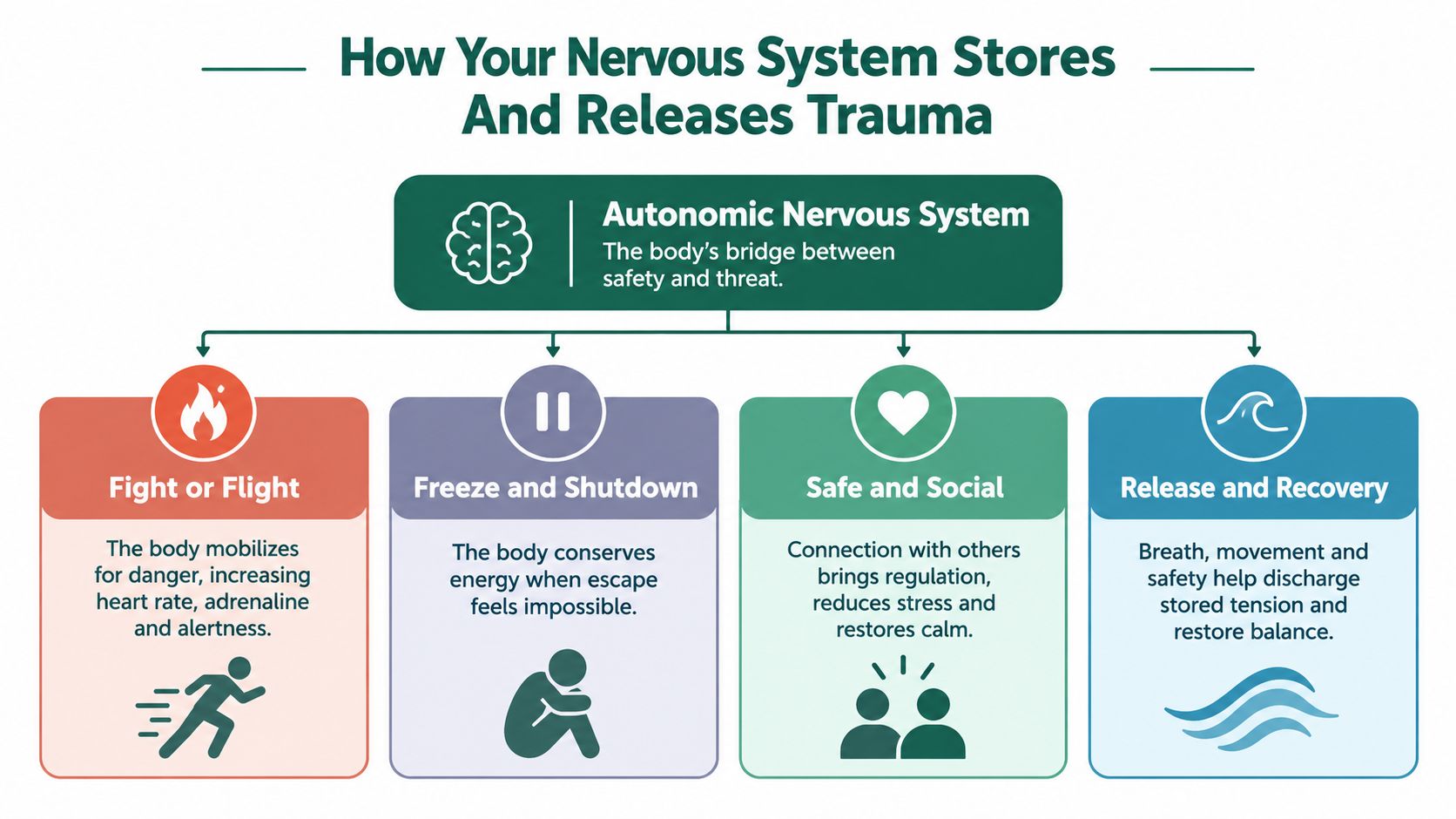
Caption: A hierarchy diagram shows how the autonomic nervous system moves between threat responses, connection, and recovery.
A helpful explanation of the body's communication system appears in this guide to how the nervous system works. Understanding these patterns separates you from the reaction. You're not “an anxious person” in every part of your identity. You're a person whose protective system may be sending a danger signal.
Teaching the body that danger has passed
Release doesn't mean forcing memories away or making yourself feel calm on command. It can involve small, repeated experiences of safety, such as slowing your exhale, noticing your feet on the ground, moving your body, or speaking with someone trustworthy. With practice and appropriate support, the brain and body can learn responses that fit the present more accurately.
The Scope of Trauma, You Are Not Alone
Trauma is widespread, although people often experience it in private. In a CDC survey of U.S. adults from 2011 to 2020, 63.9% reported at least one adverse childhood experience, or ACE, and 17.3% reported four or more. The CDC defines ACE exposure through experiences such as abuse, household dysfunction, and other forms of childhood adversity. The CDC's analysis shows why trauma-informed care belongs in ordinary health and community conversations, not only in specialized clinics.
The figures are also substantial among high school students. The CDC reported that 76.1% experienced at least one ACE and 18.5% experienced four or more. Reported experiences included emotional abuse at 61.5%, physical abuse at 31.8%, household mental health problems at 28.4%, household substance use at 25.1%, witnessing intimate partner violence at 18.6%, and parental incarceration or detention at 14.5%. These figures don't tell us how any one person will heal, but they do challenge the idea that trauma is rare or marks someone as abnormal.
The public health consequences are serious. The CDC estimates that ACE-related health consequences cost the United States about $14.1 trillion each year in direct medical spending and lost healthy-life years. That estimate helps explain why prevention, early support, accessible counseling, and community care matter alongside individual treatment.
PTSD is not inevitable after trauma, and symptoms often lessen with time. A worldwide review found an overall lifetime PTSD prevalence of about 5.6% in the general population, while reviews of adults exposed to trauma found median prevalence of 28.8% at one month and 17% at twelve months in one synthesis, and pooled prevalence of 27.0% at one month, 17.6% at three months, and 16.9% at twelve months in another, as summarized in this umbrella review of PTSD prevalence. Healing is common, yet support remains important for people whose symptoms persist or interfere with daily life.
Choosing the Right Therapeutic Approach for Your Needs
Different therapies help in different ways. The right choice depends on your symptoms, your goals, your readiness to process traumatic memories, and whether you currently have enough stability to do that work safely.
EMDR, or eye movement desensitization and reprocessing, uses structured attention and guided bilateral stimulation while you work with distressing memories, beliefs, body sensations, and present-day triggers. Trauma-focused CBT helps you examine trauma-related thoughts and patterns while gradually developing new ways to respond. Both approaches focus directly on trauma rather than offering only general encouragement.
A recent network meta-analysis found large effects for EMDR, with a standardized mean difference of -2.07, and trauma-focused CBT, with an SMD of -1.46, compared with a waitlist. The reported confidence or credibility ranges were -2.70 to -1.44 for EMDR and -1.87 to -1.05 for trauma-focused CBT, and benefits also persisted at follow-up from one to four months. These findings are reported in the network meta-analysis of psychological PTSD treatments.
Match the approach to the moment
Use these questions to guide a conversation with a therapist, not to diagnose yourself:
You feel overwhelmed by reminders: Ask about stabilization, grounding, and whether processing should begin gradually.
You want to work directly with memories: Discuss EMDR or trauma-focused CBT, including how the therapist will help you remain within a manageable level of distress.
You feel numb or disconnected: Ask how treatment addresses dissociation, body awareness, and pacing.
Your relationships are suffering: Consider therapy that includes communication, boundaries, attachment patterns, or couples work when appropriate.
You're not ready to revisit the past: Supportive counseling and practical regulation work can build safety before deeper processing.
Trauma-focused therapies also appear helpful across different trauma histories. A meta-analysis found strong post-treatment effects versus passive controls for both single-event PTSD, with Hedges' g of 1.04, and multiple-event PTSD, with Hedges' g of 1.13, as reported in this meta-analysis of psychological interventions. The results support hope for people affected by repeated or complex trauma, while your individual response will still depend on fit, timing, access, and the quality of the therapeutic relationship.
For a plain-language explanation of what this work may involve, see this overview of trauma-focused therapy. A good therapist won't rush you into a method just because it's popular. They'll explain the rationale, invite your questions, and adjust the plan when your body signals that the pace is too intense.
Beyond Symptom Reduction, Whole-Person and Community Healing
Fewer flashbacks or panic episodes can mark progress, yet recovery also includes how safely a person can take part in daily life. Someone may sleep better while remaining disconnected from family, culture, purpose, identity, or physical wellbeing. A useful question is: Can this person participate in life with more choice, connection, and belonging?
Trauma can affect the nervous system, relationships, and sense of place at the same time. An overactive smoke alarm may keep signaling danger after the immediate threat has passed. In the same way, a person may need steady support from trusted people, a safe environment, meaningful routines, and cultural connection, alongside therapy.
These needs matter especially in communities facing geographic, financial, cultural, or systemic barriers to care. A 2026 scoping review of healing services for Aboriginal and Torres Strait Islander people identified 80 services or programs and 15 exemplars. It also found limited published evaluations, despite reported improvements in wellbeing, cultural connection, and family and community relationships. The review and related discussion describes limited guidance for bringing trauma-aware and healing-informed approaches into health promotion. Much of the available evidence remains conceptual rather than ready for broad implementation.

Caption: A supportive group creates space for shared experience, connection, and relational healing.
What a wider healing plan can include
Relationships: Safe people provide opportunities to practice trust, boundaries, repair, and honest communication.
Culture and identity: Language, ceremony, ancestry, community traditions, and chosen family can restore meaning that individual therapy may not provide alone.
Environment: Stable housing, accessible healthcare, predictable routines, and physical safety reduce the demands placed on an alert body.
Purpose: Creativity, work, caregiving, spiritual life, and contribution help recovery become more than symptom management.
Families supporting neurodivergent children may need care that respects sensory needs, communication differences, and the child's surroundings. A resource on support for overwhelmed autistic kids can help caregivers consider individualized support rather than behavior correction alone.
This perspective on whole-person mental health treatment reflects the practical reality that people heal in bodies, families, neighborhoods, and cultures. Therapy remains one part of a wider support network, connected to relationships, self-care, and community life.
Practical Self-Care Tools for Daily Regulation
Self-care becomes more useful when you treat it as communication with the body rather than a reward for finishing everything else. A regulated routine won't erase trauma, but it can give your system more predictable experiences of support.
Start with one tool and practice it when you're only mildly activated. Learning a strategy during a crisis is harder than building familiarity during a calm moment.
Build a small regulation toolbox
Box breathing: Inhale, hold, exhale, and hold again for four counts each. If holding your breath feels uncomfortable, use a slower, comfortable exhale instead.
Grounding 5-4-3-2-1: Name five things you see, four you feel, three you hear, two you smell, and one you taste. This directs attention toward current sensory information.
Cold water reset: Splash cool water on your face or hold a cool cloth against your cheeks. Stop if it feels distressing, and choose a gentler option if you have a medical reason to avoid sudden cold.
Gentle movement: Stretch your hands, walk slowly, roll your shoulders, or shake out your arms. Movement can help your body complete a small action instead of remaining braced.
Consistent sleep routine: Keep your waking and bedtime patterns as predictable as your circumstances allow. A regular rhythm gives the body fewer changes to manage.
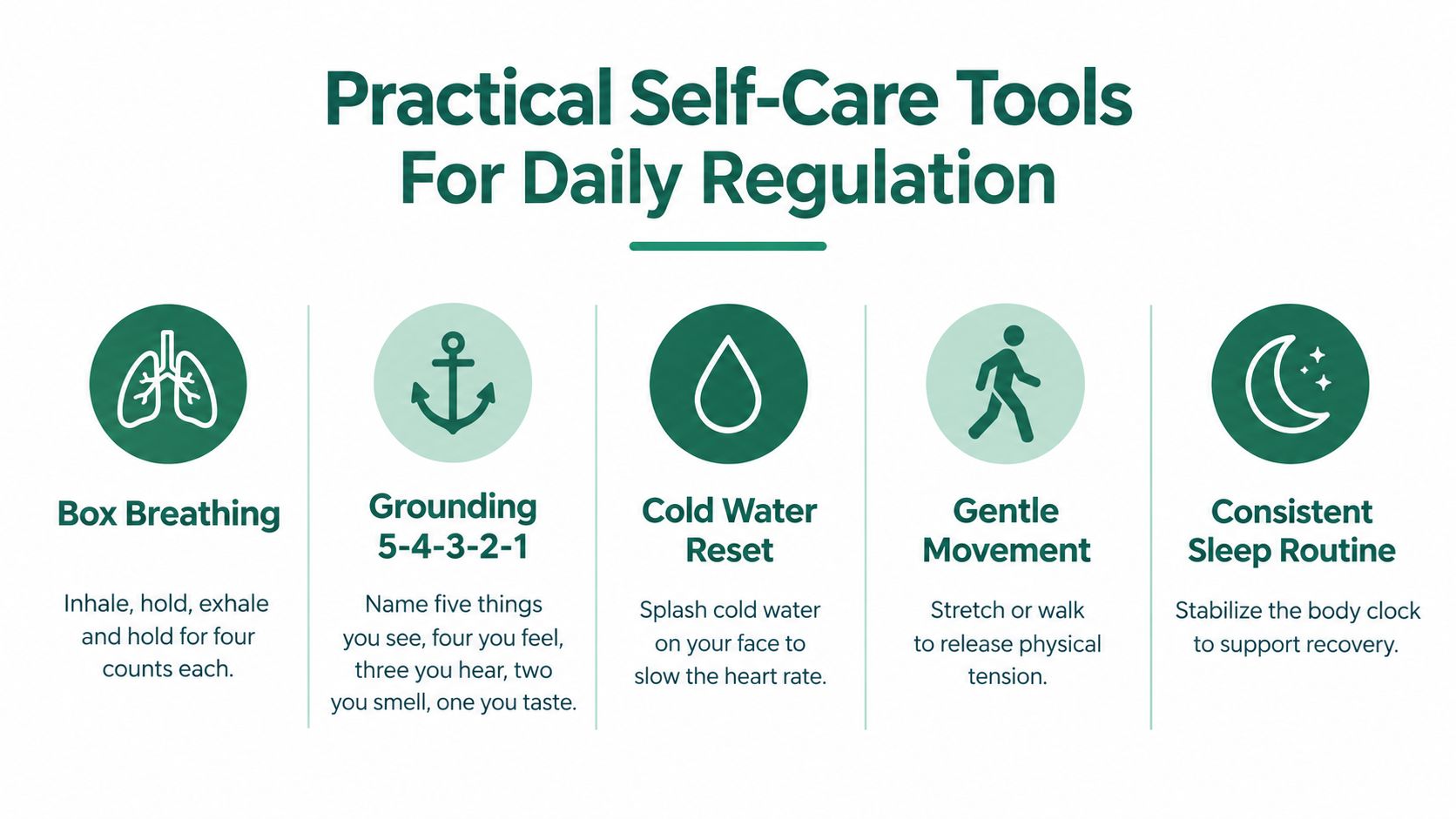
Caption: Five accessible practices support daily regulation through breathing, sensory grounding, movement, cooling, and sleep consistency.
Match the tool to your state. If you're agitated, try orienting to the room, lengthening your exhale, or walking at an easy pace. If you feel shut down, gentle light, music, stretching, or a warm drink may help you reconnect without demanding too much.
Journaling can also reveal patterns between triggers, sensations, thoughts, and needs. For more ideas about personalized emotional healing strategies, choose prompts that encourage observation rather than self-judgment. You might write, “What happened, what did I notice in my body, and what would help me feel one degree safer?”
The window of tolerance explained here can give you language for recognizing when you're becoming overactivated or disconnected. Self-care works best as a flexible practice, not another standard you can fail.
When to Seek Professional Support and How to Find It
Self-care is valuable, but it shouldn't carry the entire burden of trauma recovery. Seek professional support when distress keeps disrupting sleep, work, parenting, relationships, decision-making, or basic daily tasks. Severe dissociation, persistent hopelessness, escalating substance use, thoughts of harming yourself or someone else, or feeling unable to stay safe require prompt help. If you're in immediate danger, contact emergency services or a crisis service in your area.
Begin with a licensed mental health professional who has training and experience in trauma care. During an initial consultation, ask:
What trauma approaches do you use?
How do you establish safety before processing memories?
How will we know whether the pace is too fast?
What happens if I become overwhelmed or disconnected?
How do you adapt care for culture, disability, neurodivergence, or relationship needs?
A trauma-informed therapist should explain your options without pressure, respect your boundaries, and welcome collaboration. You don't need to commit after one conversation. This guide to finding a trauma-informed therapist can help you prepare for that search.
Trust matters, but perfect comfort isn't required at the start. Look for enough safety to ask questions, enough respect to disagree, and enough clarity to understand what you're choosing.
Your Journey from Surviving to Thriving
Healing rarely moves in a straight line. You may have a calm week, encounter an unexpected trigger, and feel as though you've lost all progress. A setback usually means you've found a place that needs more support, not proof that healing has failed.
Over time, Maya begins to notice the first signs of activation before they become a crisis. She pauses, feels her feet, texts a trusted friend, and chooses a slower conversation instead of disappearing or lashing out. Therapy helps her process what happened, while rest, movement, relationships, and cultural connection help her build a life that isn't organized around the old alarm.
The same whole-person approach applies to physical recovery. If pain and trauma overlap in the body, practical resources such as recovery tips for shoulder pain may complement, but never replace, guidance from an appropriate healthcare professional.
Your past can shape your protective patterns without dictating your future. The next step may be a therapy consultation, a grounding practice, or telling one safe person what you've been carrying.
Be Your Best Self & Thrive Counseling, PLLC offers evidence-informed, integrative counseling for trauma, anxiety, depression, stress, relationships, and life transitions, with care that connects mind, body, and daily functioning. Visit Be Your Best Self & Thrive Counseling, PLLC to learn about services and request a free initial consultation to discuss fit and goals.