
Therapy for Perfectionism: Evidence-Based Paths to Healing
You've written the email three times, changed the subject line twice, and still can't press send. The task is simple, but your mind keeps producing one more flaw to fix. Meanwhile, the deadline moves closer, your shoulders stay tense, and a small mistake begins to feel like evidence that you're failing as a person.
Therapy for perfectionism isn't about becoming careless or abandoning ambition. It's about separating healthy standards from the punishing beliefs that make your worth depend on flawless performance. The most useful treatment depends on what perfectionism is doing in your life, whether it's driving anxiety, maintaining depression, protecting you from shame, or appearing as one part of a deeper relational wound.
Understanding Perfectionism and Its Hidden Costs
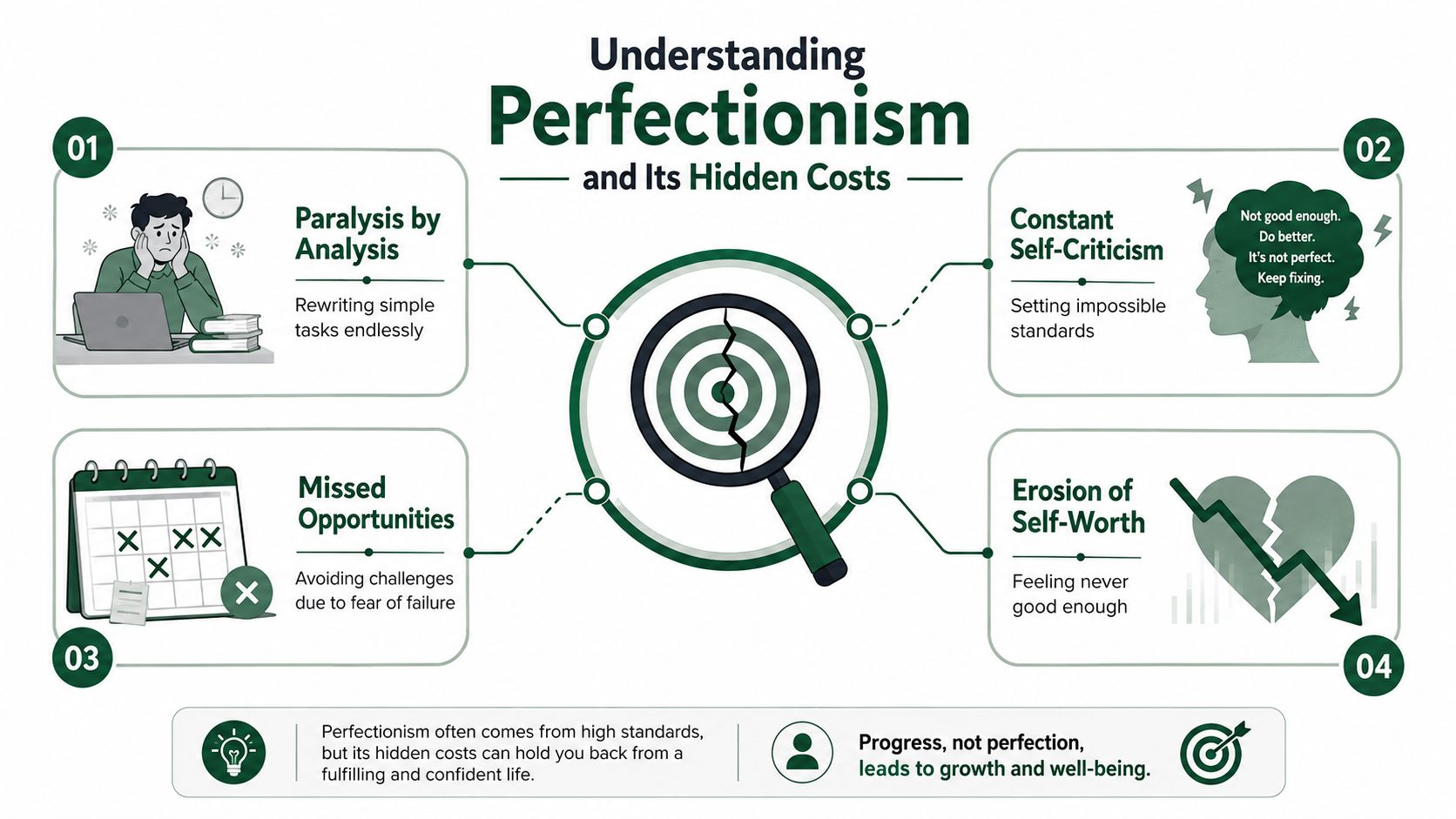
A client may arrive looking successful on paper. They meet deadlines, perform well, support colleagues, and rarely let anyone see how much effort ordinary tasks require. Yet drafting a routine email can take an hour because every sentence feels vulnerable to criticism. A missed detail becomes a personal indictment, not a correctable event.
Clinically, perfectionism is multidimensional. It can involve excessively high standards, relentless self-criticism, fear of mistakes, and self-esteem that rises or falls with performance. Healthy striving allows flexibility. You can pursue excellence, notice an error, and continue. Maladaptive perfectionism turns achievement into a condition for feeling safe, acceptable, or worthy.
The difference often appears in what happens after the inevitable imperfection. A person with adaptive striving adjusts the plan. A perfectionistic person may procrastinate, overprepare, avoid a challenge, seek repeated reassurance, or punish themselves internally. The behavior can look like dedication from the outside, while the emotional experience feels closer to entrapment.
The pattern beneath the performance
Hewitt and Flett's multidimensional model distinguishes self-oriented perfectionism, other-oriented perfectionism, and socially prescribed perfectionism. Self-oriented perfectionism directs impossible standards inward. Other-oriented perfectionism judges other people against rigid expectations. Socially prescribed perfectionism involves feeling that others demand flawlessness and will withdraw approval if you fall short.
These patterns can create chronic stress, burnout, relationship strain, and procrastination driven by fear of failure. Perfectionism also commonly appears alongside anxiety, depression, and eating-disorder symptoms, which is why the pattern deserves clinical attention rather than praise alone. Psychological interventions can reduce perfectionism and symptoms associated with anxiety, depression, eating disorders, and obsessive-compulsive difficulties, as described in this systematic review and meta-analysis of psychological interventions.
A useful first step is to notice the language of the inner critic. Statements such as “I should have done more,” “Everyone will notice,” or “If I can't do it perfectly, there's no point” reveal the rules maintaining the cycle. You can also explore examples of negative self-talk to identify how self-criticism disguises itself as motivation.
Practical rule: Therapy doesn't ask you to lower every standard. It asks you to stop using standards as a weapon against your own humanity.
Should Perfectionism Be Treated Directly or Indirectly
The clinical answer depends on what keeps the pattern active. Perfectionism can be a direct treatment target, a process that maintains another disorder, or both at different points in care. A client may need focused work on perfectionistic rules, or may improve as anxiety, depression, or another primary concern receives treatment.
Direct treatment fits when perfectionism is causing clear impairment. A client who avoids applications, cannot finish work, restricts food after perceived failure, or spends much of the day checking and revising may benefit from behavioral experiments focused on standards, mistakes, reassurance, and avoidance. CBT for perfectionism has produced medium-to-large reductions in personal standards, concern over mistakes, and clinical perfectionism, while also reducing depression, anxiety, and eating-disorder symptoms, according to this systematic review and meta-analysis.
Indirect treatment may fit better when anxiety or depression drives the presentation. A 2026 randomized study of people receiving internet-based CBT for generalized anxiety found that baseline perfectionism was associated with greater pre-treatment severity, but did not predict treatment completion or symptom reduction. Treatment reduced perfectionism even though it was not directly targeted. Addressing the central anxiety process may therefore loosen perfectionistic behavior as a secondary benefit. The findings appear in this randomized study of perfectionism during internet-based CBT.
What the evidence says about treatment planning
Perfectionism does not always block recovery. A 2025 systematic review found that higher baseline perfectionism predicted poorer mental health treatment outcomes in 9 of 16 studies, or 56%. 5 of 16 studies, or 38%, found no significant association, while 1 of 16 studies, or 6%, reported mixed findings. Among child and adolescent studies, 4 of 5 reported negative impacts. These figures come from the 2025 systematic review of randomized controlled trials.
A therapist will usually consider:
Functional impairment: Is perfectionism consuming time, blocking action, or damaging relationships?
Primary symptoms: Are anxiety, depression, eating concerns, or obsessive-compulsive symptoms urgent?
Developmental history: Does the pattern connect with conditional approval, attachment wounds, or trauma?
Readiness: Can the client experiment with imperfection, or does that prospect currently feel unsafe?
Clinical Profile | Recommended Approach | Rationale |
|---|---|---|
Perfectionism is causing avoidance, checking, or paralysis | Direct CBT-based work | Behavioral experiments can test feared consequences and weaken rigid rules |
Generalized anxiety or depression is dominant | Treat the broader condition while monitoring perfectionism | Perfectionism may soften when the primary symptoms improve |
Shame, self-criticism, or conditional-worth beliefs are central | Direct work with compassion and relational history | The client may need safety and self-kindness before challenging standards |
Perfectionism appears tied to early relationships or trauma | Integrative treatment | Addressing the underlying wound may change the protective pattern |
The treatment plan should also include the mind-body connection in therapy. Perfectionism often appears through physical tension, urgency, fatigue, and difficulty resting. The practical question is: what maintains the pattern, and how much direct attention will help this client at this stage?
Evidence-Based Therapy Approaches for Perfectionism
Therapy works best when it matches the process maintaining perfectionism. A client who avoids action may need direct behavioral work. Someone whose perfectionism rises with depression or generalized anxiety may benefit from treating the broader condition first, while tracking how rigid standards change.
CBT for action and behavioral flexibility
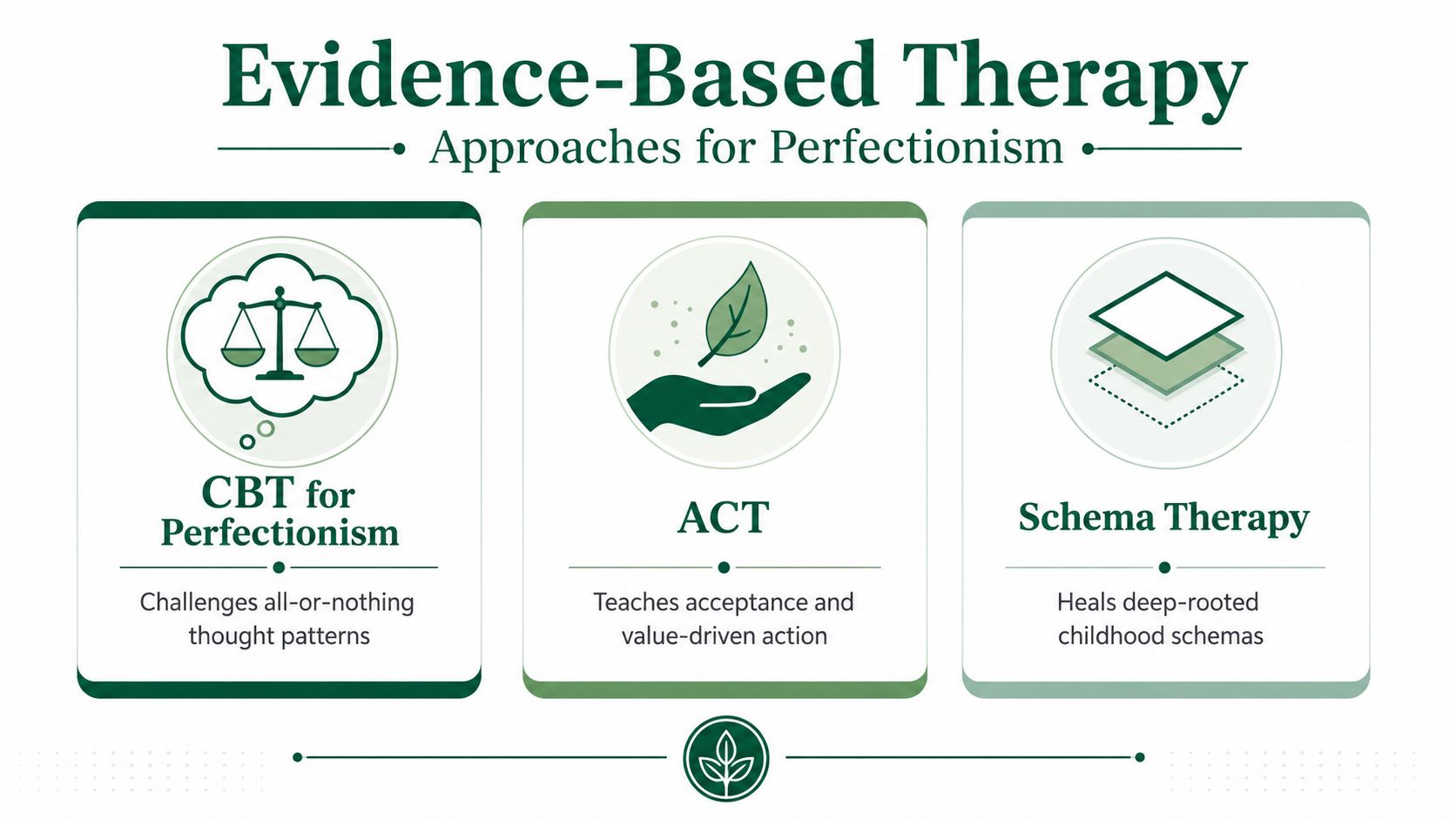
CBT adapted for perfectionism targets all-or-nothing thinking, impossible standards, fear of mistakes, and self-criticism. A therapist might examine the belief that a delayed email will damage your reputation, then plan an experiment: send a clear draft without endless revisions. Thought records, graded exposure, and response prevention turn insight into observable learning. A practical overview of cognitive behavioral therapy in counseling explains this structured approach.
CBT often suits behaviorally stuck clients. If you understand the pattern but continue avoiding, checking, overworking, or seeking reassurance, repeated experiments can test feared consequences. The trade-off is that this approach may feel demanding when shame, trauma, or low mood makes experimentation feel unsafe. In those cases, pacing and emotional support need to accompany behavioral change.
ACT for rigid overthinkers
Acceptance and Commitment Therapy, or ACT, develops psychological flexibility. Instead of eliminating every self-critical thought, you learn to notice it, make room for difficult feelings, and choose action based on values. This can fit clients who analyze therapy, collect insight, and wait for complete certainty before acting.
A 2025 randomized trial found that ACT and CBT self-help improved perfectionism, stress, well-being, and psychological inflexibility compared with a waitlist. ACT showed stronger gains on evaluative concerns and inflexibility, according to the study record for the randomized self-help trial. The finding does not make ACT universally superior. It supports choosing an approach centered on values and willingness when evaluation fears and mental rigidity keep driving the cycle.
Compassion, schemas, and relational meaning
Compassion-Focused Therapy can suit shame-driven perfectionists. Compassionate mind training helps clients respond to mistakes with less punishment and develop self-soothing instead of relying only on threat-based motivation. A 2025 study of mindful compassion found that individual and group formats reduced perfectionistic cognitions and psychosocial distress compared with a wait-list. In-person treatment produced larger gains than online treatment in self-soothing, group functioning, and distress reduction. The findings are summarized in the research record on mindful compassion for perfectionism.
Schema Therapy examines patterns such as unrelenting standards, defectiveness, emotional deprivation, and conditional acceptance. Psychodynamic therapy may help when perfectionism formed within early relationships and still shapes expectations of others. An integrative therapist may combine CBT experiments with ACT defusion, compassion work, and relational exploration, treating perfectionism directly while addressing anxiety, depression, shame, or attachment wounds that keep it active.
What to Expect in a Perfectionism Therapy Session
A perfectionism-focused session is collaborative, structured, and practical. You won't be graded on how well you complete therapy. That fear is common, and a skilled therapist treats it as useful information about the pattern rather than as a problem with your performance.
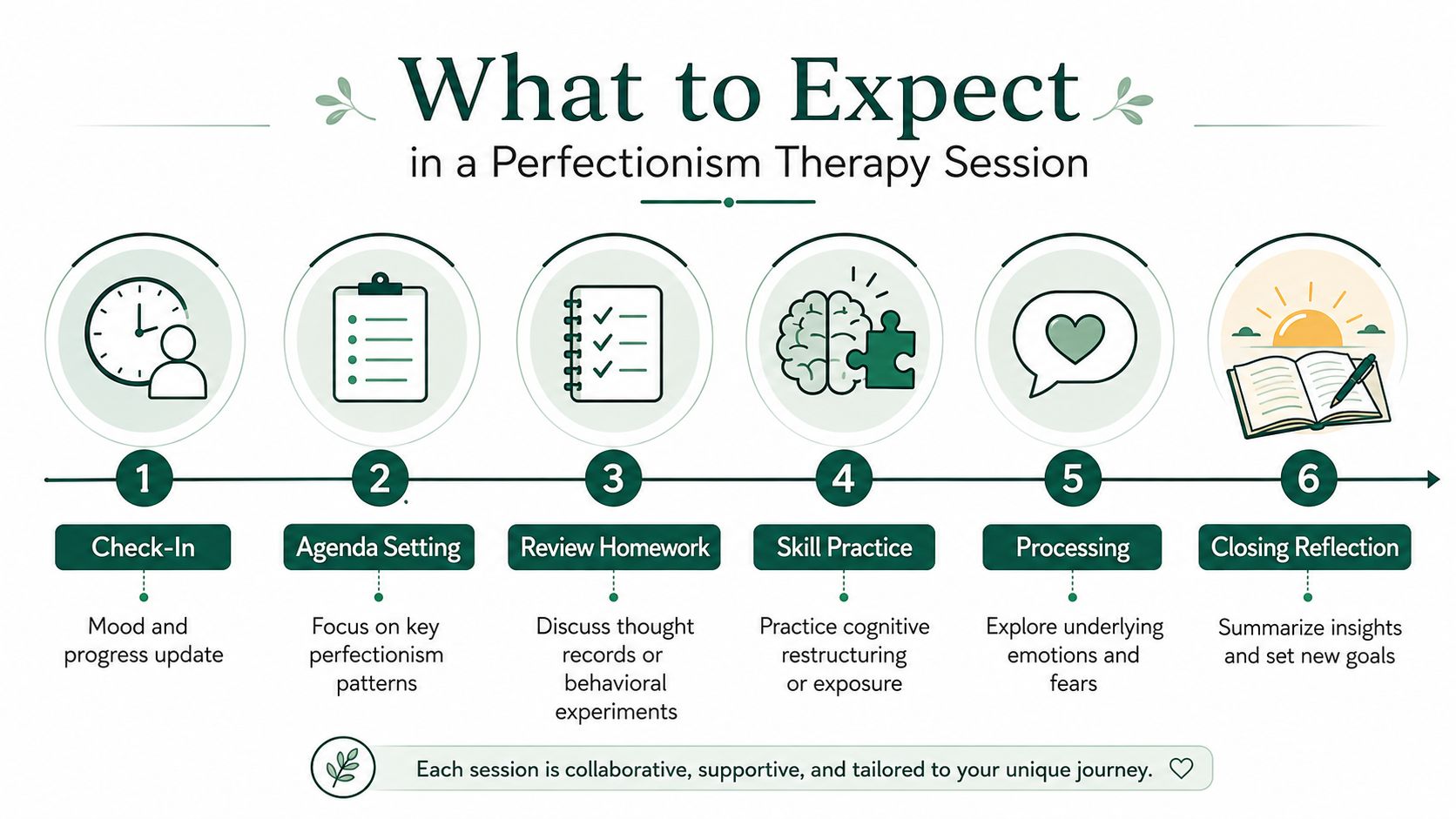
The usual rhythm
Check-in: You'll briefly review mood, stress, major events, and any changes since the previous session.
Agenda setting: You and the therapist choose one or two priorities, such as procrastination, fear of criticism, or difficulty resting.
Pattern review: You may examine a thought record, a recent trigger, a checking behavior, or an avoided task.
Skill practice: The session might include cognitive restructuring, defusion, compassion practice, or planning an exposure.
Emotional processing: You'll explore what the perfectionistic rule protects you from, such as shame, rejection, disappointment, or loss of control.
Closing reflection: You'll identify what you learned and agree on a manageable practice before the next appointment.
Early sessions often emphasize assessment, history, goals, and a shared formulation. Later sessions become more experiment-driven. You might intentionally submit work before it feels complete, express a preference without overexplaining, or leave a minor imperfection uncorrected while observing what happens.
Exposure exercises can feel uncomfortable because they challenge the strategy that has promised safety. Discomfort doesn't mean the exercise is harmful or that you're doing it incorrectly. Your therapist should adjust the pace, explain the rationale, and make room for your feedback.
Meaningful change usually develops through repetition rather than one powerful conversation. Many structured courses of therapy unfold over 8 to 16 sessions, although the appropriate length depends on your symptoms, goals, access, and response to treatment. Preparing with a brief guide on how to prepare for your first therapy session can make the first appointment less mysterious.
Integrating Mind Body Spirit Practices Into Treatment
Perfectionism lives in thoughts, but it also appears in the body. You may notice shallow breathing, clenched muscles, restless urgency, difficulty sleeping, or an inability to enjoy an activity unless you're doing it correctly. These sensations don't prove that a particular theory explains your experience, but they give therapy another point of entry.
Mindfulness can help you observe self-critical thoughts without immediately obeying them. The practice isn't to empty your mind or achieve perfect calm. It's to notice, “I'm having the thought that this must be flawless,” and create enough distance to choose your next action. A therapist may adapt mindfulness-based stress reduction exercises to your tolerance and goals.
Practices that support the cognitive work
Mindfulness meditation: Develops nonjudgmental awareness of thoughts, urges, and emotions.
Breathwork: Slows the sense of urgency and creates a pause before overworking or checking.
Gentle movement: Yoga, walking, stretching, or other accessible movement can reconnect you with bodily sensations without turning exercise into another performance test.
Progressive muscle relaxation: Helps you notice and release habitual tightening.
Values clarification: Separates what matters from rules inherited from family, work, culture, or past relationships.
Compassion practices: Builds a kinder response to mistakes and unmet expectations.
Spirit doesn't have to mean religion. Spiritual exploration may involve meaning, purpose, belonging, creativity, nature, service, or the question of who you are beyond achievement. A client might discover that the fear beneath perfectionism isn't really about the report, presentation, or appearance. It may be fear of being unworthy, disconnected, or unseen.
Integration works best when it remains personal. A practice should support treatment, not become another standard you must perform flawlessly.
These tools aren't replacements for evidence-based psychotherapy. They amplify the work by helping you experience flexibility rather than merely understand it. A therapist can introduce them gradually, account for trauma history and sensory preferences, and watch for the moment a helpful practice starts becoming another arena for self-judgment.
Practical Self-Help Strategies You Can Start Today
Self-help can interrupt the cycle while you're considering therapy or support ongoing treatment. Start with one experiment, not a new personal improvement program.
Try the good-enough experiment
Choose one low-stakes task and complete it with deliberately limited effort. You might send a routine message after one review, stop cleaning when the space is functional, or submit a draft that meets the actual requirement without polishing every sentence.
Afterward, record what you predicted would happen and what happened. The purpose isn't to prove that imperfection never has consequences. It's to learn whether the consequence matches the catastrophic rule.
Use a short compassion break
When the inner critic becomes loud, pause and name the pain without arguing with it. Then remember that struggle and mistakes are part of being human, and offer yourself a kind response you could give someone you care about.
A simple version is:
Acknowledge: “This is painful, and I'm disappointed.”
Connect: “Other people struggle with mistakes and uncertainty too.”
Support: “I can respond firmly and kindly, then take the next reasonable step.”
Capture the thought before it takes over
Use a thought record to write down the situation, automatic thought, emotion, evidence supporting the thought, evidence against it, and a more balanced alternative. “If this isn't perfect, I'll be exposed as incompetent” may become “This matters to me, but one imperfect detail doesn't define my ability.”
Set a daily worry window for perfectionistic rumination. When the urge appears outside that period, write it down and return to the present task. Keep a small journal of which experiments reduce avoidance, which trigger shame, and which feel like another demand. Bring those observations to therapy so you and your therapist can refine the plan together.
Finding the Right Therapist for Your Perfectionism Journey
Look for a therapist who understands perfectionism as more than high achievement. Useful training may include CBT, ACT, Compassion-Focused Therapy, Schema Therapy, psychodynamic work, or an integrative approach. Credentials matter, but therapeutic fit matters just as much. You need someone who can challenge rigid rules without shaming you for having them.
Ask potential therapists:
How do you assess perfectionism alongside anxiety or depression?
How do you decide whether to target perfectionism directly?
Do you use behavioral experiments, exposure, compassion work, or values-based exercises?
How do you adapt treatment for shame, trauma history, neurodivergence, or sensory needs?
What would collaboration look like if an exercise feels too fast or unhelpful?
Be cautious if a therapist treats perfectionism as a strength, promises effortless change, dismisses your fear of mistakes, or gives rigid homework without discussing your response. Also watch for the perfectionist trap of endlessly researching providers. A minor difference in website wording or scheduling availability doesn't necessarily mean you've found the wrong person.
Format matters too. Individual therapy offers privacy and personalized experiments. Group treatment can provide a corrective experience for clients who feel uniquely flawed, while online or guided self-help may improve access for people with time, transportation, or location barriers. Current research supports several formats, but it doesn't yet identify one universally superior option for every perfectionism profile.
Be Your Best Self & Thrive Counseling, PLLC approaches perfectionism through evidence-informed counseling alongside mind-body-spirit integration, with care shaped around concerns such as anxiety, depression, trauma, stress, and stuck patterns. Consider local therapists in St. Petersburg and the Tampa Bay area, review insurance and out-of-pocket requirements, and use an initial consultation to assess fit. The goal isn't to optimize the search forever. It's to choose a qualified, collaborative therapist and begin practicing a different relationship with “good enough.”
Be Your Best Self & Thrive Counseling, PLLC offers individualized counseling for perfectionism, anxiety, depression, trauma, and stress using evidence-informed and mind-body-spirit care. Visit Be Your Best Self & Thrive Counseling, PLLC to explore services and request a free initial consultation about your goals and treatment fit.