
Mind Body Connection Therapy: A Practical Guide
You've probably had the experience of knowing exactly why you're anxious, why you're tense, or why your sleep keeps breaking, and still not feeling any better. You've talked it through, journaled it out, maybe even gotten good at naming patterns, but your shoulders stay up near your ears and your body acts like something is still wrong.
That's the place where mind body connection therapy often makes sense. It doesn't replace insight, it gives insight somewhere to land, by working with breath, sensation, posture, attention, and the nervous system itself. For many people, that's the missing piece between “I understand my problem” and “I feel different in my life.”
The idea isn't new or fringe. Mind-body approaches have been used widely for years, and a national survey found that 18.9% of U.S. adults used at least one mind-body therapy in the prior 12 months, while 28.9% had used one at some point in their lives, with 20.5% of users seeing a mind-body professional (survey data). That kind of uptake says something important, people weren't using these methods as novelty wellness extras, they were turning to them for real relief and support.
When Talk Alone Is Not Enough
Mara could explain her stress clearly. She knew her job was demanding, she knew she was carrying family pressure, and she knew exactly how her anxiety started on Sunday nights and spilled into Monday mornings. She had done years of talking, reading, and journaling, yet her jaw stayed clenched, her stomach stayed tight, and she still woke up at 3 a.m. feeling wired.
That's a common turning point. Talk therapy can give language to pain, but the body sometimes keeps reacting as if danger is still present, even when the story has already been understood. If you've been searching for a different angle, experiential therapy is one helpful doorway into this kind of work, because it uses direct experience, not only analysis.
Why the body can stay stuck
Stress doesn't just live in thought. It shows up in breathing, muscle tension, sleep, digestion, and the way you brace before a meeting or a difficult text message. A person can be perfectly aware of the pattern and still not be able to shift it by thinking harder.
That's where mind body connection therapy comes in. It works with the body as part of the healing process, not as a side effect. People often come in because they want help with anxiety, chronic stress, trauma symptoms, pain, or that vague but exhausting sense of being “on” all the time.
Practical rule: if insight keeps increasing but your body never gets the memo, a body-based approach may fit better than more of the same talk-only work.
Mind-body work has also become a mainstream complement to health care, not just a niche interest. One U.S. survey summary from the Department of Veterans Affairs reports that use of approaches such as yoga, meditation, and guided imagery or progressive muscle relaxation rose over time, which fits what many clinicians now see in practice, more people are looking for tools that affect both mood and physiology (VA summary of NHIS data).
What the Mind-Body Connection Means
The simplest way to understand it
A client may arrive saying, “I understand my stress, but my body still reacts before I can stop it.” That is the mind-body connection in practice. The mind and body are not separate tracks running side by side. They influence each other constantly, so thoughts, memories, breathing, muscle tension, posture, sleep, and digestion all shape the same stress loop.
Mind-body work helps interrupt that loop from more than one angle. The body is not treated as an afterthought. It is part of the system that stores, expresses, and also softens stress. That matters for people who feel anxious, carry trauma symptoms, live with pain, or stay in a half-alert state that never quite turns off.
Expert reviews describe the clinical goal as restoring more balanced prefrontal cortex activity, decreasing amygdala activity, and normalizing the HPA axis and locus coeruleus-sympathetic nervous system response, which are tied to cortisol, arousal, and threat reactivity (clinical review). In plain language, the work is meant to help the brain's alarm system quiet down enough for the parts of the mind that think, choose, and regulate to come back online.
What that feels like in real life
When the nervous system is stuck in threat mode, the change shows up everywhere at once. Breathing gets shallow. The jaw tightens. The shoulders rise. Thoughts narrow to whatever feels urgent or dangerous. A person may know they are safe, but the body has not caught up yet.
That is why mind-body therapy uses signals the body can register directly. Breath, movement, attention, and sensory grounding give the system new information so safety has a chance to land. A session might feel subtle, like noticing the floor under your feet, or it might feel more active, like gentle movement that helps discharge tension you have been carrying for days.
The aim is not to force calm. It is to give the body enough information to stop bracing.
Different clients need different entry points, and a good therapist looks for the one that fits the nervous system in front of them. Some people settle best through breathwork. Others need slower movement, careful attention to sensation, or trauma-informed methods that make room for memory without flooding the person. For a broader look at how healing can include more than the body alone, mind-body-spirit healing offers a helpful frame, while safe exploration of non ordinary states is a useful background resource for a separate conversation about altered states and clinical caution.
A working model you can use
A simple self-check can make the pattern easier to see. Ask whether your body feels keyed up, shut down, or caught between the two. Notice whether your breathing shortens when stress rises. Pay attention to whether movement, stillness, or a mix of both helps you feel more settled.
Those questions matter because mind body connection therapy is not a single technique. It is a set of approaches that all work with the same basic problem from different angles, and the right fit depends on which part of your stress response needs the most support.
Common Modalities and What Each One Targets
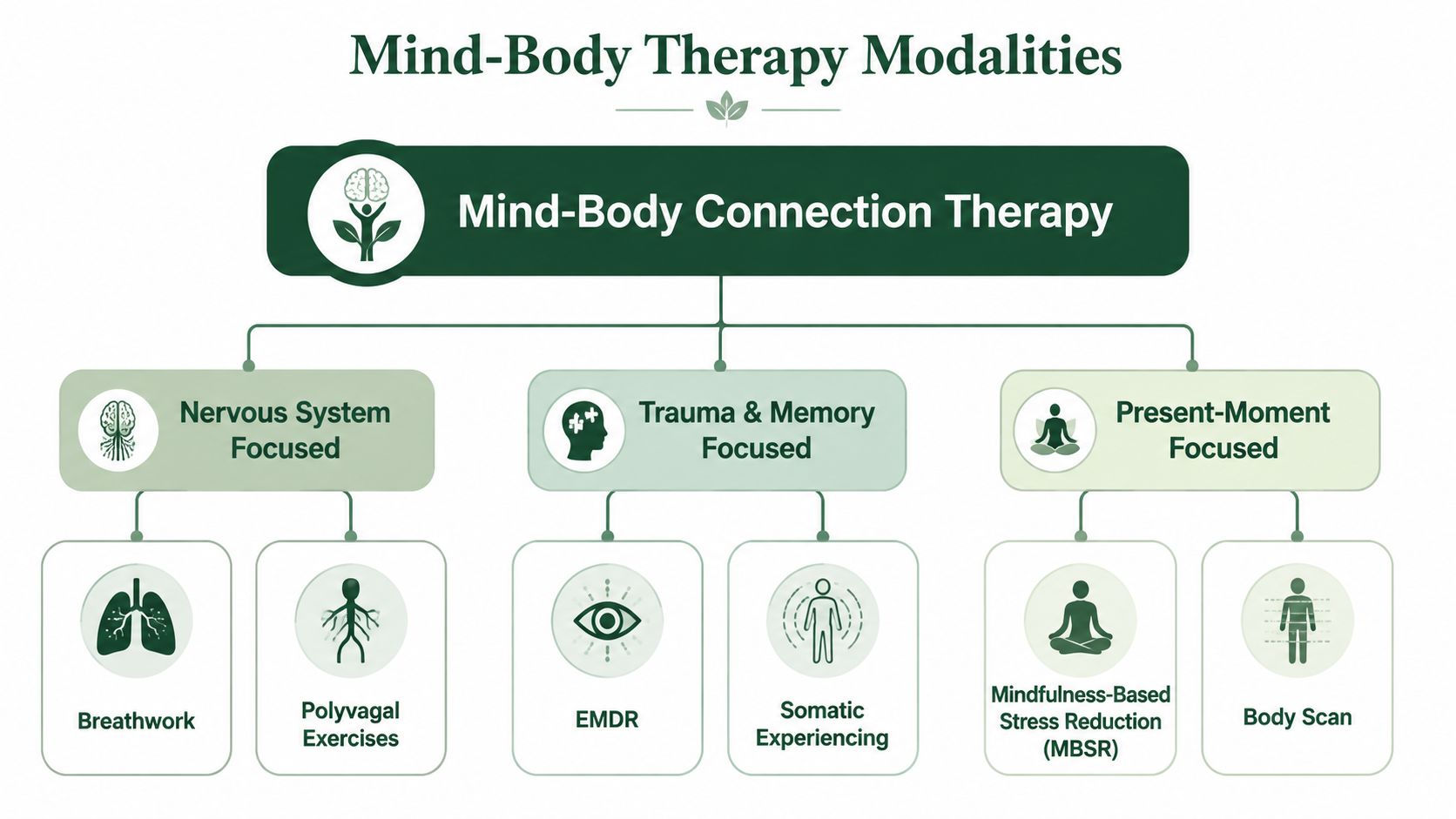
A client may arrive asking for the mind-body method, hoping there is one clear answer. The more useful question is which approach fits the nervous system in front of you. A person who feels flooded with panic usually needs a different entry point from someone who feels numb, disconnected, or tight all the time.
The usual starting points
Breathwork often helps when the body is running hot. Slow, intentional breathing can give the nervous system a steadier rhythm for long enough to interrupt urgency and let the body settle. Progressive muscle relaxation tends to fit people whose tension has become so familiar that they only notice it after pain, jaw clenching, headaches, or exhaustion show up.
Mindfulness-Based Stress Reduction, or MBSR, is often a good match when someone needs more contact with the present moment without getting pulled around by every thought. Body scan work helps clients notice where stress collects and where sensation has gone quiet. Guided imagery gives the mind a safer place to rest when pain, fear, or insomnia keeps looping through the same patterns.
When the problem is trauma, pain, or performance
Somatic experiencing and other trauma-informed body therapies are often considered when a person wants help with stored tension, hypervigilance, or overwhelm that does not change much through insight alone. These approaches pay attention to how the body holds on after stress, then work in small steps so the system does not get flooded. For a closer look at that body-centered approach, somatic therapy offers a helpful overview of how sensation, emotion, and regulation can be worked with together.
EMDR is often discussed when intrusive memories or trauma reminders keep setting off the body's alarm system. Yoga therapy can help when someone needs a blend of movement, breath, and regulation, especially if sitting still makes the distress feel louder.
Biofeedback can be a useful choice when someone wants clearer feedback about what the body is doing under stress. It makes hidden patterns more visible, which can be helpful for clients who do better with concrete cues than with abstract discussion. Meditation can support focus and reactivity, and a review from the NIH review describes clinical use of guided imagery, relaxation, hypnosis, biofeedback, meditation, and breathwork across several concerns, including pain, anxiety, depression, PTSD, and addictions.
For people in high-stress helping roles, a practical starting resource like mindfulness exercises for healthcare workers shows how present-moment skills can be adapted to real-world pressure without asking someone to step away from a full workday.
Good fit usually looks like this: the method matches your main symptom, your tolerance for body focus, and the pace you can handle without getting overwhelmed.
A therapist's free consultation should make this part clear. They should be able to explain what they would try first, why that choice fits your symptoms, and how they would adjust if your body shows too much activation or too much shut-down. If the answer stays vague, or if every concern gets the same tool, the fit is probably not strong.
The simplest way to sort the options is to ask what the therapist is trying to change first. Is it arousal, avoidance, numbness, pain, attention, or trauma reactivity? That answer tells you far more than a generic “we do somatic work” label.
What Actually Happens in a Mind-Body Therapy Session
The first session usually starts like any good therapy appointment, with conversation. A therapist asks what brought you in, what you've already tried, how your body responds under stress, and whether you've had experiences like panic, trauma, pain, or sleep disruption. That history matters because body-based work is safest and most useful when it starts from your actual pattern, not a generic protocol.
The therapist watches for how your system responds
A trained clinician pays attention to things clients often miss in themselves. Your breath may get tighter when a topic gets close to the center of the problem. Your eyes may drift away when you're overwhelmed. You may laugh when you're nervous, freeze up when you feel exposed, or go blank when your body wants to protect you.
After that, the therapist might invite a small practice, not a big one. It could be a few slow breaths, noticing contact with the chair, tracking sensation in the hands, or pausing to see whether a memory feels manageable before going further. The point is to stay inside your window of tolerance, not push through it.
What happens between visits
Home practice is usually short and specific. A therapist might suggest a brief body scan before bed, a breathing pattern to use before work, or jotting down what happens in your body when a trigger shows up. The goal is repetition, because the nervous system learns through repeated experience, not one dramatic breakthrough.
For readers who want to know how to prepare for that first visit, how to prepare for your first therapy session is a useful companion to this process. It can reduce the uncertainty that keeps people from booking in the first place.
Helpful question to ask early: “How will we know if I'm getting overwhelmed, and what do you do when that happens?”
That question tells you a lot. A competent therapist can explain pacing, grounding, and what they'll do if your system starts to spike or shut down.
Why the session feels different from talk therapy
In a mind-body session, the conversation is still important, but it isn't the only data. The therapist is reading the whole system, words, breathing, posture, muscle tone, attention, and emotional shift. That makes the work feel slower at times, but often more precise.
If you're curious about the broader integrative model that holds talk, body, and context together, integrative therapy is a helpful frame for understanding how therapists combine approaches rather than relying on just one.
Benefits and Where the Evidence Is Strongest
A client often notices the first benefit in a simple way, sleep settles a little, the body unclenches sooner after stress, or pain stops taking over every part of the day. Mind-body therapy tends to help most when it is used alongside standard care, especially when symptoms show up in more than one system at once. Reviews have found support for use as an adjunct in coronary artery disease, headaches, insomnia, incontinence, chronic low back pain, cancer-related symptoms, and postsurgical outcomes, with moderate evidence for hypertension and arthritis (PubMed review). A separate review also describes support for preoperative anxiety, acute and chronic pain syndromes, chemotherapy- and radiation-related symptoms, depression, chronic mental illness, PTSD, and addictions.
What that means for a real client
If you are dealing with anxiety, trauma symptoms, pain, or sleep disruption, mind-body work may fit as one part of a larger plan. It often makes the most sense when symptoms do not stay in one lane. Stress can turn into jaw tension, stomach trouble, or headaches. Trauma can show up as insomnia, constant muscle guarding, or a body that seems to stay on alert long after the event has passed.
The evidence does not point to a universal cure, and that honesty matters. Reviews of the field describe the research base as promising but mixed, and they call for more randomized trials, better methods for multi-component interventions, and clearer integration with standard clinical care (review of implementation and evidence gaps). That is why a careful therapist will usually present mind-body therapy as support alongside medical or psychiatric treatment when needed, not as a replacement for it.
Access matters as much as method
Access shapes who gets help and how well the help fits. Existing evidence points to gaps for people with depression, anxiety, and trauma who are less likely to receive conventional care, especially disadvantaged, racial and ethnic minority, and lower-income groups. The same review also notes weak research on implementation, dissemination, and diversity among researchers, providers, and recipients (review of implementation and evidence gaps). In practice, that means culturally responsive care, affordable telehealth, and a therapist who can explain their approach in plain language all matter.
A recent review notes that culturally adapted mind-body practices can support spirituality and psychosocial health in underserved African American adults, while rural residents may still need additional adaptation, which is another reminder that fit is not one-size-fits-all (recent review). If you want a broader framework for how a therapist combines talk, body awareness, and context, integrative therapy is a useful place to connect those pieces.
How to Choose the Right Therapist for You
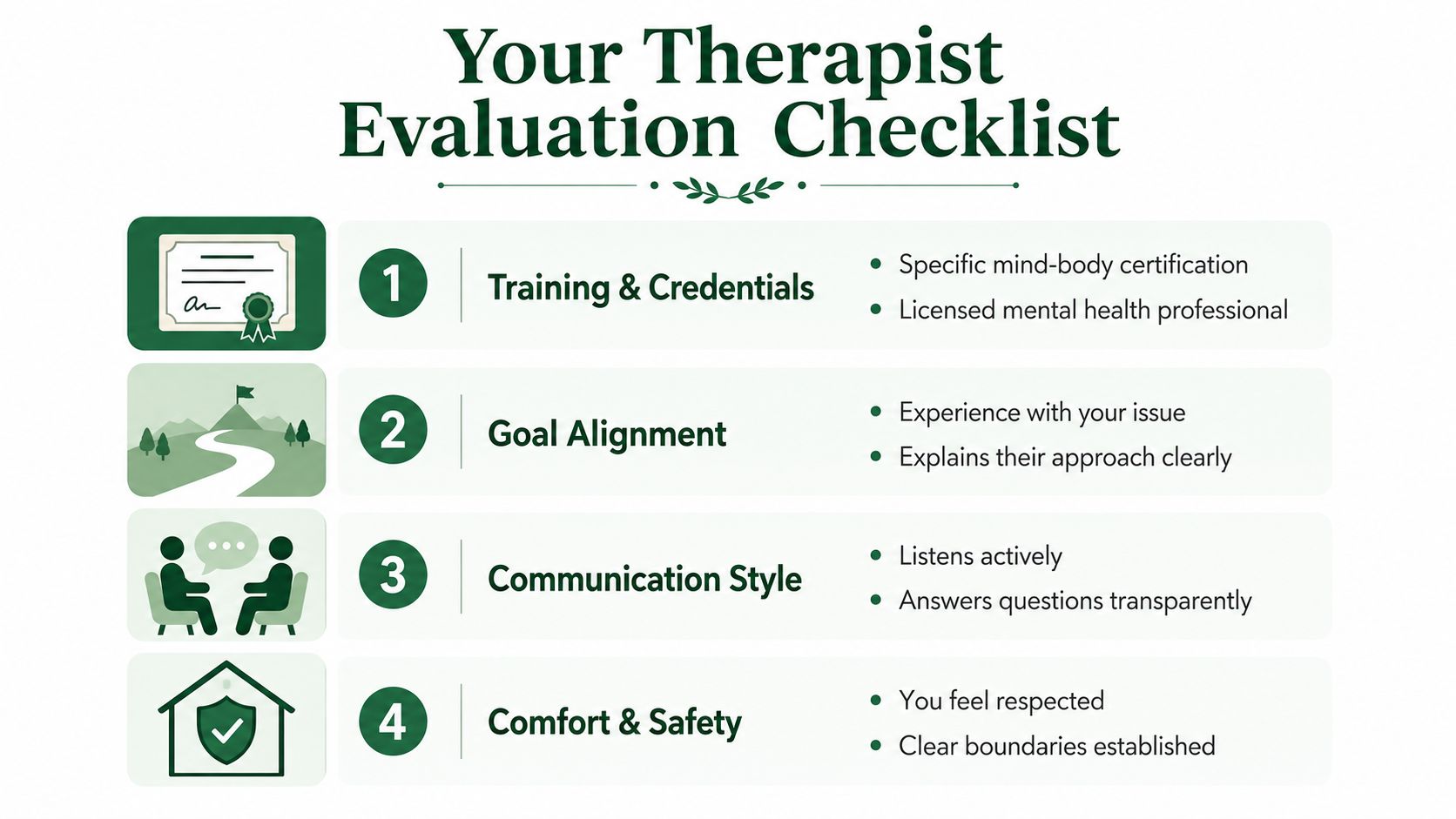
A good mind-body therapist can explain what they do, why they use it, and how they will tell whether it is helping. If that answer stays vague, treat it as useful information. You are not only choosing a technique, you are choosing a person who will help pace the work, keep it safe, and adjust when your nervous system needs something different.
What to look for before you book
Start with credentials. A licensed mental health professional who has training in somatic, trauma-informed, or experiential methods is usually a stronger match than someone using a body-based label without clear preparation behind it. Then look at fit with your goals. A therapist who works well with chronic stress may not be the right match for trauma processing, and a therapist who focuses on trauma may not be the best fit for someone mainly trying to calm physical tension or burnout.
During a free consultation, ask direct questions and listen for direct answers.
Training and scope. “What mind-body methods are you trained in, and how do you use them with clients?”
Experience. “Have you worked with people dealing with my concern, like anxiety, trauma, pain, or burnout?”
Pacing. “How do you decide when to slow down, stay with a body sensation, or shift to something else?”
Cost and access. “Do you offer in-person sessions in Pinellas County, telehealth across Florida, or both?”
Safety. “What happens if I get overwhelmed, shut down, or dissociate in session?”
How to read the answer
You want a therapist who speaks plainly, not someone who hides behind jargon. They should be able to explain how they handle grounding, boundaries, and coordination with medical providers if physical symptoms come up. If you are in the St. Petersburg and Tampa Bay area, that clarity matters even more because local options can vary a lot in format and availability.
Green flag: the therapist welcomes questions, explains the approach without pressure, and treats the consultation like a two-way fit check.
A useful way to judge the fit is to notice how your body responds while you are still talking. If you feel clearer, more settled, and more able to ask questions, that is a good sign. If you feel rushed, misunderstood, or pushed toward a method before you understand it, that is worth paying attention to. A solid consultation should feel a little like trying on a pair of shoes in the store, the therapist is checking whether the size, support, and shape match your needs before you ever start walking in them.
For clinicians and interns, the same logic applies when looking at a training institute. Real learning in this field is not just about techniques, it is about supervised practice, ethical pacing, and learning how to work with actual people instead of theoretical cases.
If you are comparing educational resources as a professional, even a practical market lens like costs for self help book publishers can remind you that quality materials and credible guidance usually come from thoughtful development, not quick content.
Contraindications, Safety, and When to Pause
Mind-body work is usually gentle, but gentle doesn't mean universal. Some people need modifications, and some situations call for pausing body-focused techniques until the right supports are in place. A skilled therapist should recognize that quickly, not try to power through it.
When extra caution is needed
Body-based work may need to be adjusted or postponed in cases such as active psychosis, certain cardiovascular conditions, recent medical procedures, or pregnancy, depending on the specific technique and medical guidance. Trauma work can also become risky if the person is already highly dissociated, overwhelmed, or likely to feel flooded by memory. In those moments, pacing matters more than technique.
A competent therapist will use resourcing, grounding, and careful titration. That means they'll help you build enough stability before moving toward difficult material, and they'll slow down if your body says the system is getting too activated. When needed, they should coordinate with a primary care clinician or other medical provider.
Red flags to watch for
Pushing past your limits. If you say something feels too intense and the therapist keeps insisting, that's a problem.
Dismissing physical symptoms. Body-based therapy should take real physical reactions seriously.
Skipping consent. You should always know what the exercise is meant to do before trying it.
Refusing collaboration. If medical input is needed and the therapist won't coordinate, the fit may be poor.
You should leave sessions feeling more informed, not less. If you consistently feel shaken, ashamed, or pressured after appointments, the issue may be the pacing or the provider, not your ability to do the work.
FAQs and Your Next Step Toward Mind-Body Therapy
A few questions come up again and again. How fast does it work? That depends on the symptom, the person, and the method, but people usually do better when they treat it like learning a skill rather than chasing a quick fix. A nervous system that has spent years on alert does not usually settle after one session, the way a smoke alarm does not stop beeping until the heat source is removed and the system has time to reset.
Can it replace medication? In some cases, no, and it should not be presented that way. For many clients, it works best alongside medication, talk therapy, sleep support, or medical care, because each piece addresses a different part of the problem. One approach may help with body tension, another with thoughts, and another with the day-to-day strain that keeps symptoms going.
Can I start on my own? Yes. A simple practice like two minutes of slower breathing, a brief body scan, or noticing three physical sensations before bed can begin teaching your system that attention does not always mean danger. Consistency matters more than intensity, the way small amounts of physical therapy done regularly often help more than one hard workout that leaves you sore and discouraged.
If you are still comparing resources and trying to understand what support should cost or include, guides on costs for self help book publishers can be a reminder to look for transparency, structure, and credibility in any support you choose.
If you are in the St. Petersburg or Tampa Bay area and want a grounded place to start, book a free consultation with a therapist who can help you sort through goals, pacing, and fit before you commit. Use that first conversation to ask how they decide between breathwork, grounding, somatic tracking, or a slower trauma-informed approach, and whether they adjust their method when your symptoms point to shutdown, panic, or dissociation. If you are a clinician, consider a training path that gives you supervised, experiential learning in mind-body care so you can bring these tools into your work with more confidence.
Be Your Best Self & Thrive Counseling, PLLC offers trauma-informed counseling that blends mind-body-spirit care with practical support for anxiety, depression, trauma, and stress. If you are ready to explore whether this approach fits your needs, visit Be Your Best Self & Thrive Counseling, PLLC to learn more and schedule a free initial consultation.