
Couples Therapy vs Individual Therapy: A Clear Comparison
You're sitting on the edge of the decision that many adults postpone for months. You're anxious, depressed, grieving, overwhelmed, or carrying a trauma history, and your partner is affected by what you're going through. At the same time, the two of you may be caught in the same argument every week, unsure whether the relationship needs attention or whether each person needs separate support first.
The choice between couples therapy vs individual therapy isn't about finding one universally superior format. It's about identifying where the presenting problem lives, what needs to become safer first, and who is free to begin the work. Sometimes the relationship needs a room of its own. Sometimes one person needs privacy and stabilization. Often, the most responsible plan combines both in a carefully paced sequence.
When the Format Is the Decision
Maya arrives alone for an intake and keeps glancing at the empty chair beside her. Anxiety now affects intimacy, decisions, and ordinary conversations with her partner. She is unsure whether to speak privately about panic and body tension first, or invite her partner to couples sessions so he can understand what happens in her body when conflict begins.
Across the hall, James and Lin arrive together after a nearly silent drive. They can describe the argument that brought them in, yet neither can identify how it starts. Lin says James withdraws. James says Lin pursues. Both sense that the pattern reaches into earlier experiences, leaving an important question: where does the problem live, and who is free to start work there?
When The Relationship Is The Primary Client
Couples therapy fits when distress is expressed mainly through the interaction. Repeated conflict, failed repair, emotional distance, betrayal recovery, parenting disagreements, and intimacy concerns belong partly to the relationship itself. The clinician needs to observe how partners respond in real time, not only hear each person describe the pattern afterward.
That live interaction offers useful information, while also requiring care. Trauma-informed couples work considers whether each partner can stay present, feel physically safe, and make choices during difficult conversations. If one person becomes flooded or frightened, slowing the process may matter more than completing the discussion. Practical preparation for this format is available in how to prepare for couples counseling.
When One Person Needs A Private Starting Point
Individual therapy may be the wiser first step when one partner is experiencing unmanaged symptoms, active trauma responses, addiction, severe grief, or identity questions that require privacy. Private sessions can give the nervous system room to settle and allow a person to discuss shame, memories, anger, or fear without simultaneously managing a partner's response.
This does not make the relationship irrelevant. It identifies the first therapeutic task: helping one person regain enough safety, choice, and self-understanding to participate in relational work without becoming overwhelmed, shutting down, or using the couple session to avoid personal treatment.
Sometimes the formats are sequenced. Individual support may come first, couples therapy may begin alongside it, or both may be appropriate when each therapist can coordinate roles and protect confidentiality.
Practical rule: Choose the format that can safely hold the most urgent problem first. You can change or add formats as the clinical picture becomes clearer.
What Couples And Individual Therapy Actually Are
Couples therapy is a relational treatment. Two partners meet with a clinician to work on the patterns between them, including communication, conflict, attachment injuries, repair, shared decisions, intimacy, parenting, and rebuilding after infidelity. The relationship becomes the focus of observation and intervention.
A therapist may help partners identify the moment a disagreement changes direction. One person criticizes, the other becomes quiet, the silence increases the first person's alarm, and the conversation escalates. The work isn't about deciding who was right. It's about understanding the sequence and creating a more effective way to respond.
Couples therapy can also address personal experiences when they affect the relationship. It isn't designed, however, to treat one partner's individual diagnosis in isolation. A partner may gain insight and support during the process, but a complex trauma history, substance-use disorder, or severe mood disorder may require individual treatment alongside or before conjoint sessions.
Individual Therapy Creates Private Depth
Individual therapy is a one-to-one format focused on one person's symptoms, history, nervous-system responses, values, and goals. Without a partner present, the client can explore shame, memories, anger, grief, dreams, identity, or ambivalence without managing another person's reaction in the same moment.
That privacy can be especially important for trauma work. A client may need to understand how past experiences shape current threat responses before attempting to explain those responses to a partner. Individual therapy can also support practical goals such as reducing anxiety, improving mood, setting boundaries, processing loss, and making decisions that reflect the client's own values.
The Main Difference Is The Unit Of Change
In individual work, the therapist and client study the person's inner experience and behavior. In couples work, the therapist studies the interactional system, including what happens between two people in real time.
Neither format automatically replaces the other. A person can become calmer without the couple learning how to repair conflict. A couple can communicate more effectively while one partner's untreated depression continues to require focused care. The right decision depends on the target, the level of safety, and each person's capacity to participate.
Side By Side Comparison Of Couples And Individual Therapy
The practical difference between the formats becomes clearer when you compare what each room is built to do. Individual therapy prioritizes one person's experience. Couples therapy prioritizes the relationship's recurring pattern and the partners' ability to respond differently while together.
Dimension | Individual Therapy | Couples Therapy |
|---|---|---|
Primary goal | Symptom relief, self-understanding, trauma processing, personal growth, and individual decision-making | Relational repair, communication, emotional responsiveness, shared decisions, and conflict resolution |
Clinical focus | Intrapersonal patterns, history, beliefs, emotions, behavior, and nervous-system responses | Interpersonal cycles, attachment needs, repair attempts, trust, intimacy, and partner behavior |
Who attends | One client and the therapist | Two partners and the therapist |
Typical structure | Often weekly 50-minute sessions, with frequency adjusted to need | Often 60 to 90-minute sessions, depending on the clinician and treatment plan |
Confidentiality | Material is generally private between client and therapist, within legal and safety limits | The therapist must explain how shared information, individual meetings, and private disclosures will be handled |
Therapeutic leverage | Greater privacy and depth into one person's history | Live observation and practice of the couple's interaction |
Typical fit | Anxiety, depression, trauma, grief, addiction, identity questions, and personal patterns | Recurring conflict, communication breakdown, infidelity repair, intimacy concerns, and shared life transitions |
Use The Grid To Identify The Target
If you're asking, “How do I stop feeling this way?” individual therapy may be the most direct starting point. If you're asking, “Why do we keep doing this to each other, and how can we change it?” couples therapy may offer more.
There's overlap. Relationship distress can worsen anxiety or depression, and individual symptoms can intensify conflict. The key is to avoid using one format to do a job it wasn't designed to do.
Structure Affects The Work
Individual sessions usually leave more room to follow one person's pace. Couples sessions often need enough time for both partners to speak, regulate, understand the cycle, and practice a new exchange. Confidentiality also works differently. An individual therapist holds one client's private material, while a couples therapist needs a clear policy for secrets, individual meetings, and information that could affect the relationship.
A clinician should explain these boundaries before treatment begins. If the policy feels unclear, ask directly before sharing sensitive information.
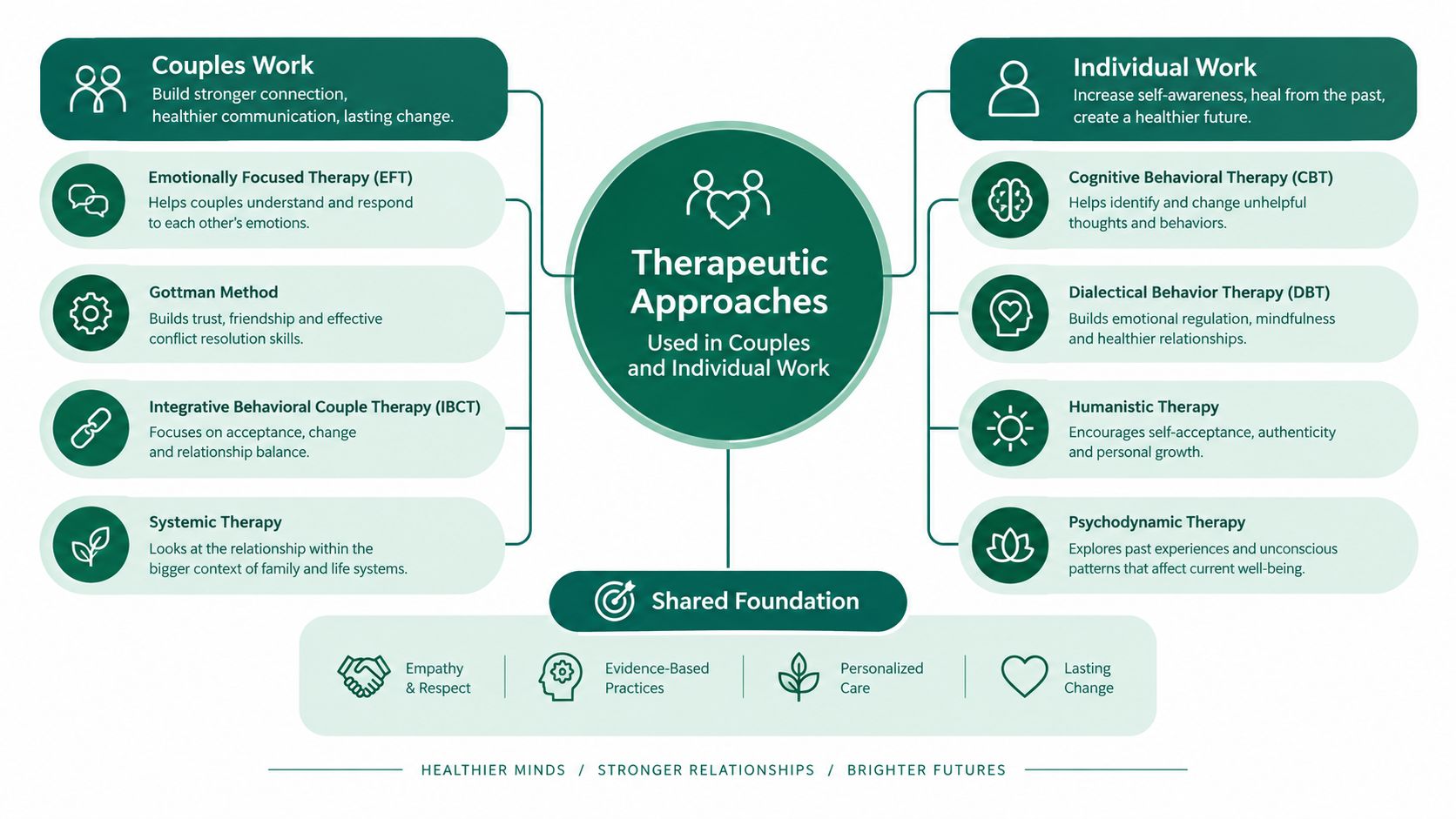
Therapeutic Approaches Used In Couples And Individual Work
The therapy format doesn't determine the method by itself. Clinicians choose an approach based on the presenting problem, the client's readiness, safety, and goals. A trauma-informed therapist also considers whether the client can stay present during difficult material, whether the relationship allows honest participation, and whether the pace supports choice rather than pressure.
Approaches That Often Fit Couples Work
Emotionally Focused Therapy, or EFT, is often useful when partners are trapped in a repetitive pursue-and-withdraw cycle or carrying an attachment injury. The therapist helps each person identify the vulnerable need beneath protest, criticism, defensiveness, or distance, then supports safer emotional responsiveness.
The Gottman Method commonly addresses friendship, conflict management, communication, trust, and repair. It can be a practical fit for couples who understand the problem but need structured skills for conversations, appreciation, listening, and recovery after arguments. Be Your Best Self & Thrive Counseling, PLLC offers individual and couples counseling, including Gottman-certified couples therapy, as one option for relationship-focused care.
Imago Relationship Therapy emphasizes structured dialogue and deeper understanding of each partner's perspective. Attachment-based and psychodynamic ideas may also help couples explore how earlier relationships shape expectations, defenses, and fears in the present.
The right approach isn't selected because a couple has a particular label. It's selected because the method matches the pattern the partners need to change.
Approaches That Often Fit Individual Work
Cognitive Behavioral Therapy, or CBT, can help when one person's thoughts, avoidance, or behavior maintain anxiety, depression, or other distress. EMDR may be appropriate when unresolved trauma continues to shape current reactions and the client has enough stability for trauma-focused treatment.
Internal Family Systems, or IFS, can help clients explore conflicting inner parts, such as the part that wants closeness and the part that expects rejection. Psychodynamic therapy may examine longstanding patterns, defenses, and emotional meanings. Somatic approaches focus on how stress and trauma appear through bodily sensations, impulses, activation, or collapse.
A nervous-system-aware approach may be used in either format. In individual therapy, the therapist can track one client's cues closely. In couples therapy, the clinician can help both partners notice escalation and pause before the interaction becomes unsafe. For a broader discussion of body-based work, see somatic therapy vs talk therapy.
What To Expect In Each Type Of Session
The first sessions should give you a clearer map, not require you to tell every painful story immediately. A good clinician gathers enough information to understand the concern, assess safety, establish goals, and decide whether the chosen format fits.
The Individual Therapy Beginning
An individual intake commonly lasts 50 to 60 minutes. The therapist may ask about current symptoms, relationships, medical and mental health history, trauma exposure, substance use, sleep, work, support, and safety. You'll also discuss what you want to change and what would make therapy feel useful.
Later sessions may be weekly or biweekly, depending on your needs and the clinician's recommendations. Treatment can include reflection, skills practice, between-session exercises, journaling, behavioral experiments, grounding, or trauma processing. Periodic progress conversations help determine whether the work is moving toward your goals.
You don't need a perfectly organized story. Bring the problem as you experience it, including what you're afraid to say, what keeps repeating, and what you've already tried.
The Couples Therapy Beginning
Couples therapy often starts with a joint intake, followed by separate individual meetings when clinically appropriate. Those individual conversations can help the therapist assess safety, substance use, trauma history, relationship expectations, and material that may be difficult to disclose with a partner present.
Conjoint sessions commonly last 60 to 90 minutes. The therapist may observe a recent disagreement, identify the couple's cycle, provide psychoeducation, and guide a structured conversation. Between-session practice might include a planned repair conversation, a listening exercise, Gottman card decks, or an EFT-informed “hold me tight” dialogue.
Confidentiality needs explicit discussion. Ask how the therapist handles secrets, disclosures made privately, safety concerns, and requests for individual contact. You can also review a practical overview of how marriage counseling works before scheduling.
A trauma-informed or somatic clinician may slow the opening phase. That isn't avoidance. It can be the work of building enough safety for both partners to remain engaged when difficult material emerges.
Who Should Choose Which Format
Start with the problem that is most urgent and most treatable in the available room. If both partners are willing to participate and the distress centers on a repeated relational pattern, couples therapy often offers the clearest starting point. If one person is struggling to remain safe, present, or functional, individual stabilization may need to come first.
Presenting situation | Best starting format | Notes |
|---|---|---|
Recurring conflict and communication breakdown | Couples therapy | The therapist can observe the cycle and coach repair in real time |
Infidelity repair | Couples therapy, with individual support as needed | Trust rebuilding requires relational work, while personal grief, shame, or trauma may need private care |
Unmanaged anxiety or depression in one partner | Individual therapy | Stabilization can improve the person's ability to participate in later couples work |
Active trauma symptoms | Individual therapy first in many cases | Trauma-focused work may require privacy, pacing, and careful safety assessment |
Parenting disagreements or differing libidos | Couples therapy | The shared decision and interaction pattern are central targets |
Addiction affecting the relationship | Individual or specialized addiction care first | Couples work may be added when safety and sobriety support are established |
ADHD or neurodivergent relationship dynamics | Combined care often fits | Individual support can address executive functioning or identity, while couples work addresses expectations and communication |
Grief that predates the relationship | Individual therapy | The client may need space to mourn without making the partner responsible for the process |
Personal identity questions | Individual therapy | Private exploration can protect autonomy and reduce pressure to reach a shared conclusion |
Major life transition | Individual, couples, or sequenced care | Choose based on whether the main strain is internal, relational, or both |
When Couples Therapy Is The Stronger First Move
Couples therapy is usually the more direct choice when both partners say, “We can't change this pattern on our own.” That includes repeated arguments about money, parenting, sex, household responsibilities, family boundaries, or emotional availability. The couple doesn't need to agree on every detail, but each partner must have enough willingness to participate openly and safely.
For neurodivergent couples, combined care can be especially useful. One partner may need individual support for ADHD-related organization, rejection sensitivity, sensory needs, or self-understanding, while the couple needs help translating those differences into workable agreements rather than moral judgments.
When Individual Therapy Needs To Lead
Individual therapy should generally lead when there is active interpersonal violence, coercive control, intimidation, serious threats, untreated addiction, or a level of instability that makes joint disclosure unsafe. Couples therapy can't create safety if one partner faces retaliation for speaking.
The same sequencing can help when one partner has severe anxiety, depression, trauma symptoms, or grief that overwhelms the relationship. One person may begin alone while the other waits, then the couple can join once individual stabilization is underway. Support for people carrying family and parenting pressure may also benefit from a private starting point, including resources on therapy for single mothers.
Couples therapy asks two people to work on the relationship. It shouldn't ask someone to disclose vulnerable material in a setting where they aren't safe to do so.
Practical Factors Cost And Combined Care Plus FAQs
Money, scheduling, insurance, and treatment length matter because the most suitable plan still has to be sustainable. In the Tampa Bay area, clinicians set their own fees and policies, and insurance coverage varies by diagnosis, provider status, plan, and whether the service is billed as individual or couples treatment. Ask for the fee, cancellation policy, payment expectations, and out-of-network process before beginning. A superbill for therapy may help with reimbursement when a clinician doesn't bill your insurance directly, but your plan determines whether reimbursement is available.
Evidence-based couples therapy has historically involved about 20 sessions over roughly 6 months, although actual pacing depends on severity, goals, safety, attendance, and the approach used. Reviews indicate that 60% to 80% of distressed couples benefit from behavioral or emotion-focused approaches, while a 2025 review notes that about half of couples maintain treatment gains at 2-year follow-up. This synthesis review also describes couples therapy as helping the average client end treatment better off than 70% to 80% of untreated individuals, while acknowledging that some gains diminish over time.
How Combined Care Can Work
Combined care may mean one partner attends individual therapy while the couple attends relationship sessions with another clinician. It can also involve coordinated care, medication-management referrals, or a staggered schedule rather than both formats every week. Clinicians may stagger sessions to reduce cost, prevent competing treatment goals, and give each person time to practice changes between appointments.
A concise decision guide is this: choose individual therapy when the urgent target is one person's symptoms, trauma, grief, addiction, or identity; choose couples therapy when the urgent target is a shared cycle; choose sequenced or combined care when both are active and safety allows.
Frequently Asked Questions
Can one partner start therapy alone?Yes. One partner can begin individual therapy to clarify goals, stabilize symptoms, and decide whether couples work is appropriate. That doesn't obligate the other partner to join later.
How often should we attend?Frequency depends on risk, distress, goals, and clinical judgment. Consistent attendance usually matters more than choosing a rigid schedule that you can't maintain.
Can we switch formats?Yes. A therapist may recommend shifting from individual to couples work, adding a second clinician, or pausing conjoint sessions while individual stabilization continues.
How does trauma history affect the choice?Trauma history doesn't automatically rule out couples therapy. It does mean the clinician should assess safety, pacing, triggers, privacy, and each partner's ability to stay regulated enough to participate.
Be Your Best Self & Thrive Counseling, PLLC offers individual therapy and couples or marriage counseling for anxiety, depression, trauma, stress, life transitions, and relationship patterns, using trauma-informed and whole-person care. Visit Be Your Best Self & Thrive Counseling, PLLC to schedule a free 20-minute consultation and map the safest, most useful place for you or your relationship to begin.