
7 Affair Recovery Stages: A Path Toward Healing
Discovery can make ordinary life feel unreal. One partner is staring at messages, replaying missed signs, and wondering what else isn't known. The other may be overwhelmed by shame, defensiveness, fear, or the consequences of choices that cannot be undone. Neither person knows whether to ask questions, take space, seek counseling, or decide the relationship's future.
Affair recovery stages offer a flexible map, not a universal schedule. The path below moves from shock and protest through grief, decision-making, rebuilding, and integration, but couples may move backward, repeat a stage, or choose separation instead of reconciliation. Safety, accountability, consent, and professional support come before repairing the relationship. Immediate danger, coercion, abuse, or suicidal thoughts require urgent help.
Progress means creating safety and clarity, not rushing forgiveness.
1. Shock And Initial Processing
The first stage often feels less like a deliberate process and more like an emotional emergency. After discovery or disclosure, the injured partner may feel numb one moment and flooded with anger, sadness, disbelief, or confusion the next. The unfaithful partner may also struggle to think clearly while facing guilt, fear, and the impact of the betrayal.
A widely cited qualitative recovery model describes this early period as part of a broader “roller coaster” phase, followed by a moratorium and rebuilding trust. A later open-access review organizes affair healing across pre-discovery, discovery, post-discovery, and recovery, with recovery connected to trust-building, therapy, and other resources. This staged account of infidelity recovery helps explain why immediate stabilization matters more than forcing a final relationship decision.
Stabilize before solving
Keep the first conversations short enough to remain safe. If either person is yelling, threatening, intoxicated, blocking an exit, or unable to stay grounded, pause and involve appropriate support. Physical safety applies to everyone in the household, including children and other dependents.
Useful first steps include:
Build a support circle: Contact a trusted friend, family member, individual therapist, or other safe person who can help with practical decisions.
Use grounding: Name five things you see, four things you feel, three things you hear, two things you smell, and one thing you taste when a trigger overwhelms you.
Protect basic routines: Eat something, drink water, rest when possible, and keep essential appointments even when motivation disappears.
Delay irreversible choices: Don't make major financial, housing, or relationship decisions while the crisis is at its most intense unless safety requires immediate action.
Record patterns: A brief journal can identify triggers, questions, sleep changes, and moments when support helped.
A first couples consultation can provide structure, but individual support may be more appropriate if one partner feels unsafe or pressured. For additional guidance on the first steps, this resource on healing from betrayal can help you identify support needs without treating reconciliation as an obligation.

Caption: A contemplative young woman sitting on a beige couch, representing the initial shock phase of emotional recovery.
2. Anger And Protest
Anger often appears as numbness begins to lift. A late reply, closed door, or vague answer can trigger a reaction that seems larger than the immediate event. The moment is acting like an alarm: it points to the wider injury of betrayal, lost trust, damaged dignity, and reduced control.
The injured partner may confront the betrayal repeatedly, ask the same questions, demand reassurance, or insist that the harm be acknowledged. The unfaithful partner may answer with guilt, defensiveness, minimization, or withdrawal. That response can make the injured partner feel that the truth is still being avoided. Clinical writing on affair recovery places initial impact and crisis management before examining context and meaning. A clinical overview of affair-specific treatment supports treating this period as containment first, with deeper interpretation later.
Give anger a safe container
Anger can reveal a violated boundary and a need for accountability. It still requires safety. Threats, intimidation, stalking, property destruction, and physical harm call for distance and outside help, not a more intense conversation. If either partner fears violence or coercion, individual support and a safety plan take priority over couples work.
The aim is to communicate the message inside the anger without creating another injury. A defined conversation time can stop every interaction from becoming an investigation. Ownership language, such as “I feel betrayed and need a clear answer,” describes the experience while keeping the request visible. Either partner can call a pause, provided they agree when and how the conversation will resume.
Physical movement can lower agitation before discussion. Walking, running, boxing, stretching, or dancing gives the body somewhere to place its energy. Naming the protected feeling may also clarify the need: anger can shield grief, humiliation, fear of abandonment, or a demand for accountability.
Try ways to regulate your nervous system during a pause, while remembering that regulation does not require silence about the betrayal. A trauma-informed therapist can help distinguish boundary-setting from a cycle that leaves both partners more dysregulated. That support can serve reconciliation, a carefully considered separation, or a decision to wait while safety and clarity develop. Couples may return to anger after calmer periods, so progress is better measured by safer responses than by a fixed timetable.

Caption: A woman looks stressed with her hands on her head while a man turns away from her.
3. Bargaining And Seeking Reassurance
After an affair, a partner may ask for constant location sharing, immediate replies, and promises that nothing will ever be hidden again. These requests can feel like a bridge over uncertainty. The unfaithful partner may agree to everything just to stop the pain, even when neither person has defined what the agreement requires.
Specific transparency can support safety. It cannot guarantee another person's future choices. The injured partner may also bargain privately, wondering whether being more attractive, sexually available, attentive, or supportive would have prevented the affair. Relationship problems can belong to both partners. The decision to betray an agreement belongs to the person who made it.
A useful question is whether a request creates shared clarity or feeds an anxiety loop. An agreed update when plans change, honest answers about known facts, and clear boundaries around contact with the affair partner are concrete requests. Repeated checking after an answer, searching for impossible certainty, or treating every neutral event as proof of betrayal keeps fear in control.
Use one conversation as a practice:
Name the fear: “I'm afraid your silence means you're hiding something.”
State the request: “Please tell me when your plans change.”
Set the container: Choose a time to discuss relationship concerns, instead of interrupting every ordinary moment.
Self-soothe between talks: Try breathing, journaling, a walk, or contact with a trusted support person.
Review behavior over time: Look for honesty, consistency, and follow-through rather than a permanently certain feeling.
Reassurance works best when it answers a clear concern and is supported by repeated trustworthy behavior. It becomes harmful when one partner must pass endless tests or surrender basic privacy to prevent the other's distress.
Discuss what transparency means in this relationship. It may include ending secret contact, proactively sharing relevant changes, and answering questions without contempt. A therapist can help the couple set proportionate boundaries and assess whether reconciliation is safe and realistic. If safety cannot be established, separation may be the healthier outcome. Either path can involve revisiting this stage as new information or fear appears.
4. Depression And Grief
Some days, the betrayal feels less like a problem to solve and more like a loss to survive. The injured partner may grieve the relationship they believed they had, the future they expected, and the sense of security they carried. The unfaithful partner may feel shame, guilt, loneliness, or grief too. Those feelings can be acknowledged without reducing accountability.
This stage often resembles a tide rather than a staircase. A couple may reconnect one day, feel distant the next, and revisit earlier fears after new information appears. In a 2024 qualitative study of injured partners, participants described talking, truth, trust, and reconstructing the relationship as parts of recovery that repeatedly shifted. A painful day does not prove that earlier progress was false.
Grief becomes more manageable when you give it a specific shape. Write down what you believe you have lost: trust, privacy, sexual safety, a shared identity, financial expectations, or confidence in your judgment. Naming each loss can turn a shapeless sadness into concerns you can address in therapy, through personal support, or through a carefully chosen relationship conversation.
Build a small daily floor beneath yourself. Keep appointments with an individual counselor or another qualified support professional. Choose manageable movement, such as a slow walk or gentle stretching, when a full workout is out of reach. Tell a safe person whether you need company, practical help, or quiet listening. Protect food, hydration, sleep, medication routines, and necessary responsibilities as well as you can.
Depression can narrow attention until even ordinary tasks seem pointless. Behavioral activation uses small, meaningful actions to restore contact with daily life, and this guide to behavioral activation for depression offers a starting point. Use individual care alongside, rather than instead of, couple work.
Suicidal thoughts require immediate help. In the United States, call or text 988 Suicide & Crisis Lifeline. If joint conversations increase danger, pause them and seek individual support. Partners may eventually choose reconciliation, separation, or different paths, and grief can return on any of them.
5. Acceptance And Conscious Decision-Making
Eventually, the betrayal itself may feel heavier than the search for explanations. Acceptance means acknowledging what happened and how it changed the relationship. It does not require approval, forgiveness, or a return to the past. It creates enough clarity for each partner to consider what future, if any, they want to build.
A 2026 study reported that 75.5% of commitment-breaking respondents said they ended the affair and reconciled with their partner, while 79.0% of betrayal-experiencing respondents were still together. The study's findings on post-infidelity outcomes also describe a decision pathway after discovery, rather than passive staying together. These figures describe study respondents, not a forecast for any individual couple.
Use a written exercise before making promises or ultimatums. Answer each question privately, then discuss selected answers with a therapist or in a planned conversation:
What do I need in a relationship? Name your values, boundaries, and dealbreakers.
What would have to change? Describe observable behavior rather than general promises.
Do I want to stay? Ask whether you want this relationship, separate from pressure from family, friends, or fear.
Can I be safe here? Consider emotional, physical, sexual, financial, and practical safety. If safety is uncertain, seek individual support before making joint decisions.
What is my independent future? Consider your identity, support system, and daily life apart from the relationship's outcome.
Reconciliation requires specific agreements. These may cover contact with the affair partner, relevant disclosure, communication during conflict, individual counseling, and conditions for rebuilding intimacy. Separation may require planning for housing, finances, co-parenting, legal advice, and emotional support.
Some couples choose a temporary separation before deciding. Others reconcile, separate permanently, or choose different paths. None of these outcomes proves that healing succeeded or failed. A conscious decision protects agency better than staying from fear or leaving only to escape the first wave of panic.
6. Rebuilding Trust And Intimacy
A partner may want closeness at breakfast and feel guarded by evening. Rebuilding trust often works like laying a path one reliable action at a time. The goal is not to erase the affair, but to make daily life safer through truthful communication, accountability, transparency, and changed behavior. Couples may revisit earlier stages, repeat parts of the process, or pause when new information or triggers appear.
Reconciliation is only one possible outcome, and this work applies to couples who freely choose to try it. Time alone cannot restore trust. A persuasive promise cannot do it either. Repeated evidence matters more: keeping agreements, answering relevant questions without defensiveness, and responding to pain with patience.
A 2025 resilience study reported that 80.6% of participants had attended some form of therapy, with couples therapy the most common format. It also reported that nearly two-thirds experienced multiple forms of infidelity, showing why one reconciliation script cannot suit every couple. The study's discussion of resilience after infidelity highlights communication, accountability, forgiveness work, and a changed sense of normalcy rather than reunion as the only endpoint.
Trust becomes easier to assess when promises become observable. Partners might agree to arrive when promised, communicate proactively when plans change, answer difficult questions respectfully, and follow boundaries they set together. Review these agreements regularly. A weekly conversation can ask:
What helped me feel safer this week?
What triggered fear or distance?
What behavior would support connection next week?
Emotional intimacy can return through shared meals, walks, honest conversations, and experiences unrelated to the affair. Sexual intimacy follows its own pace and requires separate consent. Fear, grief, anger, or numbness can make physical closeness difficult. Sex should never serve as proof that healing is complete.
Therapy can provide structure for accountability, communication, and attunement. Affair recovery counseling may help couples decide which rebuilding practices fit their situation. A faith-oriented resource such as pastoral care forgiveness tips can offer another perspective, as long as forgiveness does not silence boundaries or pressure either partner to reconcile.
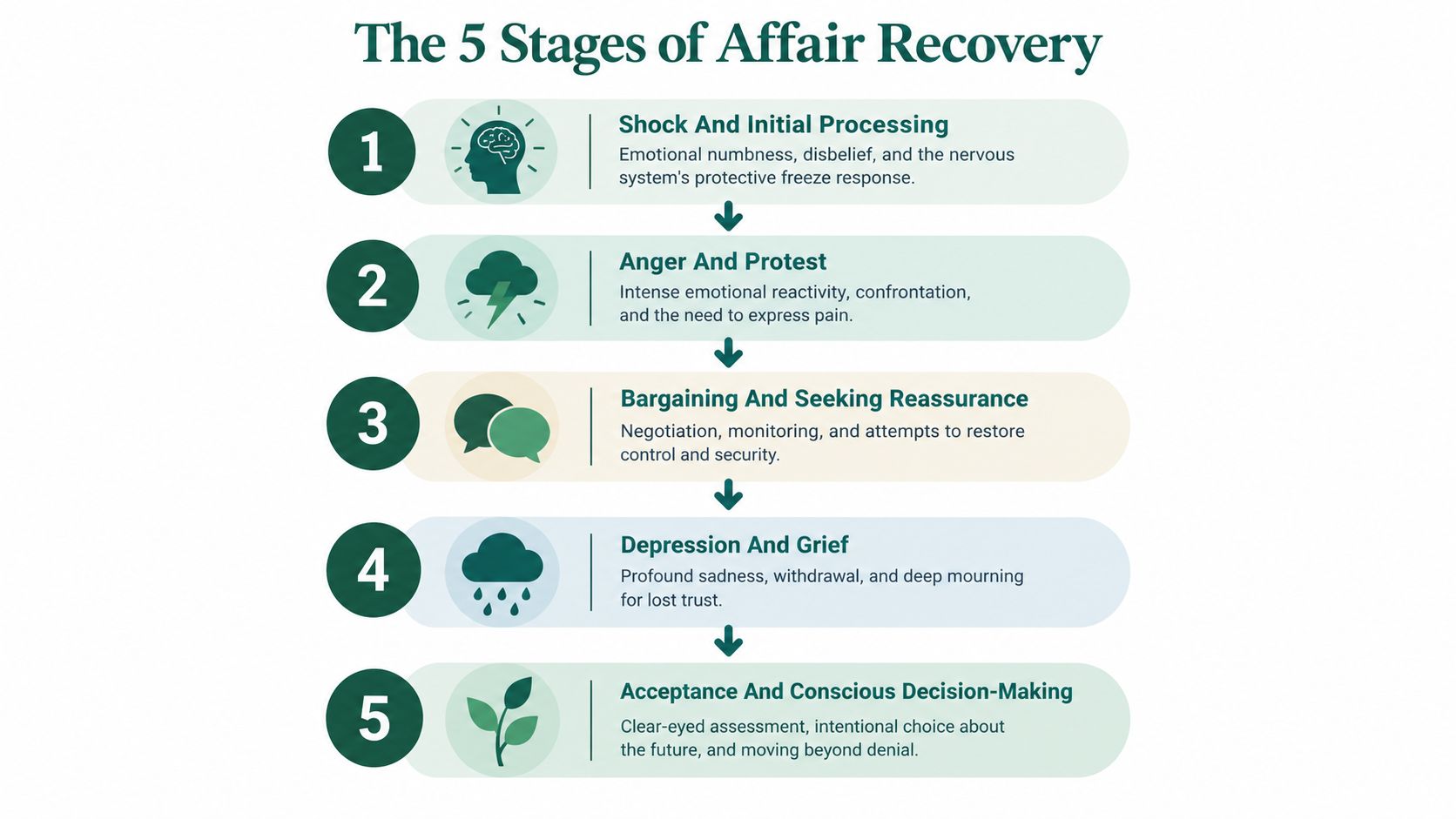
Caption: An infographic titled The 5 Stages of Affair Recovery illustrating the emotional process after relationship betrayal.
7. Integration And Post-Traumatic Growth
A song, anniversary, familiar place, or major life change can bring the affair back into focus years later. Integration does not mean the memory disappears. It means the memory sits within a larger story of self-knowledge, support, and choice rather than directing every decision. Recovery can still include difficult days, especially when a new stress resembles the original injury.
The future may take more than one form. Couples who reconcile often create a relationship unlike the one they had before, with clearer agreements, direct conversations, and a more honest understanding of their shared values. Someone who separates may use the experience to clarify personal boundaries, relationship needs, and warning signs. Either path can acknowledge the harm without treating the betrayal as beneficial or necessary.
A practical review can show what integration looks like in daily life. Write about the wisdom you gained regarding boundaries, accountability, attachment, and your own needs. Mark a transition with journaling, meditation, a spiritual practice, or another private ritual. Share your story with people who protect your privacy and respect your decisions. Keep therapy available when a new trigger, relationship change, or major transition brings old pain forward. Then choose actions that reflect your values, such as healthier habits, advocacy, mentoring, or compassionate support for another person.
These practices are invitations, not tests. Post-traumatic growth describes possible changes after suffering, including greater personal strength, deeper relationships, or a revised sense of meaning. This guide to post-traumatic growth offers prompts for reflection. Growth does not excuse the affair, erase grief, or require reconciliation.
A setback during a difficult season is information, not proof that recovery failed. Return to support, adjust your expectations, and decide what safety and integrity require now. Some people rebuild together; others heal through separation. Both outcomes can involve integration.
7-Stage Affair Recovery Comparison
Stage | Implementation Complexity | Resource Requirements | Expected Outcomes | Ideal Use Cases | Key Advantages |
|---|---|---|---|---|---|
Shock And Initial Processing | Low–Moderate: short-term stabilization focus | Immediate safety planning, crisis support network, basic grounding tools, short-term therapist consult | Emotional stabilization, safety established, avoidance of impulsive decisions | Immediately after discovery/disclosure | Protects cognitive capacity and allows time before decisions |
Anger And Protest | Moderate: needs structure to contain reactivity | Trauma-informed therapist, structured dialogue techniques, physical outlets for anger | Expression of unmet needs, boundary identification, reduced denial | When strong confrontational responses emerge | Mobilizes energy for change and boundary-setting |
Bargaining And Seeking Reassurance | Moderate: requires clear limits and coaching | Couples therapy, anxiety-regulation tools, agreed transparency parameters | Movement toward problem‑solving or recognition of unhealthy patterns | When reassurance-seeking or monitoring becomes persistent | Channels desire for repair into concrete trust-building steps |
Depression And Grief | Moderate–High: sustained support often required | Ongoing individual/couples therapy, nervous-system regulation, safety monitoring for crisis | Deep emotional processing, reorganization of self and relationship expectations | After bargaining fails and loss is fully realized | Enables authentic grief work and long-term integration |
Acceptance And Conscious Decision-Making | Moderate: reflective work and guided decision-making | Therapeutic guidance, values clarification exercises, structured conversations | Clear choices about reconciliation or separation, reduced rumination | When emotional reactivity subsides enough for sober appraisal | Facilitates intentional, values-aligned decisions |
Rebuilding Trust And Intimacy | High: long-term, consistency-focused work | Long-term couples therapy, transparency agreements, behavioral plans, time | Gradual restoration of trust, renewed intimacy, new relationship patterns | For couples choosing reconciliation and committed to change | Can produce stronger, more authentic relationship over time |
Integration And Post-Traumatic Growth | Moderate–High: ongoing reflective and developmental work | Reflective practices, continued therapy as needed, peer/support sharing, time | Increased resilience, new meaning, stable identity integration | After acceptance and sufficient healing; for growth-oriented individuals/couples | Transforms trauma into wisdom, deeper relationships, and purpose |
Keep Healing, With Support That Fits
Affair recovery stages aren't a test that couples pass or fail. You may feel calm in the morning and return to anger by evening. You may rebuild a little trust, encounter a trigger, and need to revisit stabilization. That uneven movement is compatible with healing, and reconciliation isn't the only healthy outcome.
Start with one practical assessment. Identify the stage that best describes your current experience, then prioritize physical safety, emotional stability, sleep, food, and reliable support. Choose one structured communication exercise, such as a scheduled check-in with a pause signal. Track observable trust-building behaviors rather than trying to measure recovery by mood alone. If conversations remain unsafe, circular, coercive, or stuck, seek individual counseling, couples counseling, or both.
Be Your Best Self & Thrive Counseling, PLLC offers individual and couples counseling for concerns including trauma, anxiety, depression, stress, relationship conflict, and affair recovery. The practice serves clients in St. Petersburg and the Tampa Bay area with trauma-informed, whole-person care, and a free initial consultation can help you explore fit and goals. Support for healing and connection for mental health may also be useful when isolation is making recovery harder.
Healing requires time, honesty, boundaries, and support. It doesn't require you to forgive before you're ready or stay where you aren't safe.
Every picture or infographic should include a clear, descriptive caption so readers understand its purpose. This article uses no HTML tables and doesn't discuss polyvagal theory.
Be Your Best Self & Thrive Counseling, PLLC offers compassionate individual and couples counseling for trauma, depression, anxiety, relationship conflict, and affair recovery. If you need help creating safety, accountability, and a clearer path forward, visit Be Your Best Self & Thrive Counseling, PLLC to explore services and schedule a free initial consultation.