
The Difference Between Stress and Burnout: A Practical Guide
You're answering emails late at night, waking before the alarm with your jaw clenched, and promising yourself that one quiet weekend will fix everything. Then Monday arrives, and the same dread settles back into your chest. You may still be functioning, but functioning isn't the same as recovering.
The difference between stress and burnout matters because the remedy depends on the state you're in. Stress may call for rest, boundaries, or a short-term adjustment. Burnout often requires changes to workload, support, expectations, and sometimes professional care. The distinction also matters for people carrying chronic caregiving, relationship, health, or entrepreneurial pressure, even when the strain doesn't fit neatly inside a workplace.
When Stress Quietly Becomes Something Else
A nurse I worked with in St. Petersburg spent nearly two years saying she was “just stressed.” She had a demanding schedule, children at home, and a phone that never seemed to stop. Nothing about her situation looked unusual to her, which made it easier to dismiss the warning signs.
She snapped at her kids over small requests. She dreaded work messages on weekends. She cancelled dinners and beach walks she used to enjoy because staying home felt easier. During patient interactions, she noticed herself becoming efficient but emotionally absent. She still completed her tasks, yet the empathy that once came naturally now felt like something she had to manufacture.
That shift is easy to miss because burnout rarely begins with a dramatic collapse. It often begins with irritability, disrupted sleep, narrowed attention, and a growing sense that every demand is an intrusion. Many people keep calling it stress because the label feels temporary. “Stress” suggests that relief will arrive after the next deadline, shift, school term, family crisis, or business launch.
The cue I listen for in sessions
I pay close attention to what happens after the pressure briefly lifts. A stressed person may feel depleted but still reconnect with interest, humor, affection, or motivation when there's room to breathe. A burned-out person may have time off and remain flat, detached, resentful, or unable to care.
Practical rule: If rest gives you access to yourself again, stress may be the dominant problem. If rest only makes you aware of how empty you feel, look more closely at burnout.
The work stress and burnout recovery guide offers useful context, but definitions alone won't tell you what to do next. The practical question is whether you need recovery, firmer limits, a changed workload, or clinical support. The rest of this guide uses that decision rather than treating burnout as a character flaw or stress as something you should tolerate.
Defining Stress and Burnout on Their Own Terms
Stress is a response to demand. Your mind and body mobilize when something feels urgent, threatening, uncertain, or beyond your current capacity. You may become more alert, emotionally reactive, physically tense, or intensely focused. When the demand passes and recovery follows, that activation can settle.
Stress can arise from work, family conflict, finances, illness, relocation, parenting, or a major life transition. It isn't automatically harmful, and it doesn't mean you're failing. The concern begins when pressure remains active without enough recovery, or when your coping strategies keep costing more than they restore.
Burnout is a work-linked syndrome with a recognizable pattern. In 2019, the World Health Organization classified burnout in ICD-11 as an occupational phenomenon, not a medical condition. The WHO describes it as resulting from chronic workplace stress that hasn't been successfully managed, with three dimensions: exhaustion, increased mental distance or cynicism toward one's job, and reduced professional efficacy.
That work context is important. Burnout isn't just a stronger word for feeling overwhelmed in every area of life. At the same time, work-related burnout can affect sleep, relationships, parenting, health habits, and identity. People may also experience a similar depletion pattern from caregiving, chronic illness, or prolonged personal responsibilities, even when a clinician uses a different formulation rather than applying the occupational label.
Why the distinction changes treatment
Stress is best understood as a state that may fluctuate with circumstances. Burnout is a syndrome that develops when chronic demands keep drawing from depleted resources. That's why a breathing exercise may lower immediate activation without solving the conditions that keep exhausting you.
Clinical literature also describes burnout-related problems that extend beyond mood. A review links burnout criteria with persistent fatigue after mental effort or weakness after minimal effort, alongside symptoms that can include insomnia, cognitive difficulties, pain, palpitations, gastrointestinal problems, and sensitivity to sound or light. If sleep, thinking, and physical functioning are changing together, the problem deserves more than a productivity adjustment.
For readers whose sleep has become part of the cycle, The Sleep Consultant's guide to preventing and recovering from burnout can offer practical recovery considerations. Use it as a supplement, not as a substitute for evaluation when symptoms are persistent or severe.
Side-by-Side Comparison of Stress and Burnout
The fastest way to understand the difference is to compare what happens to your energy, emotions, behavior, and performance. Stress often looks like over-engagement. Burnout tends to look like disengagement.
Criteria | Stress | Burnout |
|---|---|---|
Core experience | Too much pressure, urgency, and demand | Too little energy, motivation, or care |
Emotional tone | Anxiety, irritability, worry, emotional intensity | Numbness, cynicism, detachment, or hopelessness |
Energy pattern | Activated, restless, keyed up, or inconsistent | Persistently depleted, heavy, and difficult to restore |
Attention | Narrowed focus, racing thoughts, or hyperactivity | Cognitive fatigue, reduced concentration, and mental fog |
Relationship to work | You may care intensely and fear falling behind | You may feel distant from the work or unable to care |
Performance | Short-term pressure may sharpen effort | Effort produces less, mistakes increase, and confidence falls |
Typical trigger | An acute deadline, conflict, demand, or change | Chronic overload without adequate recovery or control |
Response to rest | Often improves after meaningful rest or resolution | Rest may help briefly, but depletion or dread returns |
Helpful first move | Recovery, prioritization, boundaries, or problem-solving | Workload change, sustained support, boundaries, and clinical care when needed |
Read the recovery signal, not just the symptom list
Both states can include headaches, stomach upset, muscle tension, irritability, sleep changes, and difficulty concentrating. The symptom itself doesn't always tell you which state you're in. The more useful question is what happens when the demand decreases.
A stressed professional may spend a weekend away from email, sleep more consistently, and feel noticeably more like themselves by Monday. A burned-out professional may technically take the same weekend off but remain emotionally absent, dread returning, or feel no pleasure in activities that once helped.
Look at emotional direction
Stress often makes people more emotionally activated. They worry, rush, argue, overprepare, or try to control every detail. Burnout often makes people less emotionally available. They stop responding, stop hoping, and stop investing because investment feels pointless.
A person can move between these states. Many burned-out clients began in a highly engaged, anxious mode and stayed there until their capacity narrowed. The change is not a clean switch, but the pattern becomes clearer when you track whether your system is pushing harder or withdrawing altogether.
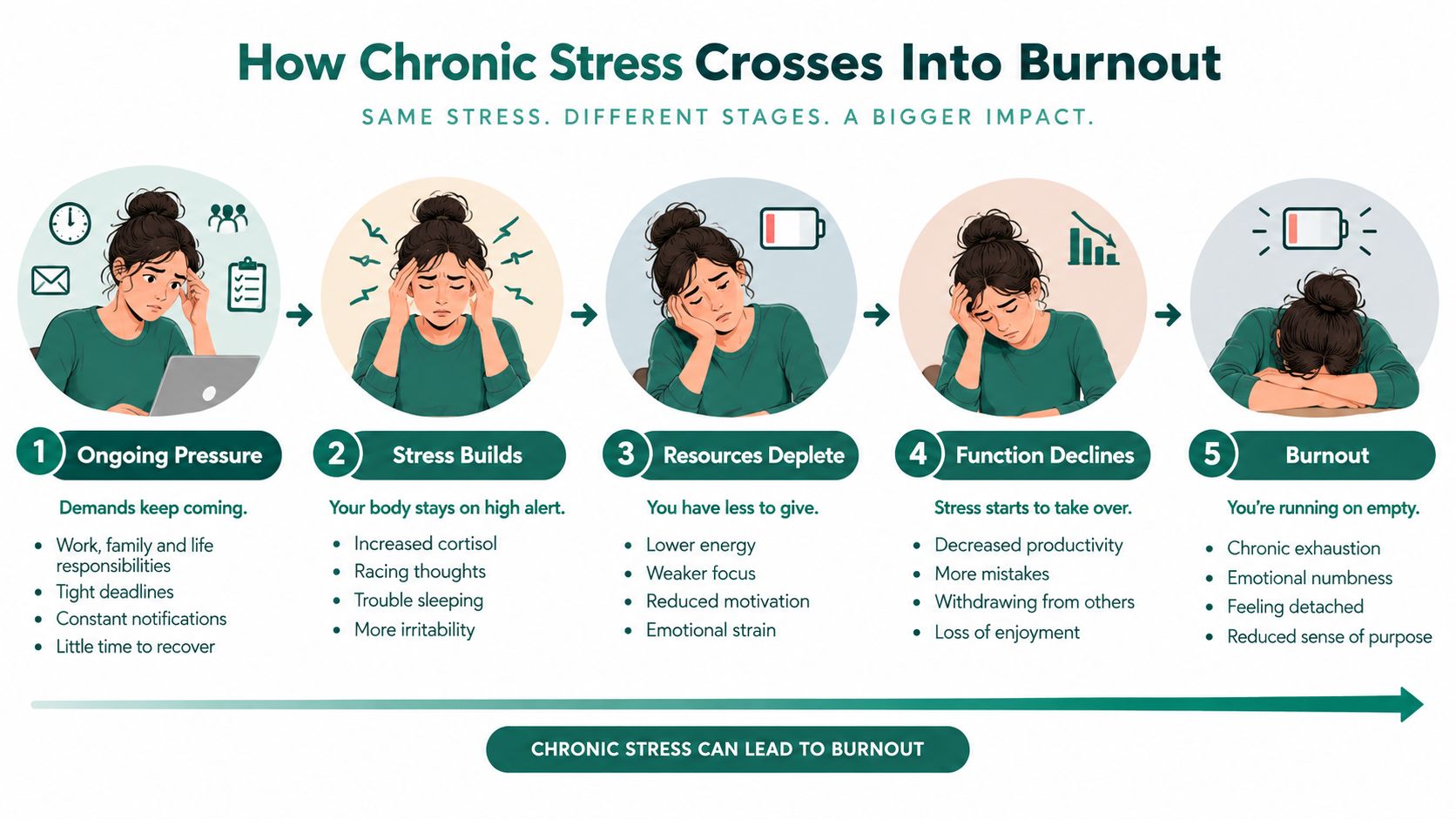
How Chronic Stress Crosses Into Burnout
The progression usually involves three related losses: energy, connection, and efficacy. Emotional exhaustion drains the capacity to keep responding. Depersonalization, cynicism, or detachment changes how you relate to work and other people. Reduced professional efficacy makes you feel that your effort no longer produces competent or meaningful results.
At first, urgency can disguise the problem. You answer faster, stay later, and rely on adrenaline to meet demands. Over time, recovery gaps become normal. Sleep becomes lighter or less restorative, muscles stay tense, digestion changes, and concentration takes more effort. The body may continue signaling danger even after the immediate task is over.
Where control and recovery matter
The tipping point isn't determined only by how much you do. It also involves how much control you have, whether demands remain predictable, whether you can recover, and whether your effort feels connected to a meaningful outcome. Two people can face similar workloads and experience very different effects when one has flexibility, support, and authority while the other has none.
This mechanism also appears outside conventional employment. A caregiver may remain permanently alert to another person's needs. Someone living with chronic illness may spend energy managing symptoms and appointments. An entrepreneur may carry financial uncertainty, identity pressure, and responsibility for every decision. The WHO's occupational definition remains important, but a work-only lens can miss the same pattern of prolonged overload and depleted capacity elsewhere.
People in high-demand clinical roles may also need practical systems for documenting workload and functioning. These mental health documentation resources may help organize observations for a medical or workplace conversation. For nervous-system regulation skills that complement, rather than replace, structural change, see this resource on regulating your nervous system.
The 2025 Frontiers meta-analysis reported pooled prevalence of 39.74% for high emotional exhaustion, 31.31% for depersonalization, and 38.44% for low personal accomplishment across the studied groups (meta-analysis). These figures describe studied populations rather than predicting an individual's diagnosis, but they reinforce that burnout's dimensions can be examined separately rather than reduced to a vague feeling of stress.
Self-Assessment Cues to Know Where You Stand
Use this checklist without bias, preferably by writing your answers rather than trusting the story you tell yourself in the moment.
Start with the recovery test
Rest: After protected sleep and time away from demands, do you regain interest, patience, and mental clarity? If yes, begin with recovery and observe whether the change lasts.
Boundaries: Do work messages, family requests, or client expectations keep entering every open space? If yes, your first intervention may be a clear limit, not another relaxation technique.
Workload: Are there more responsibilities than your available time and energy can reasonably hold? If yes, identify what must be removed, delegated, delayed, or renegotiated.
Cynicism: Are you increasingly contemptuous, numb, or detached from work or people you once valued? Persistent cynicism points toward burnout and calls for deeper change.
Body and sleep: Are insomnia, cognitive fatigue, pain, palpitations, gastrointestinal symptoms, or sensory sensitivity interfering with daily functioning? Clinical assessment becomes more appropriate when several systems are involved.
Match the cue to the intervention
If a difficult week leaves you tired but recognizable to yourself, protect recovery before adding more techniques. If you keep checking email during dinner, set a boundary that another person can understand and enforce. If the boundary reveals that the workload itself is impossible, have a workload conversation rather than blaming yourself for not managing time well enough.
Therapy becomes especially relevant when you feel detached from your identity, unable to recover, ashamed of your reactions, or trapped in a pattern you understand intellectually but can't change. Hopelessness, severe withdrawal, and persistent physical symptoms deserve prompt professional attention rather than a self-scoring exercise.
Intervention Strategies From Self-Care to Therapy
Intervention works best as a layered response. Self-care can support a stressed system, but it can't compensate indefinitely for an impossible workload, unsafe expectations, or chronic lack of control.
Begin with the smallest reliable change
For acute stress, start with a repeatable recovery action. Protect a sleep window, take a short walk without your phone, eat something substantial, or use paced breathing before responding to a difficult message. The goal isn't to create a perfect wellness routine. It's to give your body a predictable signal that the demand has ended.
Mindfulness can help you notice urgency before it controls your behavior. This mindfulness-based stress reduction resource may be useful for learning attention and regulation practices, while actionable burnout prevention tools can help translate general intentions into observable habits.
Change the conditions that keep producing the problem
Burnout usually requires a conversation about capacity. Ask which tasks are essential, what deadlines can move, who can share responsibility, and what communication hours are reasonable. A boundary without a workload adjustment may just force you to complete the same volume in less time.
Therapy adds another layer when burnout has affected identity, relationships, grief, trauma, or meaning. Effective treatment may include body-based regulation, cognitive work with guilt and perfectionism, and existential exploration of what your effort is serving. A whole-person mind-body-spirit approach doesn't mean ignoring practical conditions. It means addressing the body's depletion, the mind's interpretations, and the values that make change sustainable.
Seek more support when sleep and functioning remain impaired, when you can't follow through on basic care, or when isolation is increasing. The right sequence is often rest plus boundaries first, then workload change, with therapy layered in when symptoms persist or the emotional injury has become entrenched.
When It Is Time to Seek Professional Help
You don't need to wait until you stop working, parenting, or caring for others before asking for help. A clearer threshold is persistent impairment. If exhaustion continues beyond a reasonable recovery period, sleep changes don't improve with rest, or you've withdrawn from people and activities you once enjoyed, schedule a clinical conversation.
Pay attention to rising cynicism, repeated physical symptoms, chest tightness, frequent illness, cognitive decline, and a sense that nothing will improve. These signs don't prove burnout or any particular diagnosis, but they indicate that self-care alone may not be enough. A clinician can also consider medical contributors, anxiety, depression, trauma responses, medication effects, and sleep problems that may overlap with burnout.
A 2025 Mental Health UK report stated that 34% of adults experienced high or extreme pressure or stress always or often in the prior year, compared with 35% the year before (Mental Health UK report). Persistent strain is not a personal weakness, and seeking support isn't an admission that you're incapable. It's a practical way to protect your health, work, and relationships before withdrawal becomes your default.
Get immediate support for hopelessness
If you're experiencing suicidal thoughts, feel unable to stay safe, or believe someone else may be in immediate danger, contact emergency services or a crisis service now. Don't handle that moment alone or wait for a routine appointment.
For adults in Tampa Bay, therapy can provide a structured place to examine workload, boundaries, grief, identity, and physical activation together. Therapy for stress management may be a useful starting point when you're not sure whether the label is stress, burnout, anxiety, depression, or a combination. Integrative care can address emotional, nervous-system, and whole-person factors that a weekend off can't resolve by itself.
Your Next Step and Common Questions Answered
Choose three actions for the next seven days:
One rest ritual: Set a consistent sleep window, create a no-screen wind-down, or get morning light before opening work messages.
One boundary: Establish a work-free evening, stop checking email during meals, or define when you're unavailable.
One support move: Book a therapy consultation, speak with HR or a supervisor about capacity, or schedule a physical when symptoms are affecting your body.
Write down what changes. Your response will tell you more than a label alone. If rest brings back energy and connection, continue strengthening recovery. If dread, detachment, or exhaustion returns quickly, move toward workload change and professional support. The guide to healing from burnout can provide additional perspective as you build that plan.
Can burnout reverse with rest alone?
Sometimes early depletion improves when the demand ends and recovery becomes consistent. Established burnout usually needs more than rest, especially when the workload, role conflict, lack of control, or emotional injury remains unchanged.
How is burnout different from clinical depression?
Burnout is tied to chronic occupational stress in the WHO framework and often centers on exhaustion, work-related distance, and reduced efficacy. Depression can affect mood, pleasure, hope, thinking, and functioning across life domains, so numbness or hopelessness deserves clinical assessment rather than self-diagnosis.
Does burnout always require medication?
No. Medication isn't automatically required, and treatment depends on the symptoms and any co-occurring condition. A clinician may recommend therapy, medical evaluation, workplace changes, medication, or a combination when anxiety or depression is present.
Be Your Best Self & Thrive Counseling, PLLC offers individual and couples counseling in an evidence-informed mind-body-spirit framework for stress, burnout, anxiety, depression, trauma, and life transitions. Visit Be Your Best Self & Thrive Counseling, PLLC to explore services and arrange a free initial consultation about your next step.