
Complex Trauma Therapy Guide to Healing and Recovery
You may be waking tired after a full night in bed, scanning every conversation for danger, or apologizing for needs you haven't even voiced. Perhaps you understand that your reactions connect to painful experiences, yet you still wonder why insight hasn't made the fear, shame, numbness, or relationship patterns disappear. Searching for complex trauma therapy often begins in that confusing space, where surviving once helped you cope but now leaves you feeling stuck.
Healing doesn't require blaming yourself for adaptations that once protected you. It requires a careful, collaborative approach that recognizes both trauma symptoms and the ways repeated adversity can shape identity, emotional regulation, relationships, and trust. This guide explains what complex trauma means, how it differs from PTSD, which therapy approaches have the strongest support, and how clinicians personalize pacing rather than forcing every person through the same sequence.

Caption: Healing can begin with a compassionate understanding of survival responses and a safe next step.
If you're trying to understand your options, what trauma therapy may involve can offer a helpful starting point. You don't need a perfect label before asking for support. A qualified therapist can help you make sense of your experience without turning your story into a diagnosis made from a checklist.
Introduction to Healing From Complex Trauma
A person living with complex trauma may look capable from the outside. They go to work, answer messages, care for family, and meet responsibilities. Inside, however, ordinary moments can carry unusual intensity. A delayed reply may feel like abandonment, constructive feedback may sound like danger, and a quiet evening may bring memories or sensations that are difficult to explain.
That pattern isn't a sign of weakness. Repeated trauma can teach a person to stay alert, disconnect from feelings, please others, control surroundings, or avoid closeness. Those responses may have made sense in an unsafe environment. Later, they can interfere with rest, self-respect, boundaries, and relationships, even when the original threat has ended.
Why a different lens helps
A single overwhelming event can leave someone with intrusive memories, avoidance, sleep disruption, and a heightened sense of threat. Complex trauma often includes those experiences alongside longer-lasting difficulties with emotion regulation, self-concept, and relationships. Therapy therefore needs to address more than the memory itself. It also needs to ask what the person learned about safety, responsibility, trust, and who they are.
The diagnostic language reflects this distinction. Complex PTSD became an official diagnosis in ICD-11, while it remains absent as a standalone diagnosis in DSM-5, a difference that has shaped clinical and health-system classification since the late 2010s. Estimates vary across populations, with complex PTSD placed around 1% to 8% globally, while one ICD-based U.S. study estimated current complex PTSD at about 4% and current PTSD at 3%. In the UK, reported lifetime prevalence was 13% for complex PTSD compared with 5% for PTSD, and some treatment-seeking trauma clinics have reported rates reaching 75.6% under proposed ICD-11 criteria. These figures come from the U.S. Department of Veterans Affairs review of complex PTSD.
A compassionate starting point: Your symptoms may be understandable survival patterns, not evidence that something is fundamentally wrong with you.
The path forward should preserve agency, safety, and choice. A therapist might combine trauma processing with grounding, relational work, skills practice, and attention to the body. Progress may look like pausing before reacting, recognizing shame without obeying it, or staying present during a difficult conversation. Those changes can create room for a life that isn't organized around past danger.
What Complex Trauma Really Means
Start with a simple distinction. Trauma describes what can happen when an experience overwhelms a person's ability to feel safe and cope. Complex trauma describes the added impact of repeated, prolonged, or relational adversity, particularly when the person feels trapped, dependent on the source of harm, or unable to escape.
A useful analogy is a house exposed to repeated storms. One storm may break a window. Repeated storms can weaken several parts of the structure, change how people use the rooms, and make every dark cloud feel threatening. The house isn't defective. It adapted to repeated exposure, but it now needs careful repair rather than a single replacement window.
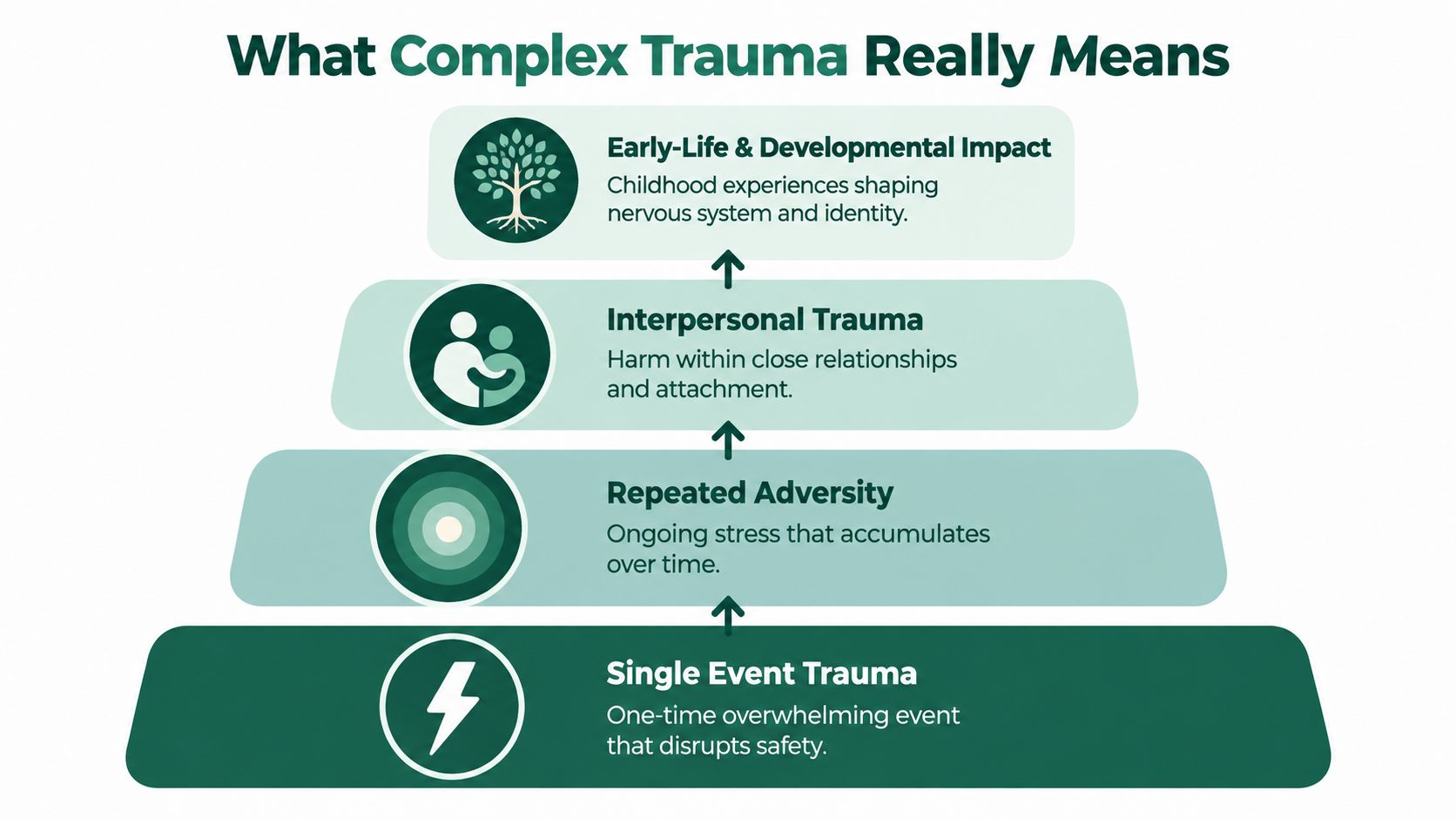
Caption: Complex trauma can develop through layered experiences, from a single overwhelming event to repeated relational and developmental harm.
Four layers to consider
Single-event trauma involves one overwhelming experience that disrupts safety. PTSD symptoms can follow even when the event doesn't repeat.
Repeated adversity adds accumulation. Ongoing neglect, bullying, violence, medical distress, or instability can keep the person preparing for the next threat.
Interpersonal trauma occurs within close relationships or systems of dependence. Harm from a caregiver, partner, community, or authority figure can affect not only safety but also expectations about love and trust.
Early-life and developmental impact reaches into identity formation and emotional learning. A child may conclude, “My needs cause trouble,” or “I must monitor everyone to stay safe.” These conclusions can persist long after the child becomes an adult.
The result may involve nightmares or avoidance, but it can also appear as shame, emotional flooding, numbness, difficulty knowing what one feels, chronic self-criticism, unstable boundaries, or fear of abandonment. These patterns don't prove a diagnosis. They show why a clinician needs to understand the person's history and current functioning rather than focusing on one symptom.
Recognition without self-blame
Complex trauma isn't defined by how dramatic a story sounds to someone else. It concerns the effects of repeated adversity and the meaning the experience carried for the person. Recognizing those effects can reduce the pressure to dismiss them with thoughts such as “It wasn't that bad” or “Other people had it worse.”
Readers seeking a plain-language overview may find this trauma therapy Vancouver resource useful for reviewing common features and terminology. For people whose wounds developed through caregiving or close relationships, learning about attachment trauma and its effects may also help connect present-day reactions with earlier relational learning.
How Complex Trauma Differs From PTSD
PTSD and complex PTSD share core trauma-related symptoms. Both can involve intrusive memories, nightmares, avoidance, hypervigilance, sleep difficulties, startle responses, and distress when something resembles the original danger.
The difference is not that one condition is “real” and the other isn't. The difference is that complex PTSD also includes disturbances in self-organization, often described through emotional regulation, negative self-concept, and relationship difficulties. The comparison below is a guide for conversation, not a tool for diagnosing yourself.
Feature | PTSD | Complex PTSD |
|---|---|---|
Typical trauma pattern | Often connected with a single event or a defined traumatic experience | Often connected with repeated, prolonged, or interpersonal trauma |
Core symptoms | Intrusion, avoidance, threat sensitivity, and changes in mood or thinking | Core PTSD symptoms plus broader difficulties with regulation, identity, and relationships |
Emotional experience | Fear, distress, anger, numbness, or persistent alertness | Those experiences may occur alongside intense shame, emotional swings, shutdown, or difficulty returning to balance |
Sense of self | Negative beliefs may develop after trauma | A more persistent negative self-concept, self-blame, worthlessness, or disconnection from identity may be present |
Relationships | Avoidance, mistrust, or distress around reminders can affect connection | Attachment insecurity, boundary difficulty, fear of abandonment, or repeated relational patterns may be central |
Treatment focus | Trauma-focused therapy often targets memories, beliefs, avoidance, and threat responses | Treatment may target those areas while also measuring self-concept, affect regulation, and interpersonal functioning |
The classification distinction matters clinically. ICD-11 recognizes complex PTSD as a distinct diagnosis, while DSM-5 does not list it as a standalone diagnosis, as discussed in the VA review linked earlier. A provider may therefore use different diagnostic language depending on training, location, and the classification system used.
What this means for therapy
Someone with complex trauma may notice that flashbacks and avoidance improve before shame or relationship patterns change. Review-level evidence supports that nuance. Standard evidence-based psychotherapies reduce PTSD symptoms, but they tend to be less effective for disturbances in self-organization, including emotion regulation, negative self-concept, and relationship difficulties, according to the UKPTS research review.
That doesn't make therapy unsuccessful. It means the treatment plan should track more than fear. A person can ask a therapist to monitor sleep, intrusive memories, emotional recovery, self-talk, boundaries, and relational functioning. For a broader look at available care, see these PTSD treatment options.
Evidence Based Approaches to Complex Trauma Therapy
No single modality fits every trauma history, nervous system, relationship, or goal. Strong complex trauma therapy usually combines a sound trauma framework with careful pacing, a reliable therapeutic relationship, and measurement of the symptoms that matter most to the client.
A systematic review of 46 trials found that psychological treatments reduced PTSD symptoms among people with complex traumatic histories. The strongest evidence continued to favor trauma-focused CBT and EMDR over present-centered approaches, while trauma-focused interventions also produced moderate-to-large improvements in negative self-concept and moderate effects on interpersonal difficulties. These findings are summarized in the PLOS Medicine systematic review.
Caption: Different approaches can target traumatic memories, beliefs, body sensations, and internal experiences.
Trauma-focused methods
EMDR uses bilateral stimulation while the client attends to traumatic material in a structured way. It may suit someone who wants a method that doesn't depend entirely on detailed verbal storytelling. Read this explanation of how EMDR therapy works before a consultation, then ask how the therapist adapts it for complex histories.
Trauma-focused CBT helps clients identify beliefs and avoidance patterns that maintain distress. Cognitive restructuring may address conclusions such as “I caused it” or “No one is safe,” while exposure-based elements can support new learning when the client is ready.
DBT skills can complement trauma processing by teaching distress tolerance, emotional regulation, mindfulness, and interpersonal effectiveness. These tools may be especially useful when intense emotions or impulsive reactions make trauma work difficult to sustain.
Relational and body-oriented methods
Somatic therapies bring attention to physical sensations, tension, movement, and cues of safety. They can help clients notice what happens in the body without forcing an immediate verbal explanation.
Internal Family Systems and other parts-oriented approaches explore protective responses and wounded aspects of experience with curiosity rather than shame. A client might learn that a perfectionistic part, an avoidant part, or a people-pleasing part developed for a reason, while still deciding whether that strategy serves present life.
Attachment-focused therapy examines how earlier relationships shaped expectations about closeness, conflict, dependence, and repair. The therapeutic relationship itself becomes a place to practice boundaries, trust, and honest communication.
Good personalization: The right question isn't “Which method is universally best?” It's “Which mechanism and pace match this person's symptoms, resources, risks, and goals?”
Evidence supports trauma-focused care, but it doesn't eliminate the need for judgment. The APA guidance notes that trauma-focused interventions have the greatest endorsement for efficacy and relative safety in adults with complex trauma histories. It also reports that trauma-focused treatment can work among people with psychiatric comorbidities, while evidence for a mandatory stabilization-first sequence remains weaker and methodologically limited. A clinician should therefore assess current risk and functioning, not use a rigid protocol as a substitute for collaboration.
What Treatment Phases and Timelines Actually Look Like
Many clinicians use a three-phase map to organize complex trauma therapy. The map can be useful without becoming a fixed staircase. People may move forward, revisit earlier skills, process memories in small pieces, or work on relationships and identity alongside trauma memories.
Caption: Trauma treatment often includes safety, processing, and integration, but the path is personalized and non-linear.
Phase one builds enough safety
Early sessions may focus on understanding triggers, establishing trust, identifying immediate risks, and practicing grounding or emotional regulation. A therapist might help a client create a plan for leaving an overwhelming conversation, identify supportive people, or notice the difference between a present cue and a past danger.
This phase isn't about proving that you're ready. It's about building enough stability for therapy to remain tolerable and useful. Some clients need substantial preparation because of current danger, severe dissociation, unstable housing, substance-related risk, or limited support. Others can begin carefully targeted trauma work while learning regulation skills at the same time.
Phase two processes trauma
Trauma processing may involve EMDR, cognitive restructuring, exposure-based work, imagery, narrative approaches, or another method suited to the client. Sessions might focus on one memory, a recurring belief, a body sensation, or the meaning attached to a relationship. The therapist watches for signs of overwhelm and adjusts intensity rather than treating distress as a test of courage.
People often ask how long this takes. There is no responsible universal timeline. History, current functioning, access to support, therapeutic fit, comorbid symptoms, and the client's goals all influence pacing. A plan that looks slow from the outside may be appropriately protective, while prolonged preparation can also delay access to treatments with the strongest evidence.
Phase three supports integration
Integration involves using new learning in everyday life. A client may practice choosing reciprocal relationships, expressing needs, grieving what was lost, developing a more stable identity, or pursuing activities that trauma once narrowed.
The evidence does not support treating this as a mandatory linear sequence for everyone. A review of complex trauma treatment found that dropout remains a significant problem, approximately 17% to 21% across trials, and that the reintegration phase remains almost entirely unresearched, as reported in the British Medical Bulletin review. Those limitations make honest planning essential.
Ask your therapist: “What tells us I'm ready for processing, how will we slow down if needed, and how will we measure progress beyond symptom reduction?”
Practical Coping Strategies and Safety Tools You Can Use Today
Coping tools won't replace professional treatment, but they can help you create a little more space between a trigger and a reaction. Choose one or two practices that feel manageable. Complex trauma therapy works better when skills fit real life rather than becoming another standard you can fail.
Grounding during activation
When the present starts to feel like the past, orient to immediate sensory information. Name the room you're in, press your feet into the floor, and describe neutral objects by color and shape. You can also try slow exhalations, a cool drink, or holding a textured object while reminding yourself of the date and location.
Grounding reminder: “This feeling is real, and I am in the present moment.”
Use a shorter version at work or in public. Notice three things you see, two sensations in your body, and one sound. If closing your eyes increases distress, keep them open and look toward the doorway, a window, or another stable point.
Regulation through small choices
Emotional regulation often begins with reducing demands. Ask, “What is the next safe, useful action?” That might mean postponing a difficult text, eating something, taking a quiet walk, or asking a trusted person to stay nearby.
A brief daily record can reveal patterns without turning your life into a monitoring project:
Notice: Write the trigger and the first body signal, such as tight shoulders or numbness.
Name: Identify the emotion or protective response without judging it.
Choose: Record what helped, even if it only reduced distress slightly.
Share: Bring the pattern to therapy so the clinician can help refine the response.
Boundaries and self-compassion
Try a boundary that is specific and observable: “I can't discuss this while we're shouting. I'll return to it when we can speak calmly.” If saying no feels unsafe, start with a pause, such as “I need time to think before I answer.”
Self-compassion doesn't excuse harm or remove responsibility. It replaces punishment with useful curiosity: “What was I protecting, what do I need now, and what repair is possible?” That approach supports learning after a setback instead of turning one difficult moment into proof that change is impossible.
How to Choose a Trauma Informed Therapist and Find Support in St Petersburg
A good therapist should be able to explain complex trauma therapy in language you understand. Look for appropriate licensure, specific trauma training, experience with repeated and relational trauma, and a willingness to discuss pacing, consent, confidentiality, and what happens if you become overwhelmed.
Use an initial consultation to ask practical questions:
Experience: “How do you work with complex PTSD, childhood trauma, or relationship trauma?”
Pacing: “Do you require a stabilization period, or can we use a flexible phase-informed plan?”
Methods: “Which approaches do you use, and how do you decide among EMDR, CBT, somatic work, parts work, or skills training?”
Progress: “How will we track changes in fear symptoms, shame, emotional regulation, self-concept, and relationships?”
Fit: “What can I do if an approach doesn't feel helpful or I need to slow down?”
Green flags include respect for your autonomy, clear explanations, attention to current safety, and openness to feedback. Be cautious if a provider promises a guaranteed outcome, pressures you to disclose details before trust exists, dismisses your concerns, or treats distress as evidence that you should try harder.
People preparing for a first appointment may benefit from this practical Uptown Psychology therapy guide, which can make the first conversation feel less unfamiliar. For local options, trauma therapy near you can help St Petersburg and Tampa Bay residents identify a starting point.
Be Your Best Self & Thrive Counseling, PLLC offers individualized counseling for trauma, anxiety, depression, stress, life transitions, and relationship concerns, with a mind-body-spirit orientation and trauma-informed care. The practice also provides a free initial consultation to discuss goals and fit, while the BYBS Training Institute offers education and consultation for mental health clinicians.
Visit Be Your Best Self & Thrive Counseling, PLLC to schedule a free initial consultation and discuss a complex trauma therapy plan that respects your pace, history, and goals. A compassionate therapist can help you build safety, process what happened, and reconnect with a fuller life beyond survival.